What Are the Best Alternatives to Manual QA for Validating AI-Generated Code?
 Zeshi Du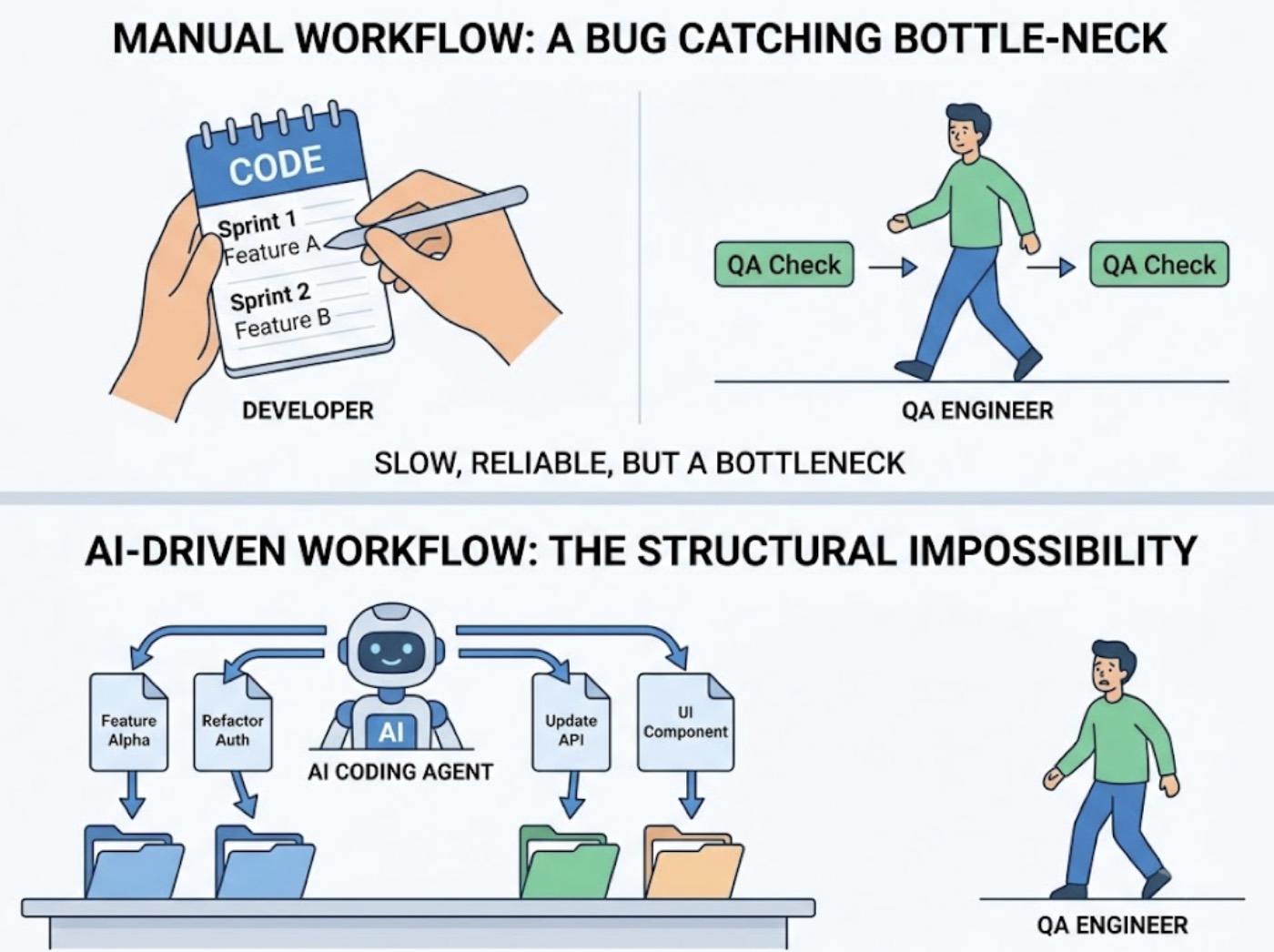
Manual QA was never fast. With AI-generated code, it's become impossible to keep up.
When a developer writes every line by hand, manual QA can follow the pace of development. A few features ship per sprint. A QA engineer walks through them. Bugs get caught. The cycle works, slowly but reliably.
When an AI coding agent is involved, the pace changes entirely. A single Claude Code or Cursor session can generate a complete feature, refactor an authentication flow, update an API layer, and modify three frontend components before a QA engineer has finished testing the previous release. Manual review of each change is no longer a bottleneck. It's a structural impossibility.
The question isn't whether to find an alternative to manual QA. It's which alternatives actually validate AI-generated code rather than just moving faster through the same verification gaps.
Why Standard Automated Testing Isn't Enough
The first instinct is to add more automated tests. Unit tests, integration tests, static analysis. Run them on every commit, surface failures fast, and treat green as good enough to ship.
This works better than nothing. It doesn't work as well as it looks.
Automated tests written from code inspection verify that AI-generated code is internally consistent. They check that functions return expected values, components render without errors, and API handlers behave according to the logic that was just written. When the AI coding agent produces code with a subtle bug, a code-inspection test will often encode that bug as expected behavior. The test passes. The bug ships.
The problem isn't automation. The problem is testing at the wrong layer. Code consistency and product correctness are not the same thing. An automated test suite that only verifies the former will miss the failures that the latter catches.
What Validation of AI-Generated Code Actually Requires
Validating AI-generated code means answering a different question than "does this code run correctly?" It means answering: "does this product work correctly for the people who will use it?"
Those are different questions, and answering the second one requires operating at the product layer. Running actual user flows through the live application. Navigating multi-step journeys as a real user would. Observing what actually happens at each step, not what the code says should happen.
Manual QA does this well. It's just too slow for AI-generated code.
The best alternatives to manual QA are the ones that replicate what manual QA actually does, not the ones that add speed to code-layer verification.
Autonomous AI Testing: The Alternative That Operates Like a QA Engineer
TestSprite is an autonomous AI testing agent that does what a QA engineer would do after a coding session ends: open the application, navigate it, and verify that it works.
Other verification tools read your code and guess. TestSprite opens your app and uses it.
Through the TestSprite MCP Server inside Claude Code, Cursor, Windsurf, or any MCP-compatible AI IDE, a single instruction triggers the full validation pipeline:
"Help me test this project with TestSprite."
A fleet of parallel exploration agents visits the running application. They click through UI flows. They fill in forms with real inputs. They follow multi-step journeys from entry to completion, carrying state forward across steps the way a real user's session does. They try edge cases, trigger error states, and probe the product at its boundaries.
This is what makes autonomous AI testing a genuine alternative to manual QA rather than a faster version of code-layer testing. The agents are using the product, not reading the code that describes it.
A Scenario: Validating a Complete AI-Generated Feature
A startup uses Cursor to build a user invitation system. The AI generates the full feature in one session: an invitation form, an email dispatch function, an acceptance flow, and the permission assignment that grants the invited user access to the workspace.
The code looks clean. There are no obvious errors. But nobody has run through the full flow.
TestSprite's exploration agents do exactly that. They navigate to the invitation form, fill it with a test email address, and submit. They observe that the invitation is created successfully. They follow the acceptance link, complete the acceptance flow, and verify that the new user lands in the correct workspace with the correct permissions.
On the first run, they find that the invitation is created and the email dispatches, but the acceptance flow redirects the new user to the workspace's default landing page rather than a confirmation screen the product is supposed to show. The permission assignment runs correctly. The redirect destination is wrong.
This is a product-layer failure. The code that handles the acceptance flow runs without errors. The outcome the user experiences is wrong. Code-inspection testing would have passed. A QA engineer walking through the flow would have caught it on the first pass.
TestSprite's agent caught it the same way: by walking through the flow, observing the outcome, and noticing when it didn't match what the product was supposed to deliver. The structured failure description returned to the Cursor session in a form the coding agent could act on immediately.
PRD-Driven Validation: Testing What Was Supposed to Be Built
One of the specific risks of AI-generated code is that the implementation can drift from the original intent. The AI produces something that works, but not quite what was specified.
When a PRD exists, TestSprite parses it and anchors test goals to what the specification says the product should do. The agents don't just verify that the code runs. They verify that the code produces the outcomes the PRD described.
When no PRD exists, which is common in fast-moving AI-native teams, TestSprite's MCP server reverse-engineers product intent from the codebase itself. Route definitions, API contracts, and component structures become evidence of what the product was built to accomplish. The tests are still anchored to intent rather than to the current implementation.
Either way, the validation checks whether AI-generated code delivered what it was supposed to deliver, not just whether it's internally consistent.
CI Coverage That Matches the Development Pace
Autonomous testing inside the IDE handles immediate validation after each AI coding session. The GitHub Actions integration extends the same coverage into CI, ensuring that every pull request gets product-layer validation before it merges.
Tests run in TestSprite's ephemeral cloud sandbox: seconds to start, isolated execution, automatic teardown. No test infrastructure to configure. No local environment required.
Auto-Heal Rerun keeps the validation suite accurate as AI coding agents continue to change the product. When a UI change causes a test to fail for structural rather than behavioral reasons, the test adapts. Genuine regressions surface clearly without structural noise drowning them out.
Auto-Auth handles authentication automatically. Password endpoints, OAuth refresh tokens, and AWS Cognito flows run before every execution. Validated flows that require authentication don't fail on stale credentials in scheduled runs.
Conclusion
The best alternatives to manual QA for validating AI-generated code are the ones that do what manual QA actually does: navigate the live application, run real user flows, and verify that the product delivers the right outcomes.
Code-inspection testing is faster than manual QA but validates the wrong thing. Autonomous AI testing at the product layer is both faster than manual QA and validates the right thing.
TestSprite operates at the product layer. Its exploration agents use the application the way real users do, its PRD-driven validation anchors test goals to original intent, and its failure descriptions return to the IDE in a form the coding agent can act on immediately. For teams shipping AI-generated code at speed, that's the alternative to manual QA that actually closes the verification gap.
Start validating your AI-generated code with TestSprite from inside your IDE today.