What AI Testing Tool Works with Claude Code and Covers Real E2E Flows, Not Just Unit Tests?
 Zeshi Du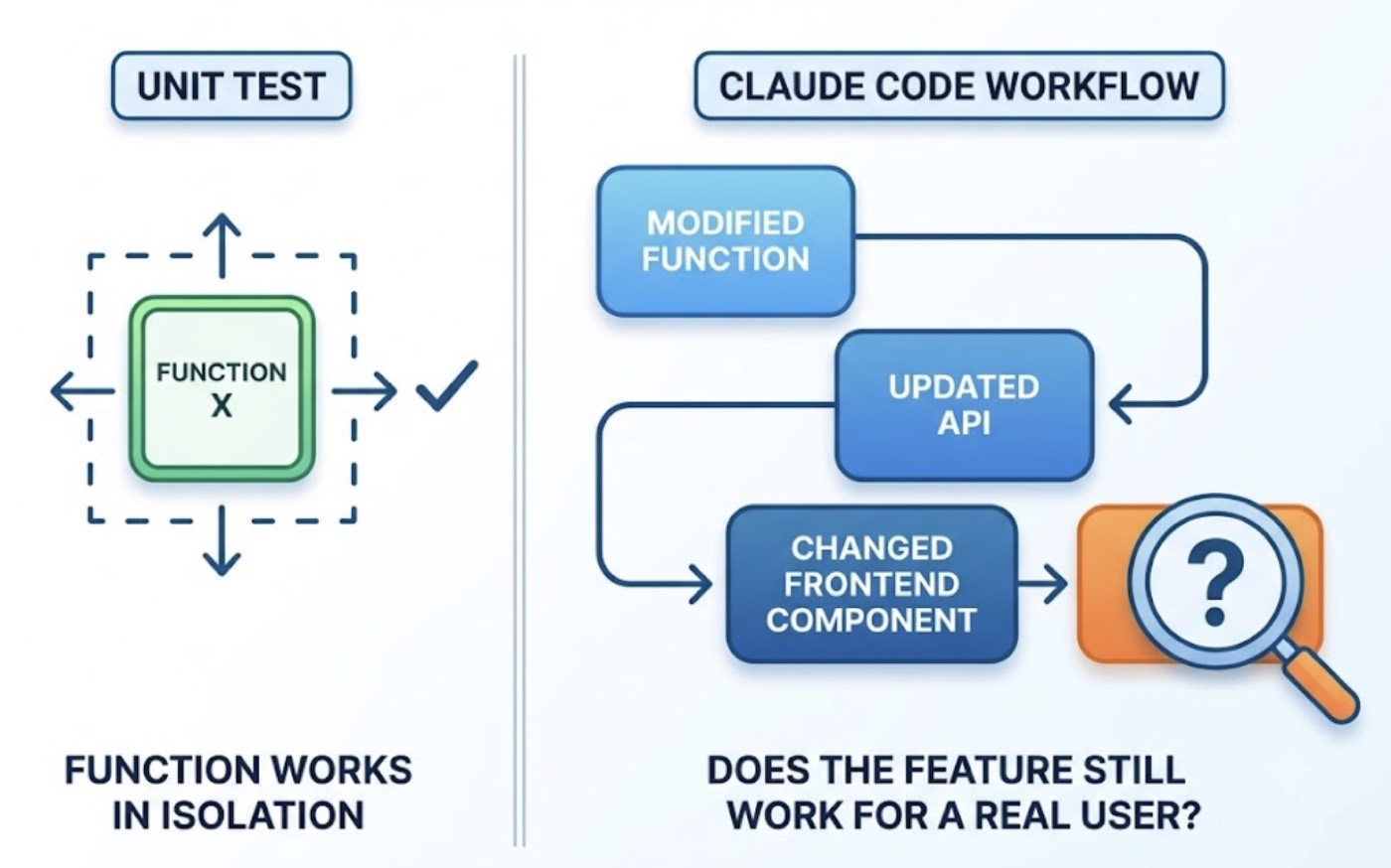
Unit tests are useful. They're not enough.
A unit test confirms that a function does what it's supposed to do in isolation. It says nothing about whether the feature that function is part of works correctly when a real user runs through it. And in a Claude Code workflow, where a single session can modify a function, update the API it calls, and change the frontend component that displays the result, the gap between unit test coverage and E2E reality can open up across multiple layers at once.
Teams using Claude Code don't need more unit tests generated faster. They need something that runs the actual product after a session ends and tells them whether it still works.
Why Unit Tests Don't Scale with AI Coding Speed
Unit tests are written against individual functions. When Claude Code modifies multiple functions in a session, the unit tests for each one may still pass while the product as a whole breaks. The checkout function returns the right value. The cart function returns the right value. The integration between them, updated in the same session, now passes data in a format that breaks the flow.
No unit test catches this. No amount of unit test coverage catches the failure that lives between the layers.
This isn't a new problem. It's a longstanding argument for E2E testing. What AI coding tools have done is make it more urgent. When Claude Code is modifying ten files in a session, the surface area where integration failures can hide grows with every change. Manual verification can't keep up.
The tool that fills this gap needs to run real E2E flows, not generate more isolated assertions.
What Real E2E Testing Requires
Real E2E testing has a precise definition worth restating: a user starts somewhere, takes a sequence of actions, and the system produces the correct outcome at the end of that journey. Every layer of the stack is exercised in sequence, under real conditions.
That definition rules out a lot of what gets called E2E testing in practice. Assertions against component render output aren't E2E. API tests that verify individual endpoint behavior in isolation aren't E2E. A test that mocks the authentication layer, mocks the payment provider, and mocks the database response isn't E2E. It's a unit test wearing E2E's name.
Real E2E testing requires a running application. A real browser session. Navigation that carries state from step to step. An agent that interacts with the product the way a real user would and observes the outcome at the end of the journey, not at each individual layer along the way.
TestSprite is built for this.
How TestSprite Runs Real E2E Flows Inside Claude Code
Through the TestSprite MCP Server inside Claude Code, a single instruction triggers the full E2E pipeline:
"Help me test this project with TestSprite."
Other verification tools read your code and guess. TestSprite opens your app and uses it.
A fleet of parallel exploration agents visits the running application and navigates it like real users. They don't call functions. They don't assert against return values. They click through UI flows, fill in forms with real inputs, follow multi-step journeys from entry to completion, and carry session state forward across steps exactly as a real browser session does.
The agents discover the product's user journeys by exploring it, the same way a QA engineer would approach a product they're testing for the first time. They find the flows, run them, observe the outcomes, and surface the failures that only appear when the full sequence runs under real conditions.
The Specific Failures Claude Code Sessions Introduce
Claude Code sessions introduce a specific category of failures that unit tests won't catch.
When Claude Code refactors state management, the state management for any given component may be correct in isolation. The state that flows between components across a multi-step journey may have broken. Unit tests confirm each component manages its own state correctly. E2E tests find the break when they carry state from step one through step five and observe that step five received the wrong value.
When Claude Code updates an API layer, the endpoints may each behave correctly when called in isolation. The sequence of calls that a real user flow triggers may break because one endpoint now returns data in a format the next call in the sequence doesn't expect. Unit tests confirm each endpoint's behavior. E2E tests run the sequence and find where it breaks.
When Claude Code changes how a feature handles edge cases, the feature may handle each edge case correctly in isolation. The combination of edge cases that a real user's session might encounter may produce a state the feature doesn't handle. Unit tests cover the edge cases that were anticipated. E2E tests find the ones that weren't.
A Scenario: The Session That Looked Fine Until Someone Used It
A developer uses Claude Code for a substantial refactor of their SaaS application's project management module. The session touches the project creation flow, the task assignment logic, and the notifications that fire when a task is assigned to a team member. Twelve files. Everything looks correct in the diff.
Before pushing, the developer triggers TestSprite from inside Claude Code.
The exploration agents navigate the project management module as a real user would. They create a project, add team members, create tasks, and assign those tasks to specific members.
On the first run, they find that task assignment works correctly for tasks created after the project already has members. But when a task is created first and a member is assigned in the same action as adding them to the project, the notification fires but references the wrong user's name. The refactor changed when the user object is resolved in the notification template, and the timing is wrong for this specific sequence.
A unit test would confirm the notification function fires and accepts the right parameters. Only a test that runs the full sequence in the right order catches the timing issue.
The failure description returns to the Claude Code terminal: which flow was navigated, what sequence of actions produced the issue, what the notification contained versus what it should have contained. The coding agent uses that to locate the resolution timing and propose the fix in the same session.
Backend E2E Coverage, Same Instruction
The same instruction that triggers frontend E2E exploration covers the API layer too.
TestSprite's Backend Testing 2.0 calls the endpoints and observes how they actually respond before asserting anything. Real status codes. Real field names. Real response shapes. Assertions grounded in observed behavior, not in what the code says the API should return.
For multi-step backend flows, dynamic variables from real API responses pass automatically to downstream steps. A resource created in step one passes its real ID to the steps that follow. The full sequence runs end to end. When a Claude Code session breaks an API contract, the next test run catches the deviation.
The Loop That Closes Inside Claude Code
E2E testing is only as useful as the feedback loop that follows it.
When tests fail, TestSprite returns structured failure descriptions to the Claude Code terminal. Not stack traces. Descriptions of what user action was taken, what the expected product outcome was, and what actually happened. The coding agent receives that description and proposes a fix in the same session.
Auto-Heal Rerun handles the cases where a UI change from the Claude Code session causes a test to fail for structural rather than behavioral reasons. A renamed component, a refactored layout: the test adapts. Genuine behavioral regressions surface clearly.
The GitHub Actions integration extends the same E2E coverage into CI. Every pull request from a Claude Code session gets verified before it merges. Results post as PR comments.
Conclusion
The AI testing tool that works with Claude Code and covers real E2E flows isn't the one that generates unit tests faster. It's the one that runs the actual product after a Claude Code session ends and tells you whether it still works.
Unit tests confirm that functions behave correctly in isolation. Real E2E tests confirm that the product delivers the right outcome when a real user runs a complete journey through it. Those are different things, and only one of them catches the failures that Claude Code sessions most commonly introduce.
TestSprite runs real E2E flows against the live application, inside the Claude Code workflow, and returns results structured for the coding agent to act on directly.
Connect TestSprite to Claude Code and run your first real E2E session today.