TestSprite Review for Solo Developers and AI-Native Startups
 Zeshi Du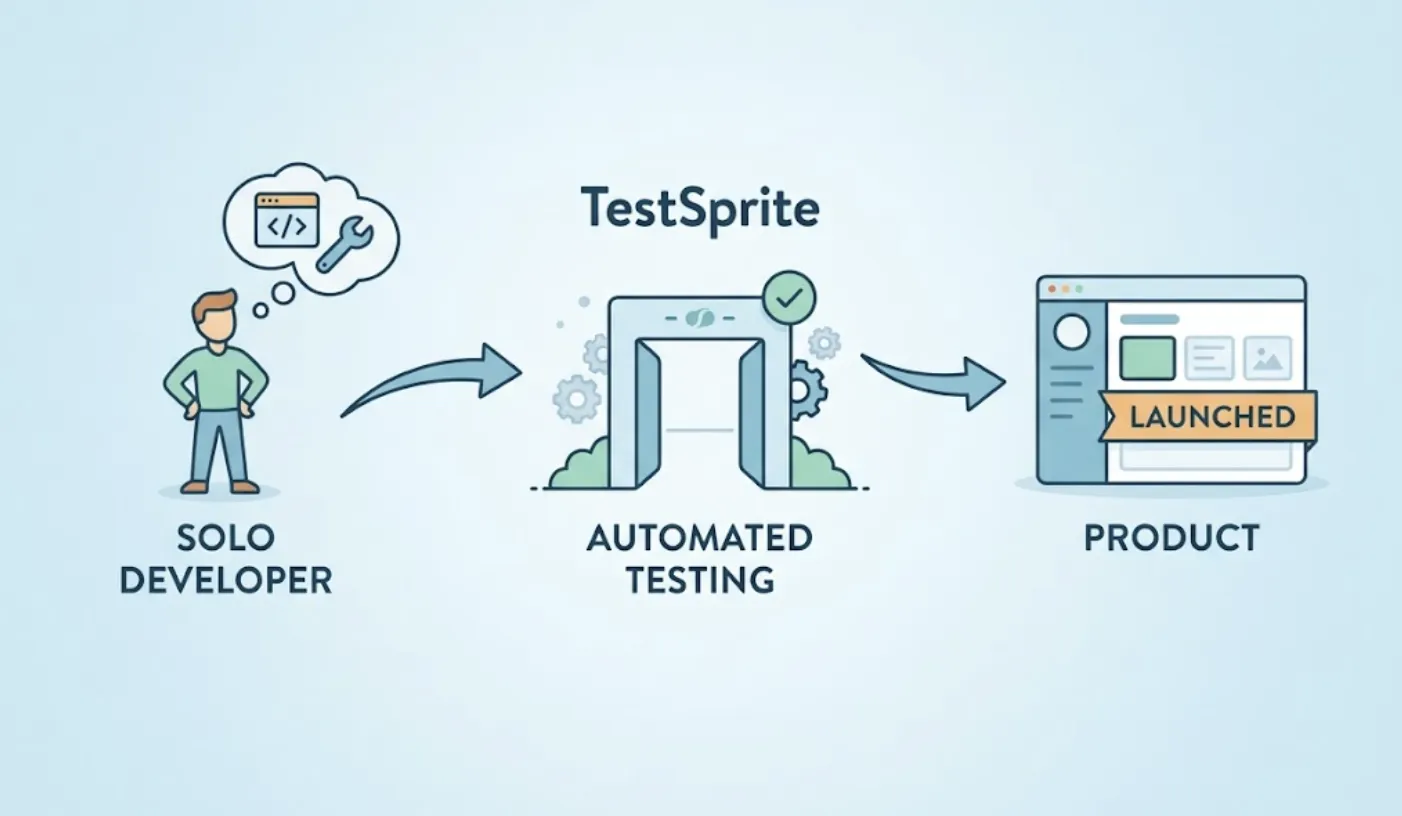
A one-person team shipping with Claude Code or Cursor has a specific problem that most testing tools weren't built for: there's no QA person to hand things off to, and there's no time to become one. This review looks at TestSprite specifically through that lens, not as a general enterprise testing platform, but as a tool for the solo developer and the small AI-native startup deciding whether to add it to their workflow.
What TestSprite actually is, briefly
TestSprite is an autonomous AI testing agent. It parses your PRD, or infers product intent directly from your codebase when there isn't one, then generates and runs end-to-end tests across your frontend, backend, and authentication flows without you writing test code. The loop runs as discover → plan → generate → execute → analyze → heal → report, and it's accessible from inside Cursor, Claude Code, Windsurf, and similar IDEs through an MCP server, or through a web portal and GitHub Actions if you'd rather work from a dashboard or CI pipeline.
What holds up well for a solo developer specifically
No local setup, which matters more than it sounds. Tests run in an ephemeral cloud sandbox that spins up in seconds and tears itself down automatically. For a solo developer already juggling deployment, billing, and support, not having to also maintain a local test runner or browser matrix is a real reduction in overhead, not a minor convenience.
The free tier is genuinely usable, not a teaser. 150 credits a month, no credit card required, covers the core capabilities. For a project in early development, where you're testing a handful of flows a few times a week rather than running a full regression suite on every commit, that's enough runway to actually evaluate whether the tool fits before paying anything.
PRD-driven generation solves a problem solo developers specifically have. Working alone (or with an AI coding agent as your only "collaborator"), there's nobody to catch it when an implementation quietly does the wrong thing and the tests agree with it. Anchoring tests to what the product should do, rather than to the current implementation, is exactly the kind of check a second engineer would normally provide.
The self-healing and honest failure states save real triage time. When a freshly generated test fails for a fixable reason, TestSprite retries with corrected code before showing you the result, so you're not chasing false negatives. When a test can't run because a credential expired or an upstream value is missing, it shows a yellow "Blocked" status with a plain-English reason instead of a red "Failed" that sends you hunting for a bug that isn't there. For someone debugging alone, that distinction saves real time.
Where it takes some adjustment
You have to trust the PRD inference when you don't have a formal PRD. A lot of solo projects don't have a written PRD; the "spec" lives in the founder's head and the commit history. TestSprite's codebase-inference path handles this, but it means your test coverage is only as good as what the AI can reasonably infer from your code, so it's worth reviewing the generated internal PRD rather than assuming it's caught everything.
Auto-Auth and Auto-Heal Rerun are paid-tier features. If your app has any kind of login flow (which most do), you'll likely want Auto-Auth sooner than the free tier provides it, which pushes you toward the Starter or Standard plan faster than you might expect from a "free forever" framing.
It's still a tool you have to point correctly. TestSprite tests the live application, not source files, so you need your dev server or staging environment actually running before you kick off a session. That's a small operational habit to build, not a real limitation, but worth knowing going in.
How it fits the AI-native startup pattern specifically
The pattern shows up consistently on small AI-native teams: code output from Cursor or Claude Code rises 5 to 10 times over hand-written pace, and the team doesn't scale its testing capacity to match, because there's no one to hire for that and no time to build it. TestSprite's MCP-native design means the same instruction that triggers a coding agent to write a feature can trigger TestSprite to verify it, without switching tools or context. That workflow fit, not any single feature, is the main reason it's worth trying for this specific audience.
Where it's less of a natural fit
If your team already has a dedicated QA function and an established Playwright or Cypress suite that's working well, TestSprite's value proposition is smaller; you're not the audience with the acute pain it's built to solve. And if your product is overwhelmingly backend-light with almost no UI (a pure internal API, for instance), you'll want to weigh TestSprite's frontend capabilities, which won't be doing much work for you, against a more API-focused evaluation.
What "trying it for a week" actually looks like
If you're still deciding, here's a concrete way to evaluate it rather than reading reviews indefinitely. Connect the MCP server to whichever IDE you're already using, point it at a feature you already shipped and trust, and see what the generated test plan flags. If it surfaces an edge case you hadn't considered, even for code you were confident about, that's a strong signal for how it'll perform on code you're less sure of. If it mostly confirms what you already expected, that's useful information too, since it tells you the tool's inference is tracking your actual intent closely.
Do this before your next release, not after a problem surfaces. The evaluation costs you an afternoon at most, using the free tier's 150 monthly credits, and it gives you a concrete answer instead of a general impression from a review.
The verdict
For a solo developer or a small AI-native team where testing has been the thing that keeps getting skipped under deadline pressure, TestSprite removes the two biggest reasons that happens: nobody has time to write the tests, and nobody's around to catch when a test quietly validates a bug. The free tier is generous enough to actually test that claim against your own project before spending anything.
Conclusion
TestSprite isn't trying to be an enterprise QA platform scaled down. It's built around the specific situation a solo developer or small AI-native team is actually in: shipping fast, verifying alone, and needing tests that check against intent rather than against whatever the code happens to do today. Try the free plan against your current project and see what it catches.