testRigor Review: Is Plain-English Test Automation Enough for AI-Generated Apps?
 Zeshi Du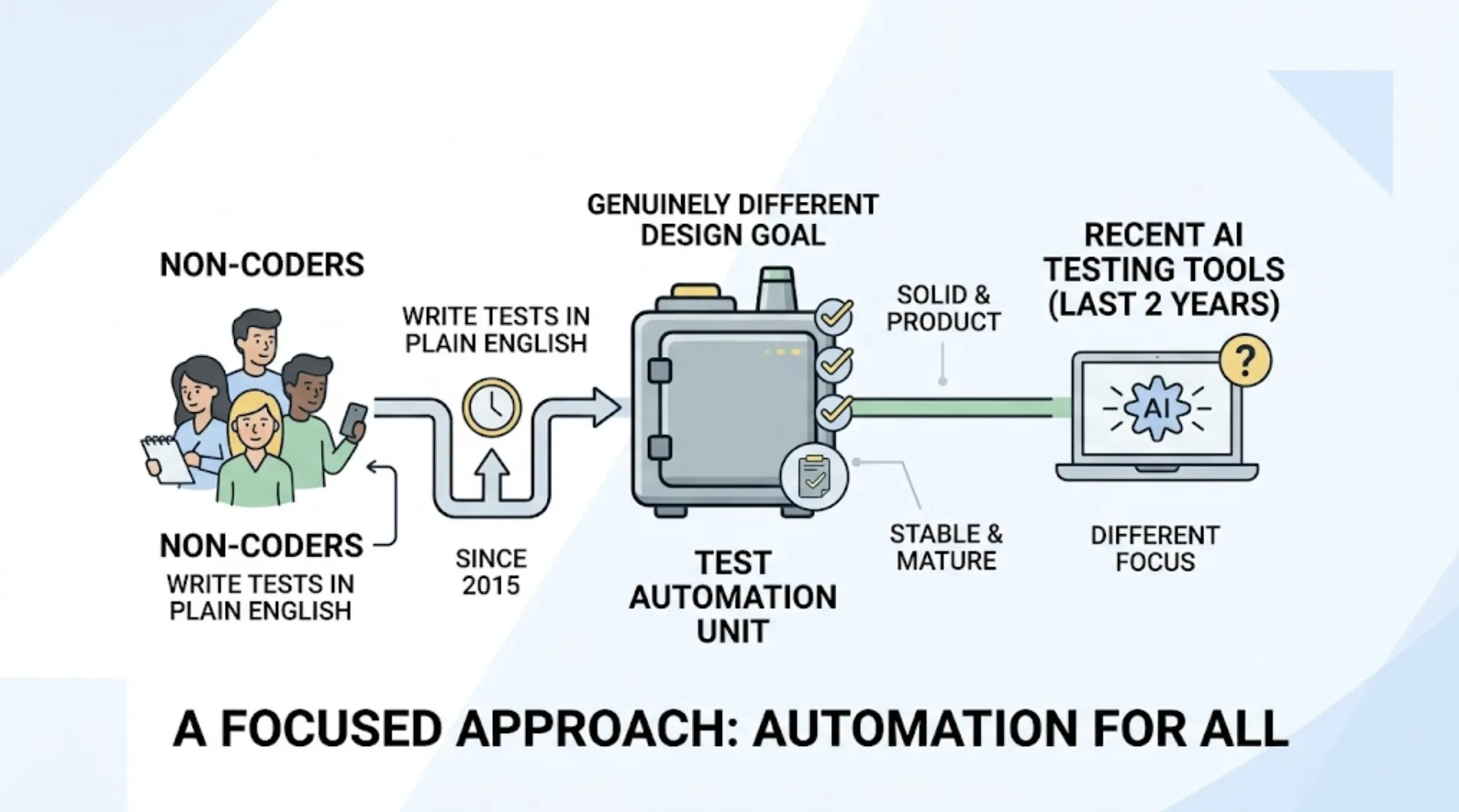
testRigor solves a real, specific problem: it lets people who can't code write real automated tests, in plain English, and it's been doing that since 2015. That's a genuinely different design goal than most AI testing tools launched in the last two years, and it shows up clearly once you look at where it fits and where it doesn't.
What testRigor actually is
testRigor is a cloud-based test automation platform built around plain-English test creation. Instead of scripting or recording, you write steps like a person would describe them, and testRigor executes them across desktop web, native and hybrid mobile apps, and APIs. It claims up to 15x faster test creation and roughly 95% less maintenance compared to traditional automation tools, backed by self-healing tests that adapt to "equivalent functional changes."
Its scope is broad: cross-platform testing across 3,000+ browser and device combinations, database and mainframe testing, Salesforce and ServiceNow automation, Vision AI for validating images, and OCR for reading on-screen text. It also supports 21 CFR Part 11 compliance, which matters specifically for regulated industries like healthcare and pharma.
What it genuinely does well
Accessibility for non-technical testers is real, not just a marketing angle. A manual QA tester with no coding background can write and maintain a legitimate automated test suite. That's testRigor's core value proposition, and independent reviews consistently back it up.
Breadth of platform coverage is unusually wide. Salesforce, ServiceNow, SAP, mainframes, and generic web and mobile, all from one tool, is a genuinely differentiated footprint compared to most testing platforms that focus narrowly on web or mobile.
It can test genuinely hard-to-automate things. Vision AI and OCR let it validate images, charts, and chatbot or LLM-based outputs where a traditional selector-based tool would have nothing to grab onto.
API testing is a first-class capability, not an afterthought. testRigor lets you invoke APIs, retrieve values, and validate return codes directly, alongside its UI-testing steps.
Where it shows its age for an AI-native workflow
It's built for converting manual testers into automation users, not for verifying AI-generated code against a PRD. testRigor's design center is: a human describes what should happen, in plain English, and the tool executes it. That's a fundamentally different starting point than a tool that reads your PRD (or infers intent from your codebase) and generates the test cases itself. If nobody has time to write those plain-English descriptions in the first place, because the bottleneck is that AI is generating code faster than anyone can review it, testRigor doesn't remove that authoring step, it just makes the authoring easier once someone sits down to do it.
No MCP-native integration for coding agents. testRigor predates the current wave of AI coding agents by roughly a decade in design philosophy. There's no equivalent to triggering a test run with a single instruction from inside Cursor or Claude Code.
Pricing isn't public, and third-party estimates vary widely. testRigor doesn't publish exact figures; based on G2 reviews and its own pricing FAQ, third parties have estimated its Pro tier at roughly $900–$1,000/month, though this is a modeled estimate, not an official quote. It does offer a free tier for publicly accessible test suites, which is a genuine option for open-source projects specifically.
Fewer pre-built integrations than newer competitors. Independent reviews note this directly: testRigor's integration list is thinner than some newer entrants, though the team has reportedly been responsive to feature requests.
Who it's actually built for
Teams with manual QA staff who want a path into automation without learning a framework, especially in industries with platform sprawl (Salesforce, mainframes, regulated compliance requirements) that most modern testing tools don't touch.
Where an AI-native team's problem is different
If your team doesn't have manual QA staff writing plain-English test descriptions, and the actual bottleneck is that Claude Code, Cursor, or another coding agent is producing code faster than anyone can verify it, testRigor's core value proposition (making manual test-writing easier) doesn't address the root problem: nobody has time to write the test description in the first place, plain English or not.
TestSprite starts one step earlier. It parses your PRD, or infers product intent directly from your codebase, and generates the test cases itself, no one writes a description at all. It's MCP-native, so a single instruction inside your IDE triggers generation, execution, and self-healing without switching to a separate console. On the backend, Backend Testing 2.0 observes real API behavior before writing assertions, a more evidence-grounded approach than describing an expected outcome in plain English up front.
Other verification tools read your code and guess. TestSprite opens your app and uses it.
Conclusion
testRigor is a strong, mature choice if your organization's problem is converting manual testers into automation users across a wide range of platforms. It's not built to solve the specific problem AI-native teams have today: verifying code that's being written faster than anyone can describe a test for it. If that's your actual bottleneck, TestSprite's PRD-driven generation removes the authoring step testRigor still requires.