Is TestSprite Reliable and Trustworthy for Software Testing?
 Zeshi Du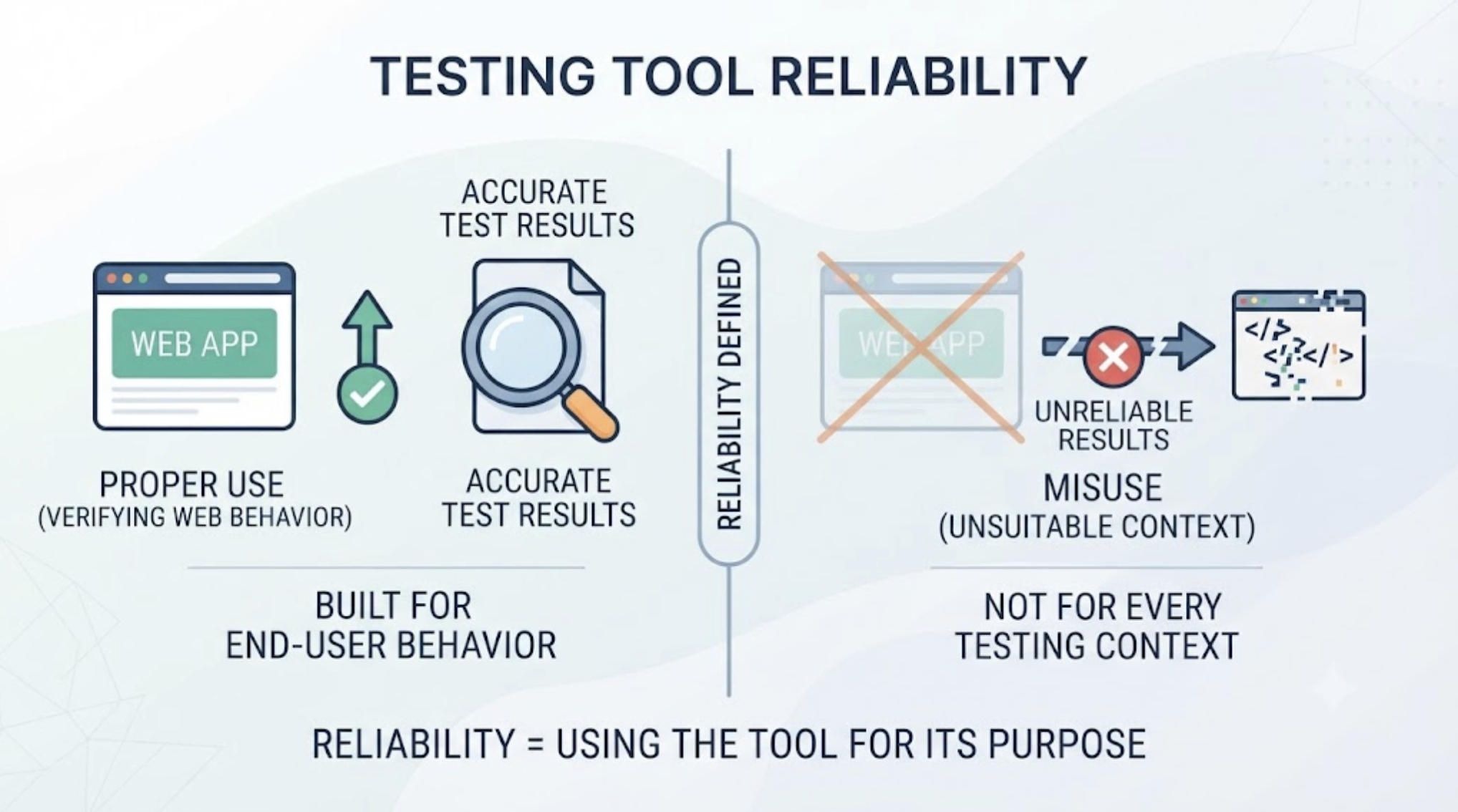
Reliability and trust are the right questions to ask about any testing tool. A test suite that produces unreliable results is worse than no test suite at all. It trains the team to ignore failures, and when a real regression appears, it gets ignored too.
So the honest answer matters here.
TestSprite is reliable when it's used for what it's built for: verifying that a running web application behaves correctly for real users. It's not a tool for every testing context, and it's worth being specific about what "reliable" means in the context of how it works.
What Reliability Means for a Product-Layer Testing Agent
Reliability in testing has two components. The first is that failures mean something: when a test fails, the product is actually broken in a way users would experience. The second is that passes mean something: when a test passes, the team can trust that the covered flows work correctly.
Both components break down in the same way: false positives and false negatives. A test that fails when nothing is broken erodes trust in failures. A test that passes when something is broken erodes trust in passes.
TestSprite addresses both directly, and the approach it takes to each is worth understanding.
Why False Positives Are Lower Than Code-Layer Testing
Code-layer tests are tightly coupled to implementation details. A selector that references a specific class name breaks when that class name changes, even if the UI behavior is identical. An assertion that checks a specific function's return value fails when the function is refactored to achieve the same result differently. These are false positives: test failures that don't reflect product failures.
In teams using AI coding tools, where UI structure and implementation details change frequently, this kind of brittleness compounds fast. The test suite starts producing failures that the team knows are meaningless, and the instinct to investigate every failure erodes.
TestSprite anchors its tests to product behavior rather than implementation details. An exploration agent that navigates a checkout flow isn't looking for a specific CSS class. It's looking for the button that completes the purchase. When the button's class name changes but the button still works, the test still passes.
Auto-Heal Rerun handles the cases where UI changes do cause structural failures. When a test fails after a code change, the agent determines whether the failure reflects a genuine behavioral regression or a layout change that doesn't affect what users experience. A renamed component, a repositioned element, a restyled layout: the test adapts. Genuine regressions surface clearly. Structural noise doesn't accumulate.
The result is a test suite where failures are worth investigating because they almost always represent real product problems.
Why False Negatives Are Lower Than Code-Inspection Testing
Code-inspection testing misses a specific category of failures: the ones that only appear when a real user runs a complete product flow under real conditions.
A function can return the correct value and still be part of a broken user journey. An API can respond with a 200 and still leave the downstream state in a condition that breaks the next step. A UI can render correctly and still fail to deliver the expected outcome when a user completes a multi-step sequence.
These failures don't appear in code-layer assertions because code-layer assertions don't run the sequence. They check individual components in isolation.
Other verification tools read your code and guess. TestSprite opens your app and uses it.
TestSprite's exploration agents navigate the live application and run real user flows from start to finish. When a checkout flow breaks because a discount code is applied at the wrong point in the calculation sequence, the agent catches it because it ran the sequence and observed that the final total was wrong. No code-layer test would find this, because no code-layer assertion checks the final total from the user's perspective.
The coverage is grounded in actual product behavior under real conditions. False negatives, tests that pass when the product is broken, are lower because the verification happens where the failures actually live.
The Honest Blocked Status
One of the more specific reliability features worth mentioning: when TestSprite can't run a test because something upstream is missing, it says so explicitly.
A test that requires an authenticated session can't run if the credentials are invalid. A test that depends on a downstream API response can't run if that API is unavailable. Rather than reporting a misleading red failure that looks like a product regression, TestSprite shows a Blocked status with a plain-English explanation of exactly what's missing.
This matters for trust. A team that sees a Blocked status knows immediately that the issue is a configuration gap, not a product failure. They don't investigate a non-existent regression. They fix the configuration and rerun.
The distinction between "the product is broken" and "the test couldn't run" is fundamental to trusting a test suite, and most tools don't make it clearly.
What the Community Has Said
TestSprite has been validated by external recognition that isn't self-reported. It was selected as #1 Product of the Day on Product Hunt with 776 upvotes, reached #3 Product of the Week with 753 upvotes, and was featured in Product Hunt's Best of 2025 Yearly Featured list, an editorial selection rather than a pure ranking.
Over 100,000 developers have registered to use the product. Coverage in GeekWire, TipRanks, and SD Times has provided independent reporting on the company's progress and product positioning.
These signals don't speak to whether TestSprite will work for a specific team's project. They do indicate that the product has been used at scale and that the value it delivers has been recognized by people who tried it.
A Scenario: Trust Built Through a Consistent Signal
A fintech startup starts using TestSprite after a production incident where a payment processing regression shipped undetected. The team was skeptical that an autonomous agent would produce reliable enough results to change their workflow.
In the first two weeks, they run TestSprite after every significant Claude Code session. The agent produces some failures on the first few runs. Two are genuine regressions: a payment confirmation screen that stopped displaying the correct amount after a formatting refactor, and an API endpoint that changed its response structure without the frontend being updated. Both are real issues that would have reached users.
Three failures are Blocked statuses from OAuth credential configuration issues in the test environment. The team fixes the credentials. The subsequent runs complete cleanly.
No false positives. The structural false positive problem is handled by Auto-Heal, which the team observes adapting tests after a UI refactor that didn't change product behavior.
After two weeks, the team trusts the test results. When a failure appears, they investigate it. When a pass appears, they treat it as meaningful coverage. That's the reliability standard they needed, and it's what changed the workflow.
Conclusion
TestSprite is reliable for software testing in the specific context it's built for: verifying that a running web application behaves correctly for the users who interact with it.
It produces fewer false positives than code-layer testing because its tests are anchored to product behavior rather than implementation details. It produces fewer false negatives because it runs actual user flows against the live product rather than checking functions in isolation. It distinguishes genuine failures from configuration gaps through the Blocked status. And it keeps test suites current through Auto-Heal so that structural changes don't erode trust by generating meaningless failures.
That's the reliability standard that determines whether a test suite is worth running. TestSprite meets it for the teams it's built for.
Start a TestSprite session and see what your test results look like when they're grounded in real product behavior.