How to Test Multi-Step API Workflows That Branch, Not Just Chain
 Rui Li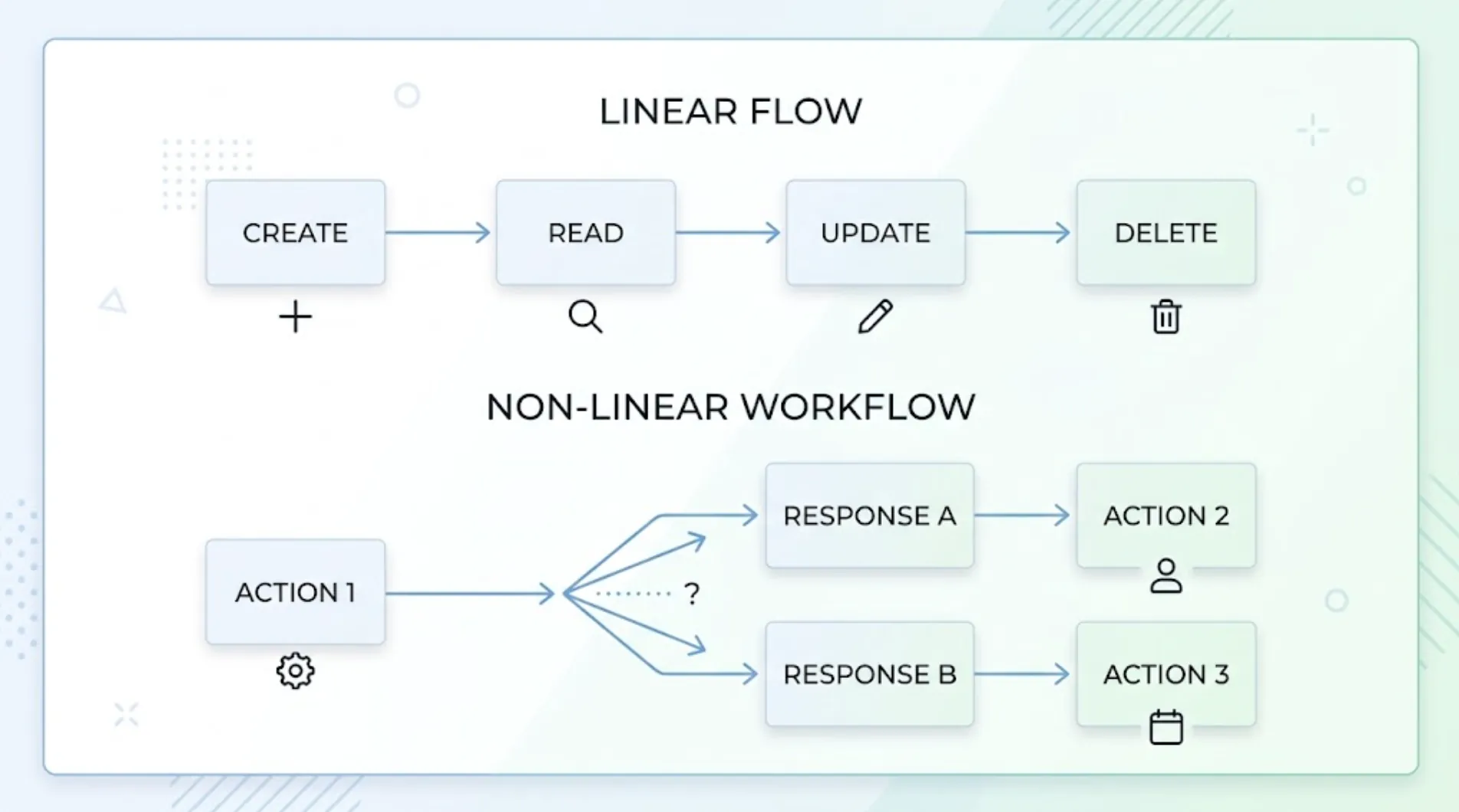
A simple API chain is linear: create a resource, use the ID it returns, read it back, update it, delete it. Plenty of real workflows aren't linear at all. A response comes back, and depending on what it contains, one of several different follow-up requests fires instead of a single predictable next step. Testing that kind of workflow requires more than passing an ID from one call to the next.
Where Branching Workflows Actually Show Up
Branching happens whenever an API's next step depends on a value in the previous response, not just on the previous call having succeeded.
A payment authorization returns either an immediate approval or a request for additional verification, and the client's next call differs completely depending on which one it gets. A claim submission returns a status that's either auto-approved or routed to manual review, and only one of those paths involves a follow-up call to a review-assignment endpoint. A file upload returns either a successful processing result or a validation error with a list of specific issues, and only the error case triggers a follow-up call to a correction endpoint.
In every one of these, a test that only knows how to pass a static ID forward misses the actual complexity of the workflow. The interesting behavior lives in which path gets taken and whether each path behaves correctly, not in whether an ID made it from one call to the next.
Why Linear Chain Testing Misses This
A test built around a single expected path through a sequence works fine as long as the sequence only has one path. The moment a response can determine the next step in more than one way, testing only the path someone happened to think of leaves every other branch completely unverified.
This matters more than it might seem, because the untested branch is often the one that matters most. The happy path, everything approved, nothing flagged, tends to get exercised constantly just from normal use and normal manual testing. The branch that only fires under specific conditions, an amount over a threshold, a flagged pattern, a failed validation, is the one nobody happens to trigger by accident, which means it's also the one most likely to have a bug nobody's caught yet.
Testing Branches by Observing What Actually Triggers Them
Covering branching workflows requires understanding what condition sends a workflow down each path, then deliberately exercising each condition rather than hoping normal testing happens to hit all of them.
TestSprite's Backend Testing 2.0 builds this from observed API behavior rather than a static description of the flow. When the exploration agent submits requests with values on either side of a decision boundary, it observes which response path each one triggers, and builds test coverage around both, rather than assuming there's only one path to check.
Other verification tools read your code and guess. TestSprite opens your app and uses it.
Dynamic variables carry values captured from each real response into whichever downstream request matches the branch that response actually took, so a claim that was auto-approved gets tested down the auto-approval path, and one that got flagged gets tested down the review path, with each branch verified against what should happen on that specific path.
A Scenario: An Insurance Platform's Claim Routing Logic
A team building a claims processing platform for an insurance product has an API where submitting a claim triggers one of two paths depending on the claim amount: claims under a set threshold get auto-approved and immediately queued for payout, while claims over the threshold get routed to a manual review queue and require an adjuster to act before payout.
An AI coding agent recently changed the threshold logic as part of a broader update to claim categories. The team runs TestSprite against the live API rather than testing only the path someone remembers to check manually.
The exploration agent submits several claims at different amounts, some clearly under the threshold, some clearly over, and a few deliberately close to the boundary on both sides. Most behave as expected. One doesn't: a claim submitted at exactly the threshold amount is being auto-approved when it should be routed to review, because the updated comparison logic used a strict less-than check where the original specification called for less-than-or-equal.
That's a boundary bug in a branch that almost never gets hit by normal testing, since claims rarely land on the exact threshold value by chance. It surfaced because the test deliberately exercised the boundary condition rather than only testing values comfortably on either side.
The failure report specifies the claim amount, the expected path, and the actual path taken. The coding agent corrects the comparison operator, and TestSprite reruns claims across the full range, including the boundary value, confirming both paths route correctly.
Making Sure Every Branch Gets a Dedicated Check, Not Just the Common One
The practical habit this points to is treating each branch of a workflow as its own thing to verify, not as a single "does the workflow work" question. For any API where a response determines what happens next in more than one way, it's worth explicitly identifying each possible path and confirming each one gets exercised during testing, rather than assuming broad coverage of the workflow means every branch got a fair test.
This is where scheduled regression runs through the TestSprite Web Portal add value beyond the in-session check: a workflow's branches can shift subtly as conditions and thresholds change over time, and a recurring check catches drift in a branch that hasn't been deliberately tested since the feature first shipped.
Conclusion
A workflow with more than one possible next step needs more than a test that passes an ID from call to call. It needs each branch treated as its own path worth verifying, including the boundary conditions that decide which path a given request takes.
TestSprite builds coverage from observed API behavior across branches, not from a single assumed path, catching boundary bugs that only show up when a specific condition gets deliberately tested.
Test your branching API workflows with TestSprite and stop leaving the paths nobody remembers to check unverified.