How to Decide What to Regression-Test When Your App Ships Daily
 Rui Li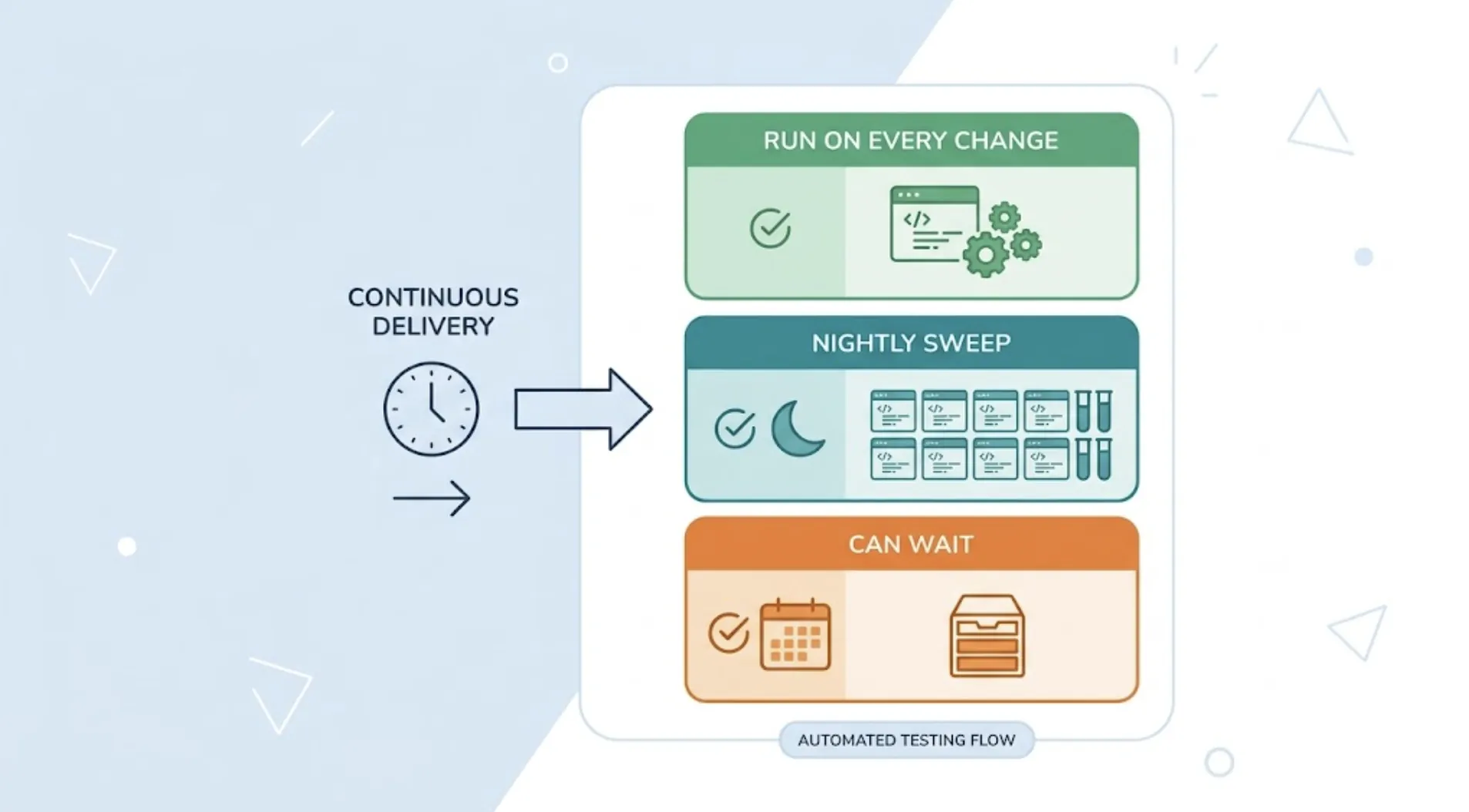
A team shipping several times a day can't regression-test everything, every time, without the test suite becoming the bottleneck it was supposed to prevent. The real question isn't whether to run regression tests. It's how to decide what belongs in the nightly sweep, what needs testing on every change, and what can wait.
Why "Test Everything, Every Time" Doesn't Scale
A comprehensive regression suite run against every single change sounds like the safest option. In practice, at daily shipping velocity, it becomes something teams route around rather than something that protects them.
Long-running suites slow down the exact feedback loop that made daily shipping possible in the first place. If a full regression pass takes forty minutes and a team is shipping five times a day, either the suite runs constantly in the background creating queue delays, or it gets skipped when someone's in a hurry, which defeats the purpose.
The fix isn't a smaller suite that catches less. It's a suite structured around a real cadence: different scopes running at different frequencies, matched to how risky and how frequently-touched each part of the product actually is.
Three Tiers of Regression Coverage
Tier one: the core flows, tested on every change. Sign-up, login, checkout, whatever three to five flows would be catastrophic if they broke silently. These run through the in-session trigger, "Help me test this project with TestSprite," at the end of every AI coding session that touches anything near them, and again through the GitHub Actions integration on every pull request.
Other verification tools read your code and guess. TestSprite opens your app and uses it.
Tier two: the actively developed area, tested daily. Whatever part of the product the team is currently building out gets a focused, deeper pass once a day, covering the flows within that area more thoroughly than the core-flow check does. This is where TestSprite's scheduled regression runs through the Web Portal fit, configured to hit the specific feature area under active development.
Tier three: the full product surface, tested on a longer cycle. Areas that aren't actively being changed still need periodic verification, because a change elsewhere in the codebase can break something in a part of the product nobody touched directly. A weekly or twice-weekly full sweep catches this category without running the complete suite on every single change.
Matching Test Frequency to Change Frequency, Not the Other Way Around
The instinct to test everything equally often treats all parts of a product as equally risky, which they're not. A payment flow that hasn't changed in months but handles real money warrants frequent testing regardless of how often it's touched. A internal admin panel that changes constantly but only affects three employees can tolerate a lighter cadence.
The right question for each part of the product is a combination of two factors: how often does this area change, and how bad is it if this area breaks silently. High on both means tier one. High on one and low on the other means tier two. Low on both means tier three is enough.
A Scenario: A Fitness Class Booking App Restructures Its Test Cadence
A team building a fitness studio booking app was running its full regression suite on every merge, and it had grown slow enough that developers had started merging without waiting for it to finish, treating a red result after the fact as something to investigate only if a user complained.
They restructured around the three-tier approach. Class booking, cancellation, and payment became tier one, tested on every PR through GitHub Actions and after every coding session touching those flows. The waitlist feature, which the team was actively rebuilding that quarter, became tier two, with a focused scheduled run through the Web Portal each morning. Instructor profile management and studio settings, both stable and rarely touched, moved to a twice-weekly tier three sweep.
The tier two waitlist testing caught a race condition within its first week: when a spot opened up and two waitlisted members were notified within the same second, both could claim it, overbooking the class by one. Under the old all-or-nothing suite, this would have been buried among dozens of unrelated checks running on every merge, easy to miss in the noise. In the focused daily run on the specific area under active development, it was the one thing being checked closely, and it surfaced immediately.
The fix used a proper claim-locking check instead of a simple availability read. The tier two run confirmed it the next morning.
Letting Auto-Heal Reduce the Cost of Frequent Testing
Testing core flows on every single change only stays sustainable if it doesn't generate constant false alarms from unrelated UI adjustments. TestSprite's Auto-Heal Rerun, available from the Starter plan, adapts tests automatically when a change is structural rather than behavioral, an element renamed or moved, without flagging it as a regression.
This overlaps with what's usually called visual regression testing, catching unintended changes to how the interface looks or is structured. Auto-Heal goes a step further than a typical visual diff: instead of just flagging that something on screen changed, it distinguishes a cosmetic change from an actual behavioral regression before deciding whether to raise it at all.
This is part of what makes tier-one testing viable at daily shipping speed: the frequent checks stay signal, not noise, which is the only way a team keeps trusting them enough to actually look at the results.
Conclusion
Regression testing at daily shipping speed isn't about running one suite more or less often. It's about matching test frequency to how risky and how actively developed each part of the product actually is, so the highest-stakes flows get checked constantly and the stable, low-risk areas get checked on a cadence that doesn't slow anyone down.
TestSprite supports this with in-session triggers for immediate checks, GitHub Actions for every PR, and scheduled runs through the Web Portal for the daily and weekly sweeps that round out the coverage.
Set up tiered regression testing with TestSprite and stop choosing between shipping fast and testing thoroughly.