How to Build Full-Stack Test Coverage Without a QA Team
 Zeshi Du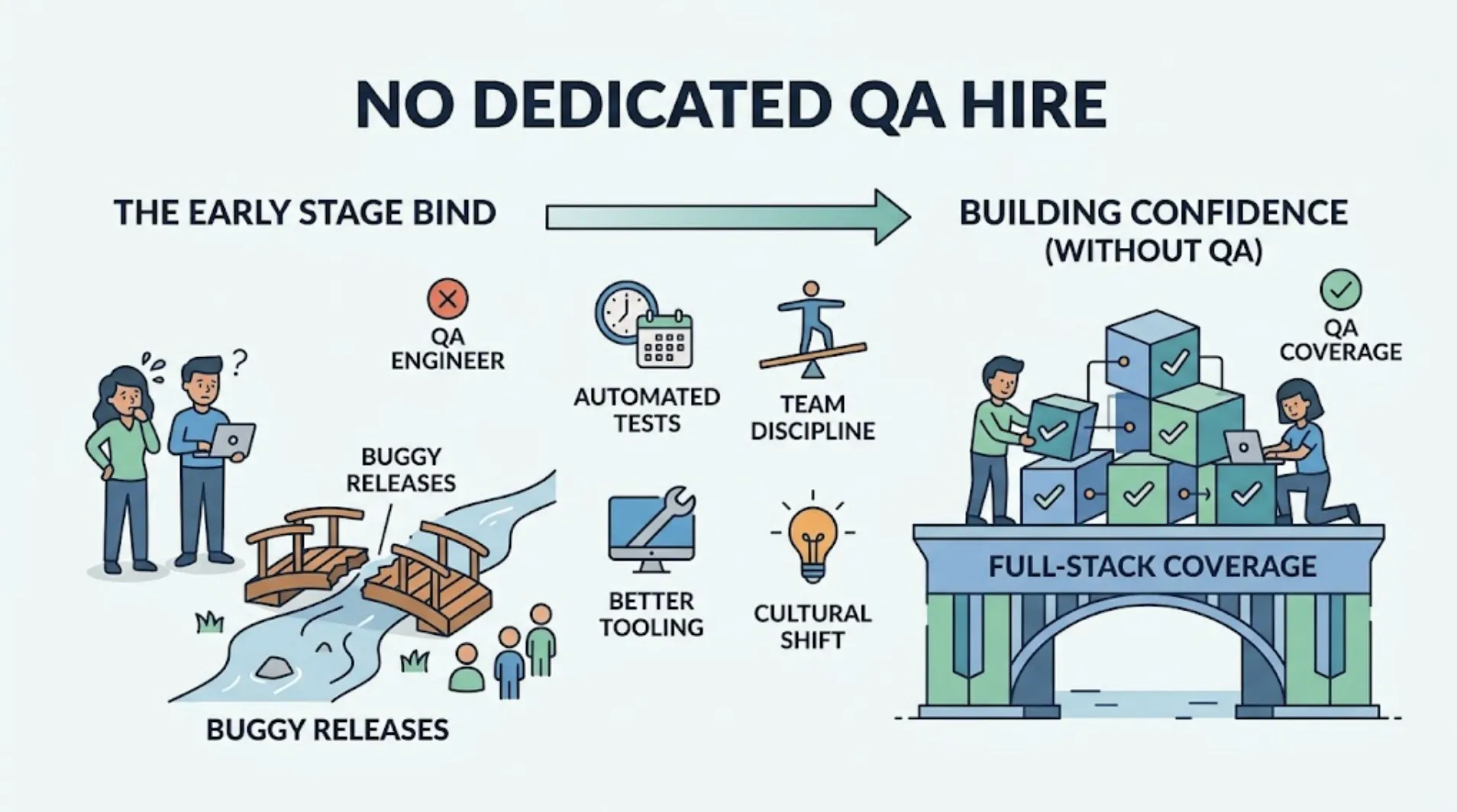
Small teams face a specific bind. Hiring a QA engineer is too expensive to justify early on, but shipping without any verification means production becomes the QA environment, and your users find the bugs instead.
Here's how to get real full-stack coverage without a dedicated QA hire, and what that actually still requires from you.
Who ends up owning testing when there's no QA hire
When there's no QA function, testing responsibility doesn't disappear. It quietly lands on whoever wrote the feature.
That's a conflict of interest even when nobody names it that way. The engineer who just shipped a change is now also the person deciding whether that change is safe, on a deadline, with the least objective eye in the room.
Manual testing eats hours that should go into building. So it gets compressed: the happy path gets clicked through once, and the stuff that actually breaks in production (an expired session, a race condition on a double-click, a payment webhook that fires out of order) gets skipped because nobody has time to think through every edge case before a release.
The result isn't "no bugs, because we're careful." It's bugs that surface for real users first, followed by a late-night fix and a roadmap that slips a little more each time this happens.
None of that is really a people problem you can fix by hiring more carefully or writing a better checklist. It's a workload problem: one person can't be both the builder and the objective verifier of the same change, on the same deadline. That's the specific gap an autonomous testing agent like TestSprite is built to close, and it's worth understanding what "full-stack" coverage needs to include before getting into how that works.
What "full-stack" coverage actually has to include
Real full-stack coverage means your frontend, your backend, and the contract between them all get checked, not just whichever layer is easiest to test.
- Frontend UI flows: the actual user-facing path, from signup through your core feature loop to billing.
- Backend APIs: the endpoints those flows call, verified against what they actually return, not what you assume they return.
- Authentication: login, session handling, and token refresh, since a broken auth flow blocks everything downstream of it.
- Error handling and edge cases: a failed payment, an expired session, a malformed input, exactly the category of bug a quick manual walkthrough tends to skip.
- Contract consistency between frontend and backend: whether the two layers actually agree on request and response shapes, which is where a lot of real bugs live and where testing one layer in isolation structurally can't catch them.
None of that gets solved by trying harder manually. A small team doesn't have a spare person to own test planning, write and maintain a suite, and triage failures on top of shipping features, which is where TestSprite actually fits into the picture.
Where an autonomous testing agent fits in
TestSprite is an autonomous AI testing agent, not a framework you configure and then still have to operate yourself. It takes on the parts of the job that used to require a dedicated hire: test planning, test writing, execution, and reporting, while you review the output instead of authoring it from scratch.
The starting point is your product's intent, not a blank test file. If you have a PRD, TestSprite parses it. If you don't, the MCP Server reads your codebase directly, from inside your IDE, and reverse-engineers what your product is supposed to do before it writes a single test. One prompt is enough to trigger the whole cycle: "Help me test this project with TestSprite."
“Other verification tools read your code and guess. TestSprite opens your app and uses it.”
That distinction matters for the exact reason manual testing breaks down for small teams: a test suite that's anchored to what your product should do, rather than to whatever the current code happens to do, doesn't quietly turn today's bugs into tomorrow's "expected behavior." The full loop runs discover, plan, generate, execute, analyze, heal, and report, so you're reviewing a finished cycle instead of babysitting each stage.
If your team is spread across a mix of solo IDE work and a shared dashboard for reviewing runs together, that's also the exact split TestSprite's use cases are built around, not an either-or choice between the two.
Generating both layers from one source, not one at a time
A common trap for small teams doing this manually is treating frontend and backend testing as separate projects: "we'll get to frontend this quarter and backend eventually." That's how half your risk stays unaddressed for months.
Generating both from the same requirements source removes that sequencing problem entirely. On the backend side, TestSprite's API testing doesn't just guess at response shapes from documentation. It observes your live API's actual responses first, real status codes, real field names, before it writes an assertion, which is what keeps generated tests from failing on things that were never actually broken.
Multi-step flows get covered the same way a QA engineer would map them: TestSprite's integration tests automatically identify sequences like create, then read, then update, then delete, and chain them into one workflow, capturing values like an order ID from one step and passing them into the next.
Running tests without building your own infrastructure
A QA team would typically own test environments and CI integration too. Without that team, that ownership has to go somewhere, and building it yourself is its own project on top of everything else.
Tests run in a secure, temporary cloud sandbox that spins up in seconds, stays isolated, and tears itself down when it's done. There's no local environment to configure and nothing for you to maintain between runs.
When something fails, the report includes the specific step, a screenshot or recording, and a root cause, structured in a format your coding agent can act on directly. That closes the loop that usually breaks at the last mile: instead of a report that just tells you something's wrong, the failure and the fix suggestion flow back to whichever coding agent wrote the change in the first place.
Regression testing on a schedule, rather than "whenever someone remembers," is handled through Monitoring, and you can group related tests into a single Test List so a scheduled run checks everything that matters in one pass instead of ten separate ones.
What you're still responsible for
None of this means testing suddenly takes zero human involvement. Full-stack coverage without a QA team still needs someone, probably you, to periodically check whether the coverage actually reflects current priorities.
A workable rhythm for a small team: a light weekly check (does anything look obviously off, is a new feature area missing coverage) and a more thorough review monthly or before a major release (does the coverage still match what matters most right now, not just what mattered when the PRD was written). Thirty minutes a month is usually enough. Skipping it entirely is how coverage quietly goes stale.
Treat a near-miss, a bug that reached production despite tests being in place, as a trigger for an off-cycle review rather than waiting for the next scheduled one. It usually means either the PRD didn't capture a requirement clearly, or a new risk area emerged that nobody flagged yet. Both are worth fixing immediately.
Conclusion
Full-stack coverage without a QA team is realistic once the work that used to require a dedicated hire, planning, writing, executing, and triaging tests, moves to an agent anchored to your actual product intent, with you reviewing results instead of authoring everything from scratch.
TestSprite is built for exactly this position: shipping fast, without a QA function, and needing real coverage across the whole stack anyway. You can get started free and run your first project from your IDE or the dashboard in under 15 minutes.