How to Add an Independent Testing Agent to Your Coding Workflow
 Rui Li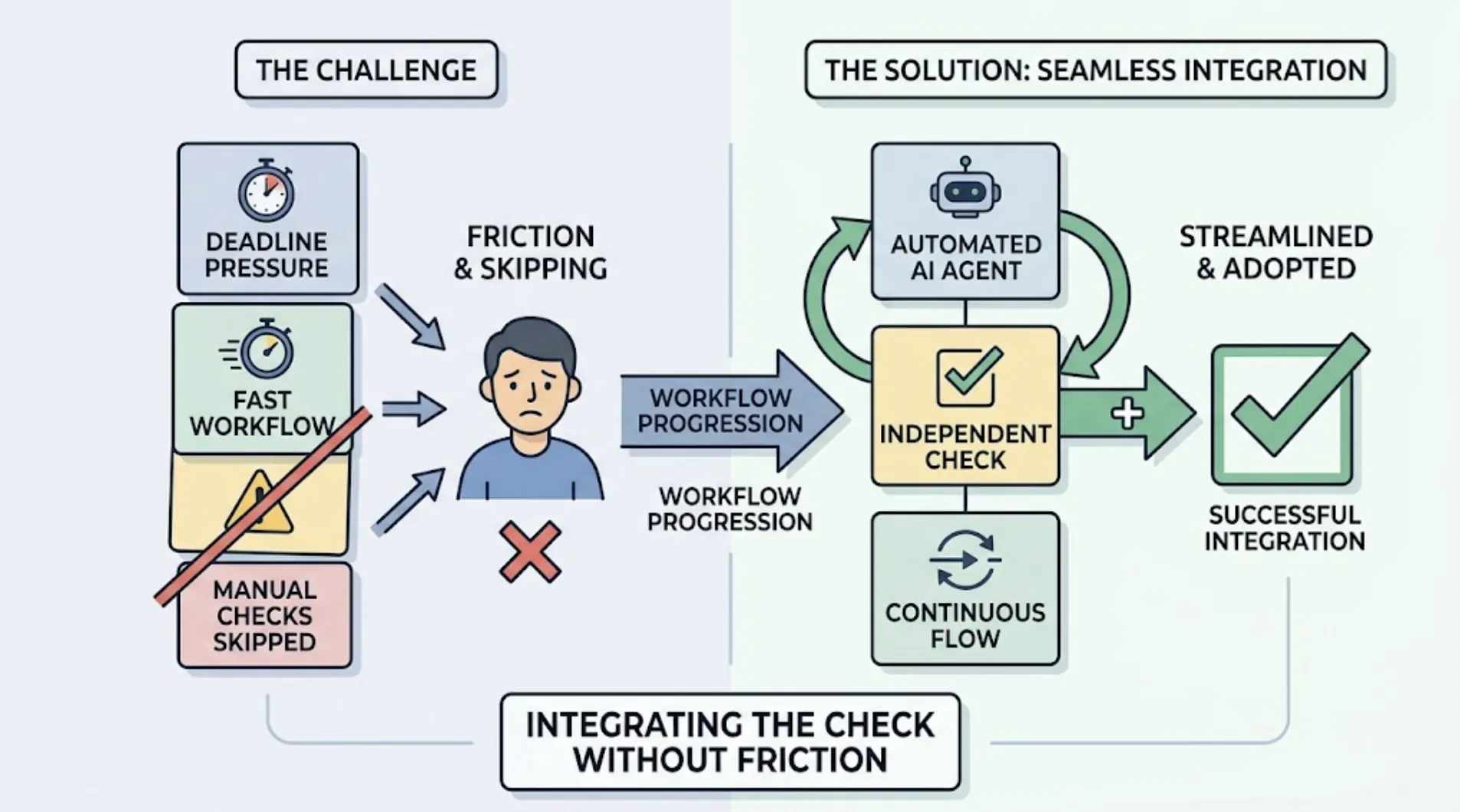
Your coding agent writes the code, runs its own checks, and tells you it's done. That's not verification. That's the same reasoning process grading its own homework, and it can't catch a misunderstanding it doesn't even know it has.
Here's how to add an ai testing agent that verifies independently, without turning your workflow into something slower than working without AI at all in the first place.
Why a coding agent can't fully verify itself
If a coding agent misread a requirement, that same misreading shows up in both the implementation and in whatever self-check the agent runs afterward, since both come from the same underlying understanding of what the task was. A coding agent declaring success is a claim from inside its own context and assumptions, not proof the deployed application actually works the way a real user experiences it.
This is a structural limitation, not a quality problem specific to any one coding agent. Even the most capable model checking its own output is still reasoning from the same premises that produced the output in the first place, which means a wrong premise gets confirmed rather than caught. Only a check that runs against the actual deployed behavior, independent of what the agent assumed while writing the code, can catch that category of mistake. This is the specific role TestSprite plays: not a rival coding agent, but an independent verifier.
How TestSprite fits in as a separate layer
“Other verification tools read your code and guess. TestSprite opens your app and uses it.”
Think of it as the difference between a player and a referee on the same field. Your coding agent is the player, writing and shipping code. TestSprite is the referee, checking the outcome from outside that player's own assumptions. Through the MCP Server, TestSprite installs directly into the same IDE your coding agent already works in, so verification happens in the same session rather than as a separate tool you have to context-switch into.
The practical setup
Install the MCP Server once. Setup takes a few minutes and works with Cursor, Claude Code, Windsurf, VS Code, and other AI IDEs that support the Model Context Protocol, so there's no separate installation path to figure out per editor.
Trigger it with one instruction. "Help me test this project with TestSprite" starts the full pipeline: exploring your application, generating tests grounded in what it observes, executing them in the cloud, and reporting back, all without you writing a single line of test code yourself.
Let failures flow back to your coding agent, not just to you. When TestSprite finds something wrong, it packages the failure, the specific step, a screenshot, a root cause, in a format your coding agent can use directly to propose a fix, closing the loop in the same session instead of requiring you to manually translate a bug report into a follow-up prompt.
Add continuous monitoring once the initial setup feels solid. This keeps coverage running as the project evolves, rather than treating the first session as a one-time check that never gets repeated. As new features get added, continuous monitoring surfaces regressions in existing flows that a one-time testing session would have no way to catch on its own.
Why this doesn't slow your workflow down
The instinct to worry that adding a verification step will slow down an already-fast AI coding workflow is reasonable, but it gets the trade-off backwards. Without independent verification, the actual bottleneck becomes the debugging session after something breaks in production, which costs far more time than a testing pass that runs in the background while you move to the next task. TestSprite's cloud sandbox spins up in seconds and doesn't require you to wait around watching it run.
The comparison worth making isn't "testing versus no testing," it's "a fast automated check now versus an expensive manual investigation later." A production incident doesn't just cost the time to fix the bug. It costs the time to notice it happened, reproduce it, trace it back to the change that caused it, and then fix it, usually under more pressure than a routine testing pass would ever involve. An independent testing agent that runs automatically in the background removes most of that overhead by catching the issue before it ships in the first place.
What this changes about how you review AI-generated code
Once an independent testing agent is part of the workflow, code review shifts from "does this look right" to "does the generated test coverage confirm this actually works," which is a more concrete, checkable question to answer. You're no longer relying entirely on reading a diff and trusting your own judgment about whether an AI-generated change is safe. You have an independent signal to check that judgment against.
This shift matters most on changes that look correct but touch behavior a quick read can't verify: async timing, state that persists across steps, or a calculation that depends on values pulled from several different places in the codebase. A diff review alone doesn't exercise any of that. Actually running the flow does, which is exactly what an independent testing agent contributes that a second pair of eyes on the code cannot.
How this fits a team that already does code review
Independent testing doesn't replace code review, it changes what code review is actually checking. A reviewer reading a diff is evaluating whether the approach looks reasonable, whether the code is maintainable, whether it fits the existing architecture. None of that confirms the feature actually works end to end for a real user. Pairing a human code review with an independent testing agent's verification covers both halves: is this the right approach, and does it actually do what it's supposed to do. Neither one alone answers both questions.
Conclusion
A coding agent that verifies its own work is checking its assumptions against itself, not against reality as experienced by a real user. Adding an independent testing agent gives you a genuinely separate signal, one that observes your running application rather than trusting the reasoning that produced it.
TestSprite fits into your existing coding workflow through the MCP Server, without requiring you to change how you already work with your coding agent day to day. Add it to your IDE for free and see what an independent check catches on your next change.