How Should Teams Evaluate Self-Healing Test Automation Without Hiding Real Bugs?
 Zeshi Du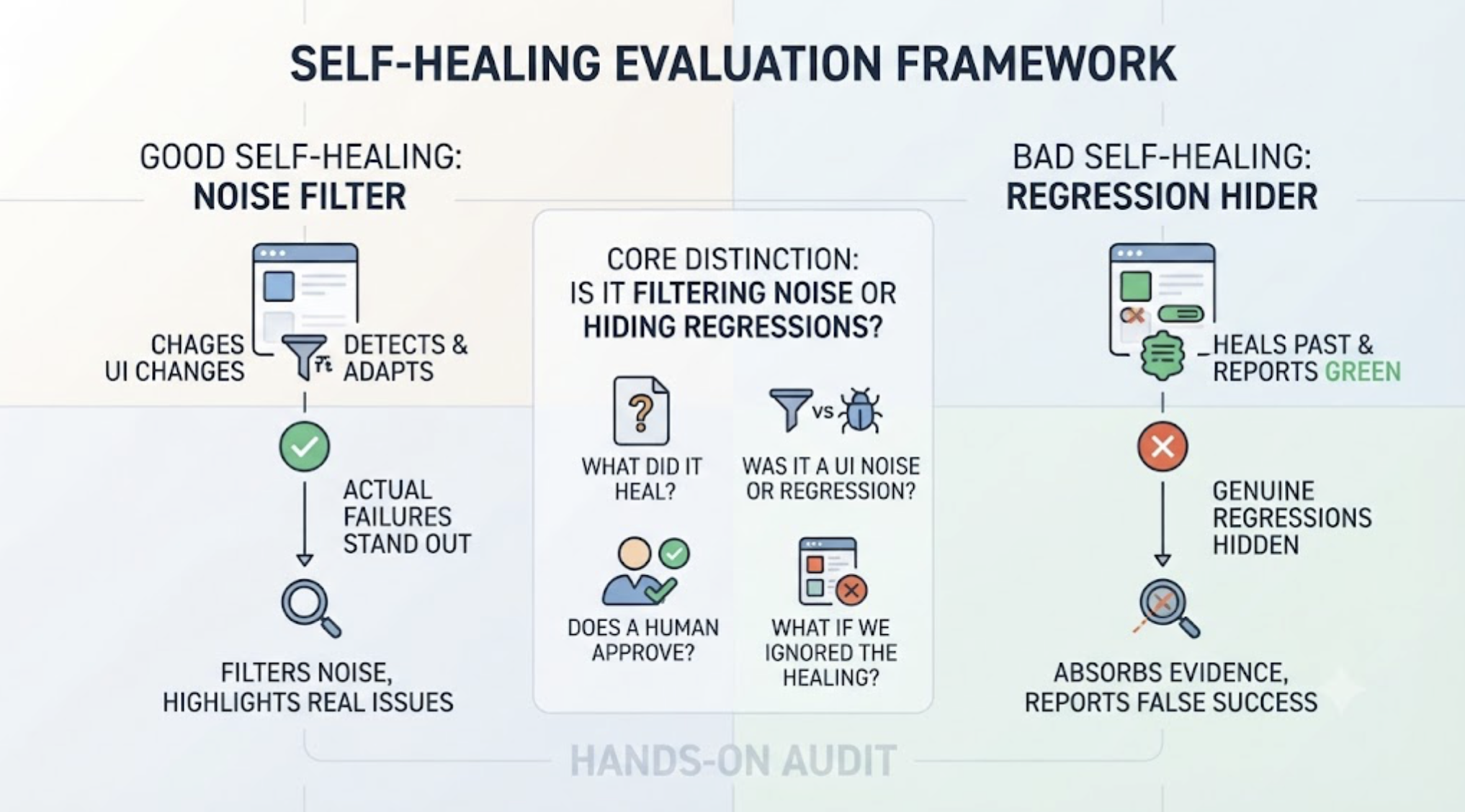
Self-healing is the feature that can save a test suite or quietly hollow it out, and the marketing for both versions sounds identical. A mechanism that adapts tests when the UI changes is either filtering noise so real failures stand out, or it's a machine for absorbing evidence, healing its way past genuine regressions and reporting green.
Which one you're buying is discoverable, but only if the evaluation asks the right questions. Here's the framework: the core distinction, four questions that expose it, and a hands-on audit any team can run during a trial.
The Core Distinction: What Does the Healing Judge?
Every self-healing mechanism answers a question when a test fails. The entire evaluation hinges on which question.
Selector-repair mechanisms ask: can I find the element again? A button's class changed, the locator gets patched, the test proceeds. The judgment is structural, does the pointer still point at something, and it carries a dangerous silence: a repaired pointer can find the right element in a flow that no longer works. The heal succeeds; the verification quietly stops verifying.
Behavioral mechanisms ask: does the product still deliver the correct outcome for the user? TestSprite's Auto-Heal Rerun is built on this question. When a test fails after UI drift, the agent re-engages the flow like a real user, if the form still submits, the journey still completes, the outcome is still right, the test adapts and verifiably reruns. If the outcome broke, nothing adapts: the failure surfaces with a product-level description.
Other verification tools read your code and guess. TestSprite opens your app and uses it.
Structural healing repairs the test's ability to run. Behavioral healing protects the test's reason to exist. The first can hide bugs by design; the second is designed to be incapable of it, because a broken outcome is the one thing it refuses to heal around.
Four Questions That Separate the Two
One: what evidence does a heal require? The safe answer is a verified rerun, the adapted test executes again and passes against the current product before anything reports green. A heal that's an assumption rather than a rerun is a green checkmark on faith.
Two: can healing ever touch the application? The correct answer is an unambiguous no. Healing adapts tests to UI drift; it never rewrites application code, and any tool vague on that boundary is describing a different, alarming product. TestSprite draws this as a hard line: Auto-Heal adapts tests, and when the product itself is broken, the fix belongs to your workflow, the finding returns to the IDE and the coding agent proposes the repair with you in the loop.
Three: is every heal visible? Silent adaptation is unaccountable adaptation. The mechanism should record what healed, so the team can audit the judgment rather than trust it blind.
Four: what happens when behavior actually breaks? Ask the vendor to describe, concretely, a case their mechanism refuses to heal. A tool whose answer is fuzzy has a mechanism whose boundary is fuzzy, and fuzzy boundaries are where bugs get absorbed.
The Hands-On Audit: Break Your Own Product
Specifications can be verified in an afternoon during any trial, with a two-part test on your own staging environment.
Part one, the drift test: make a structural change that leaves behavior intact, rename a component, restyle a button, reorder a layout, and run the suite. The right outcome is quiet adaptation: no false alarm, and a record that a heal occurred.
Part two, the regression test, and this is the part teams skip: deliberately break a flow's behavior behind an intact-looking UI. Make the submit button submit to nothing. Point a form at the wrong handler. Then run the suite and watch what the healing does. The right outcome is a loud, specific failure. The disqualifying outcome is a heal, a mechanism that adapted its way past a broken flow just demonstrated, on your own product, exactly how it will hide your next real bug.
A tool that passes both halves filters noise without absorbing evidence. A tool that passes only the first half is the dangerous kind, and the audit just saved you from adopting it.
A Scenario: The Audit That Changed a Decision
A four-person team running a print-on-demand store trials two tools, planning to pick whichever handles their weekly Claude Code refactors with less noise.
The drift test looks like a tie: they rename their product-customizer components and restyle the checkout, and both tools sail through without false alarms.
The regression test breaks the tie in twenty minutes. They deliberately disconnect the shipping-option selector from the order payload, the UI still renders, options still highlight when clicked, but every order submits with the default shipping regardless of selection. Tool one's healing repairs its selectors against the restyled checkout, finds every element, completes the flow, and reports green: a customer-facing pricing bug, demonstrated live, healed into invisibility. TestSprite's run fails exactly where it should, with the finding in product terms: express shipping was selected, the order confirmation showed standard, here's the sequence. The description lands in the Claude Code terminal, and, since the break was deliberate, the team simply reverts it, having learned what they came to learn.
They pick the tool that refused to heal the bug. The other tool's green would have been worth less than no test at all, because it came with confidence.
Conclusion
Evaluating self-healing test automation comes down to one distinction and one afternoon. The distinction: does the mechanism judge structure, can the element be found, or behavior, does the product still work for users? Only behavioral judgment is structurally incapable of hiding real bugs, because a broken outcome is precisely what it refuses to adapt around.
The afternoon: run the two-part audit on your own staging, drift that should heal quietly, and a deliberate behavioral break that must fail loudly. Demand verified reruns, a hard line against touching application code, visible heal records, and a concrete answer to "what won't you heal."
Run the audit against TestSprite's Auto-Heal Rerun on your own product today. Free plan, no credit card required.