How Much Does TestSprite Cost and Does It Have a Free Plan?
 Zeshi Du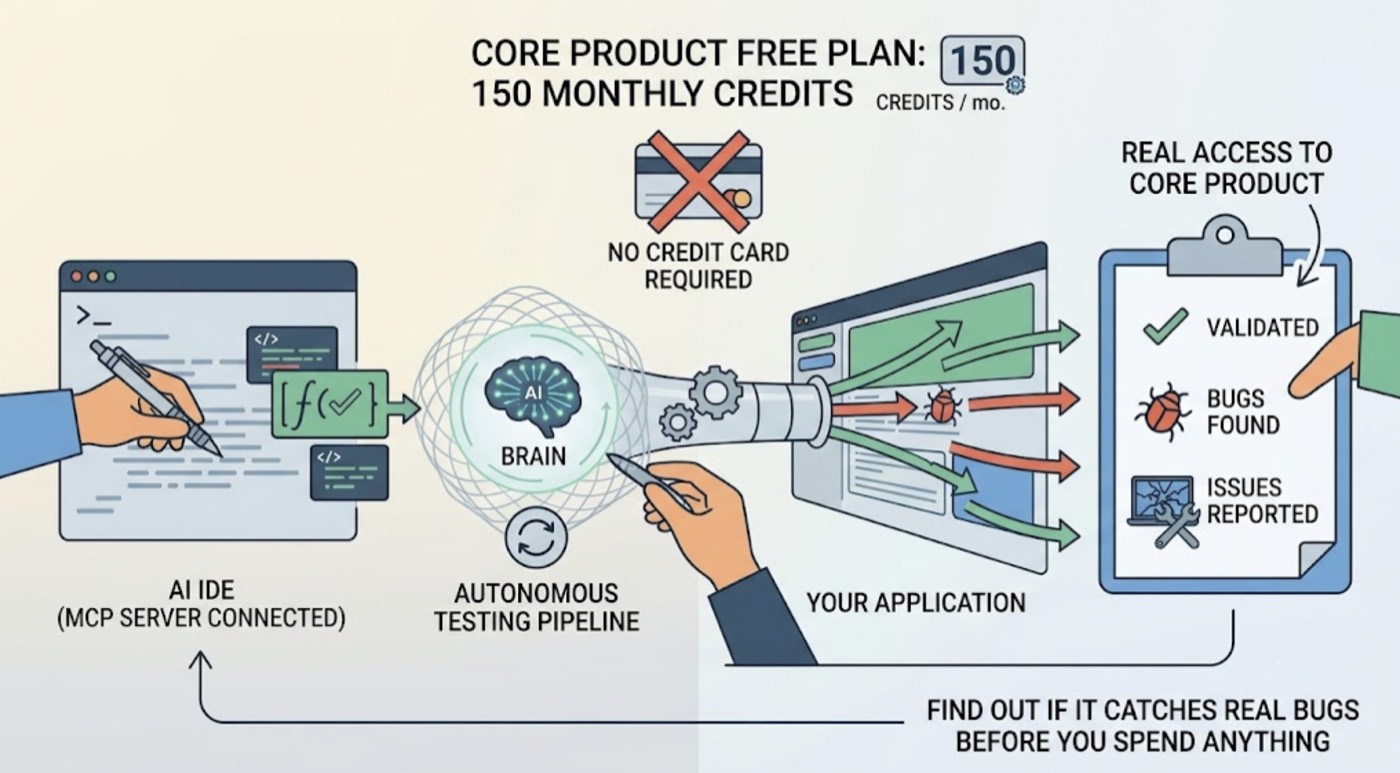
TestSprite has a free plan. That's the most important answer for most developers evaluating it.
The free plan gives you 150 credits per month, no credit card required, and real access to the core product. Not a limited demo. The actual autonomous testing pipeline, connected to your AI IDE through the MCP Server, running against your application, returning results to your IDE.
If you're evaluating TestSprite for the first time, start there. The free plan lets you find out whether it catches real bugs in your product before you spend anything.
What the Free Plan Actually Gets You
150 monthly credits refresh automatically. For a focused product with a handful of core flows, that's enough to run meaningful test sessions regularly.
The MCP Server integration with Claude Code, Cursor, Windsurf, VS Code, and any MCP-compatible AI IDE is available at the free tier. One instruction in the IDE chat triggers the full autonomous pipeline. The exploration agents visit your running application, navigate it like real users would, generate tests from what they find, and return results to the same window.
Other verification tools read your code and guess. TestSprite opens your app and uses it.
GitHub Actions CI integration is available on the free plan. Automated coverage on pull requests isn't gated behind a paywall.
Backend Testing 2.0, the approach that calls your API and observes the real response before generating any assertion, is available on the free plan. So is frontend exploration across multi-step flows, stateful interactions, and dynamic elements.
What the free plan doesn't include: scheduled regressions (Test Schedules), Auto-Heal Rerun for automatic test adaptation, and Auto-Auth for complex authentication flows. Those unlock on paid plans.
The Paid Plans
Starter at $19/month (first month free): 400 credits, 5 Test Schedules, 5 Test Lists, access to advanced AI models, and priority support. Right for solo developers and small teams who want scheduled regressions and higher credit volume without the full Standard feature set.
Standard at $69/month: 1,600 credits, unlimited Test Schedules, unlimited Test Lists, Auto-Heal Rerun, backend integration test chains, custom configurations, and 300 MB of test file uploads per project. This is the production tier for teams integrating TestSprite into a regular CI workflow. The unlimited scheduled regressions and Auto-Heal make this the plan where testing becomes a sustainable part of the development workflow rather than an occasional manual step.
Enterprise: Custom credit allocation, custom AI model configuration, API access for programmatic integration, and dedicated support. Pricing requires a conversation with the team. Right for larger organizations, compliance-sensitive deployments, or teams that need to integrate TestSprite into internal tooling beyond the GitHub Actions integration.
Yearly billing reduces the effective cost by 30% across all paid plans.
How to Think About the Cost
The useful cost comparison isn't TestSprite versus nothing. It's TestSprite versus the ongoing cost of finding bugs in production.
For a small team shipping weekly, a single production incident that reaches users involves engineering time to diagnose, fix, and deploy a patch. Support emails to answer. Potential churn. For a team without dedicated QA, these incidents happen regularly because the verification process doesn't keep up with the pace of development.
The Standard plan at $69/month is less than a few hours of engineering time. For teams where a production regression costs more than that, which is most teams shipping real products, the math works in one direction.
The more honest calculation is whether TestSprite's coverage changes the incident rate. For teams that have run it consistently, the answer is usually yes. The failures it surfaces are the ones that would have reached users.
A Scenario: From Free to Standard in Six Weeks
A two-person fintech startup signs up for the free plan. They've been building with Claude Code and having roughly one production incident per month: bugs that get through code review and reach users because the manual walkthrough before deployment doesn't catch integration failures.
First two weeks on the free plan: they trigger TestSprite after each significant Claude Code session. The agents surface two genuine regressions in the first ten days that their manual process had missed. One is a payment flow that breaks when a discount code is applied after the shipping method is selected. One is a dashboard filter that stops working after a state management refactor. Both caught before deployment.
Week three: they notice they're approaching their monthly credit limit before the refresh date. The current testing cadence isn't sustainable on 150 credits.
Week four: they upgrade to Standard at $69/month. They set up a nightly scheduled regression using one of the unlimited Test Schedules. Auto-Heal handles the structural test failures that accumulate when the frontend team reorganizes components. Their morning dashboard shows which tests changed status overnight without requiring full investigation of the complete suite.
Six weeks in: the incident rate is materially lower. The engineering time that was going to investigation and hotfixes is going to new features. The $69/month is covering itself several times over in recovered engineering hours.
That's the upgrade path for most teams. Start free, verify that it finds real bugs, upgrade when the credit limits become the constraint.
What Each Plan Is Actually For
Plan
Price
Best For
Free
$0/mo
Individual developers, MVPs, and evaluation
Starter
$19/mo
Small teams wanting scheduled regressions and higher volume
Standard
$69/mo
Production teams integrating TestSprite into CI workflows
Enterprise
Custom
Larger orgs, compliance requirements, API access needs
Yearly billing saves 30% on all paid plans.
Conclusion
TestSprite has a free plan with 150 monthly credits and no credit card required. The free tier includes the MCP IDE integration, GitHub Actions CI coverage, and the full autonomous exploration pipeline. It's a real starting point, not a restricted preview.
Paid plans start at $19/month for scheduled regressions and higher credit volume, and $69/month for the full production feature set including unlimited Test Schedules and Auto-Heal Rerun.
The right plan depends on testing volume and cadence. Start free, see what TestSprite finds in your product, and upgrade when the credit limits become the constraint.
Start on the TestSprite free plan today. No credit card required.