How Can I Generate Tests from Product Intent Instead of Current Implementation?
 Zeshi Du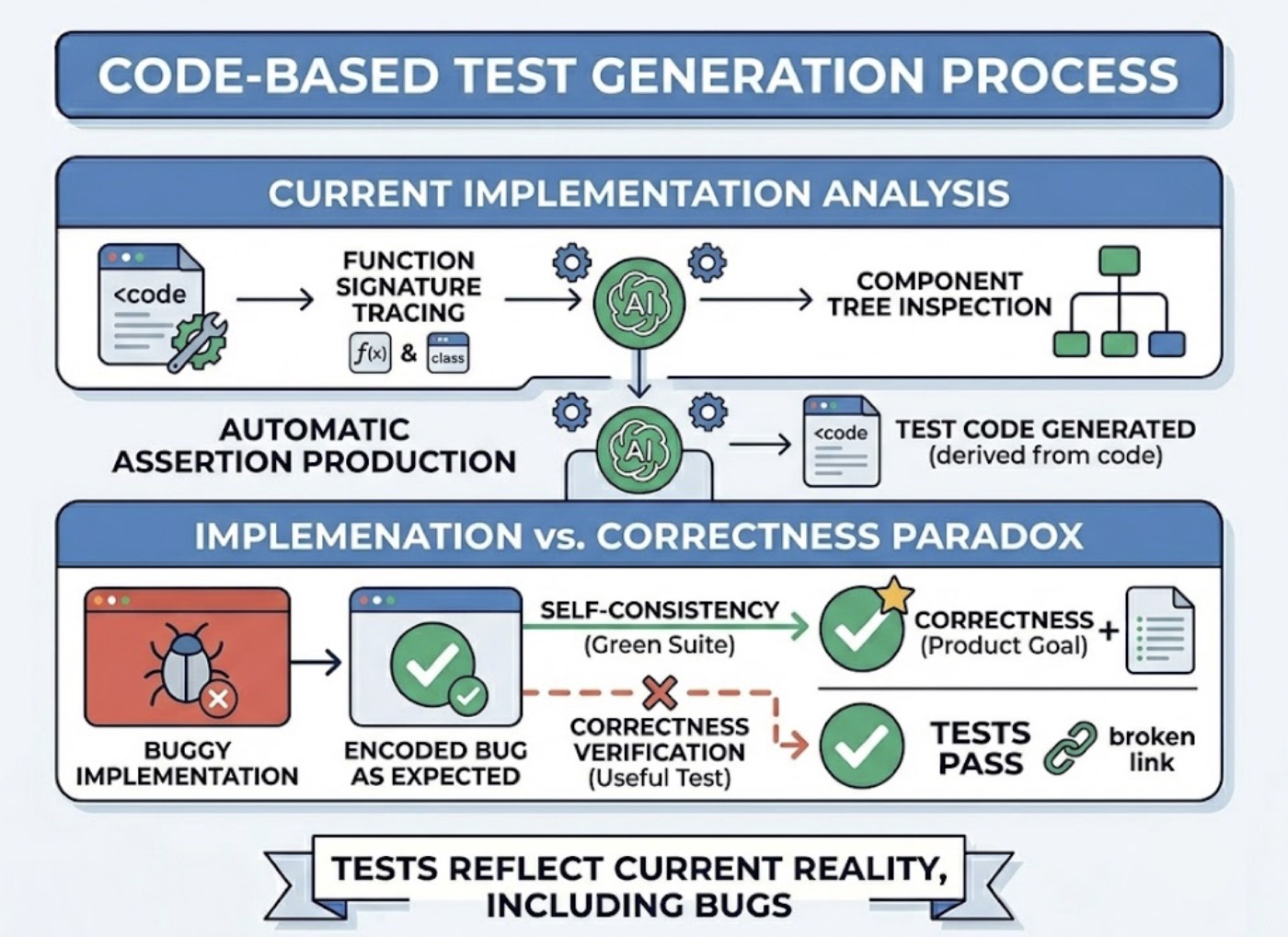
Most test generation starts in the wrong place.
It starts with the code. A tool reads your source files, traces function signatures, inspects component trees, and produces assertions based on what the current implementation does. The tests are technically grounded. They reflect the product as it exists right now, including every bug that exists right now.
That's the problem. Tests derived from implementation don't verify whether the product is correct. They verify whether the product is consistent with itself. If the implementation has a bug, the tests will encode that bug as expected behavior. The suite goes green. The bug ships. The tests did exactly what they were designed to do, and it still wasn't useful.
Generating tests from product intent is a fundamentally different approach. It means anchoring test goals to what the product should do, independent of what the current code happens to produce. Here's how to get there.
Understand Why Implementation-Derived Tests Fail at Their Job
Before changing the approach, it helps to be precise about why implementation-derived testing fails in ways that aren't immediately obvious.
When an engineer writes tests by reading the code, they're asking: "What does this code do?" and writing assertions that verify that behavior. The question sounds right. The problem is that it's the wrong question.
The right question is: "What should this product do for users?" Those two questions produce different tests, and the difference matters every time the implementation and the intended behavior diverge.
Here's the concrete failure mode. An AI coding agent generates a checkout flow. The implementation has a bug: the discount code is applied before tax calculation rather than after, producing incorrect totals. A code-derived test reads the implementation, sees the order of operations, and asserts that the discount is applied before tax. The test passes. The bug is now encoded as correct behavior. Every future change that accidentally fixes the bug will cause the test to fail, and the engineer will update the test to match the new implementation, never realizing the original behavior was wrong.
Intent-derived tests anchor to the user-observable outcome: the final total should reflect the discount applied to the post-tax amount. When the implementation gets the order wrong, the test fails because the outcome is wrong, not because the implementation changed.
Step One: Separate Intent from Implementation
The first practical step is establishing a source of truth for product intent that exists independently of the code.
If your team uses PRDs, user stories, or acceptance criteria, those documents are your intent layer. They describe what the product should do from the user's perspective, not how the code achieves it. A test suite grounded in those documents is anchored to intent by definition.
If your team doesn't have formal documentation, which is true of most early-stage and AI-native teams shipping fast, the intent still exists. It lives in the original design decisions, the feature goals, the mental model of what users should be able to accomplish. The challenge is making that implicit intent explicit enough to ground test generation.
TestSprite handles both cases.
When a PRD or specification exists, TestSprite parses it and builds a structured model of product intent from the document. Test goals are anchored to what the specification says the product should do, not to what the current code happens to produce.
When no PRD exists, TestSprite's MCP server reverse-engineers product intent directly from the codebase. Not by reading function return values and asserting against them, but by treating route definitions, API contracts, component structures, and naming conventions as evidence of what the product was designed to accomplish. The result is a structured internal PRD that captures intent rather than implementation.
Either way, the test generation process starts from intent, not from the current state of the code.
Step Two: Test at the Product Layer, Not the Code Layer
Having the right starting point matters. So does testing at the right layer.
Even with a clear intent document, a code-layer testing tool will translate that intent into implementation assertions. It reads the PRD, identifies the relevant components, and generates tests that verify those components behave consistently with the code. The intent-grounding helps, but the verification still happens at the code layer.
Testing from product intent requires verifying at the product layer: the running application, under real conditions, with real user interactions.
Other verification tools read your code and guess. TestSprite opens your app and uses it.
Through the TestSprite MCP Server inside Claude Code, Cursor, Windsurf, or any MCP-compatible AI IDE, a single instruction launches the intent-grounded testing pipeline:
"Help me test this project with TestSprite."
A fleet of parallel exploration agents visits the live application and navigates it the way real users would. They don't read the source files to understand what to test. They use the product to discover what it actually does, and compare that against what the intent model says it should do.
Step Three: Let the Agent Discover the Gaps
The most valuable output of intent-grounded testing isn't the tests themselves. It's the discovery of where the product behavior diverges from the product intent.
When the exploration agents navigate the live application with an intent model in mind, they're looking for exactly those divergences. The user story says a Viewer-role user should not be able to delete records. The agent logs in as a Viewer, navigates to the relevant section, and attempts the delete action at both the UI layer and the API layer. If the frontend correctly hides the delete button but the API accepts the delete request anyway, that's a divergence between intent and implementation. It surfaces immediately.
The user story says completing a purchase should display a confirmation with the correct order total. The agent adds items to a cart, applies a discount code, completes checkout, and reads the confirmation. If the total displayed doesn't match the expected calculation, that's the divergence. Not a code-level assertion failure. A product behavior failure, described in user-perspective terms.
This is how intent-derived tests catch bugs that implementation-derived tests miss. The implementation is internally consistent. The implementation and the intent are not. And the test is anchored to the intent.
Step Four: Cover the Backend Intent Too
Product intent extends to the API layer. Every API contract represents an implicit intent: this endpoint should accept these inputs and return these outputs under these conditions.
When tests are derived from code inspection of the API, they assert what the API currently does. When tests are derived from API intent, they assert what the API is supposed to do and catch deviations from that intent.
TestSprite's Backend Testing 2.0 covers this through prior observation rather than code inspection. Before generating any API test plan, the agent calls the endpoint and observes the real response. That observed behavior becomes the baseline, representing the API's actual contract. Subsequent runs compare new behavior against that baseline.
When an AI coding agent changes the backend and silently alters what an endpoint returns, the next test run catches it as a deviation from the established contract. The field that was previously returned as user_id and is now returned as userId is a breaking change, surfaced as a specific, actionable failure.
Dynamic variables from real responses flow automatically through multi-step API sequences. A create endpoint returns a real ID. That ID passes to the read, update, and delete steps. The full lifecycle runs against the real intent of the API surface, not against static assertions written from code inspection.
Step Five: Feed Failures Back to the Coding Agent
Intent-grounded testing is most powerful when it closes the full loop.
When a test fails because the product behavior diverges from the product intent, that failure should return to the development environment in a form the coding agent can act on directly. Not a stack trace or an assertion error. A description of what user action was taken, what the product intent required, and what the product actually delivered.
TestSprite structures failure information for exactly this purpose. The failure description returns to the IDE where Claude Code, Cursor, or Windsurf is running, in a format the coding agent can read and act on. The agent proposes a fix based on the gap between intent and behavior. The fix gets reviewed and applied in the same session.
The loop from intent to test to failure to fix closes inside the development workflow. No dashboard switching. No manual investigation to connect a code-level assertion failure to a product-level behavior problem.
The GitHub Actions integration extends this loop into CI. Every pull request triggers intent-grounded verification against the live application. Results post as PR comments. Intent violations surface before code merges.
Conclusion
Generating tests from product intent instead of current implementation requires three things: a source of truth for intent that exists independently of the code, a testing approach that verifies at the product layer rather than the code layer, and a feedback loop that describes failures in intent terms rather than implementation terms.
TestSprite provides all three. It parses PRDs when they exist and reverse-engineers intent from codebases when they don't. Its exploration agents navigate the live application like real users and compare observed behavior against the intent model. Its failure reports describe product behavior divergences in user-perspective terms the coding agent can act on directly.
The result is a test suite that catches the failures implementation-derived testing misses: the bugs that are internally consistent but wrong, the behaviors that match the code but not the product, and the gaps between what the product does and what it was built to do.
Start generating tests from product intent with TestSprite inside your AI IDE today.