Does TestSprite Replace Selenium, Cypress, or Playwright?
 Zeshi Du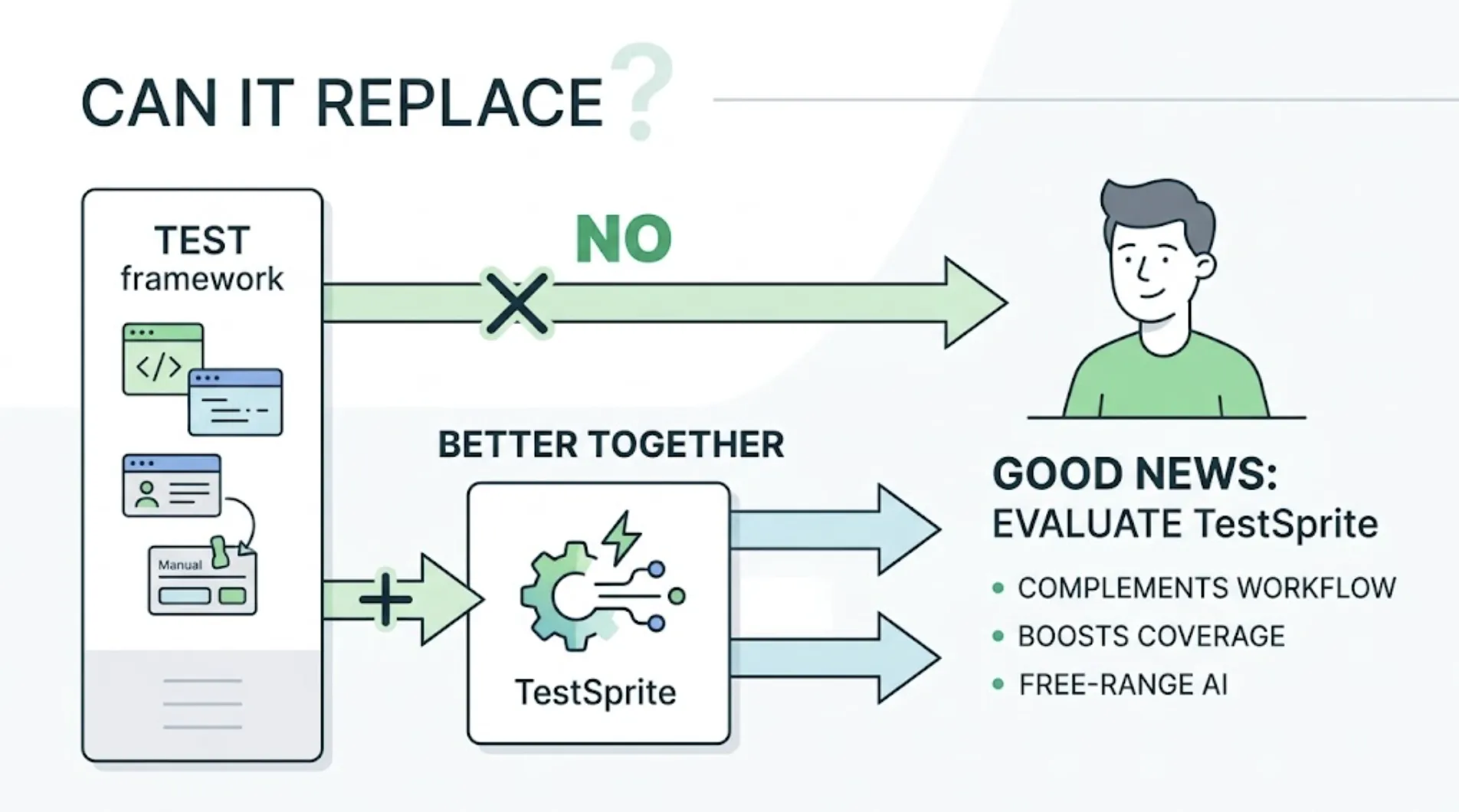
Short answer: no, and it's not trying to. The longer answer explains why that's actually good news if you're evaluating TestSprite alongside a framework you already use.
They're not solving the same problem
Selenium, Cypress, and Playwright are frameworks. They give you an API to drive a browser, and they're excellent at that job. What they don't do is decide what to test, write the test case, or fix it when your app changes. That part is still yours.
TestSprite is a different layer entirely. It's an autonomous AI testing agent that parses your PRD (or infers intent from your codebase when there's no PRD), generates the test cases, executes them in a secure cloud sandbox, and proposes fixes when something breaks. No test code authored by hand.
Put simply: these frameworks are the layer you write scripts against. TestSprite operates one layer above, deciding what those scripts should be and keeping them current.
What actually changes if you add TestSprite
If your team currently maintains a Selenium, Cypress, or Playwright suite, TestSprite doesn't ask you to rip it out. What it changes is where new coverage comes from and how much of your team's time goes into maintaining it.
A few concrete differences:
The framework question ("Selenium or Cypress or Playwright") and the agent question ("do I write this test myself or does something generate it") are answers to two different problems. You can run TestSprite-generated coverage in the same CI pipeline you already have.
Why this distinction matters more now than it used to
Before AI coding tools, the bottleneck was writing features. A team could reasonably keep pace hand-writing tests alongside hand-written code. That balance changed once Cursor, Claude Code, and similar tools started producing code 5 to 10 times faster than before. Code review became the new bottleneck, and testing got squeezed even harder.
Frameworks didn't get slower. The problem is that a framework never wrote the test in the first place; a person did, and that person is now busy reviewing AI output instead. TestSprite closes that specific gap: it sits between "AI finished writing" and "merge to main," generating and running the verification a person would otherwise have had to write manually.
This shows up clearly on small teams first. A two-person startup shipping fast with Claude Code doesn't have a spare engineer to sit down and write Playwright coverage for every new endpoint. The choice in practice isn't "Playwright versus TestSprite." It's "ship untested, ship late while someone writes tests by hand, or let an agent generate and run the tests instead." Framework loyalty doesn't change which of those three actually happens.
A concrete example
Say your team just added a checkout flow with Claude Code. A hand-written Playwright suite would need someone to: identify the flow, write selectors for each form field, script the assertions for successful and failed payment states, and then update all of it the next time the checkout UI changes.
TestSprite's version of that same task starts from your PRD, or infers the intent directly from the code if there's no PRD. It generates the test cases for the flow, including the edge cases (declined cards, expired sessions, empty carts) that get skipped when a person is racing a deadline. Those tests run in an isolated cloud sandbox, and if the checkout UI changes next sprint, TestSprite adapts or regenerates the affected coverage rather than leaving a stale, failing test in your CI pipeline.
The framework underneath (whatever engine actually drives the browser) is invisible in that workflow. That's the point: you're not choosing a framework, you're choosing whether a person or an agent does the authoring and upkeep.
The one thing worth being direct about
TestSprite doesn't retire the concept of frameworks, and it doesn't compete with Selenium, Cypress, or Playwright as tools. If anything, it's a reason those frameworks matter less as a skill you personally need to master, and more as infrastructure that runs quietly underneath an agent that handles the authoring and upkeep.
If your team's actual problem is "we don't have time to write and maintain E2E tests for everything AI is now generating," that's a different problem than "which framework should we pick." TestSprite is built for the first one.
What if we already have a mature Selenium or Cypress suite?
Keep it. There's no reason to discard test coverage that already works and that your team already understands. The more useful question is where new coverage comes from going forward: if new features are shipping faster than anyone can write new tests for them, that gap is what TestSprite is designed to fill, alongside whatever your existing suite already covers, not instead of it.
Conclusion
Selenium, Cypress, and Playwright remain solid choices for teams that want to write and own their test code directly. TestSprite isn't a fourth option in that same category. It's the layer that decides what to test, generates the cases, runs them, and proposes fixes, without anyone hand-authoring scripts. If manual test-writing has become the thing slowing your releases down, see how TestSprite fits into your existing pipeline.