Does TestSprite Replace Playwright and Cypress, or Work with Them?
 Zeshi Du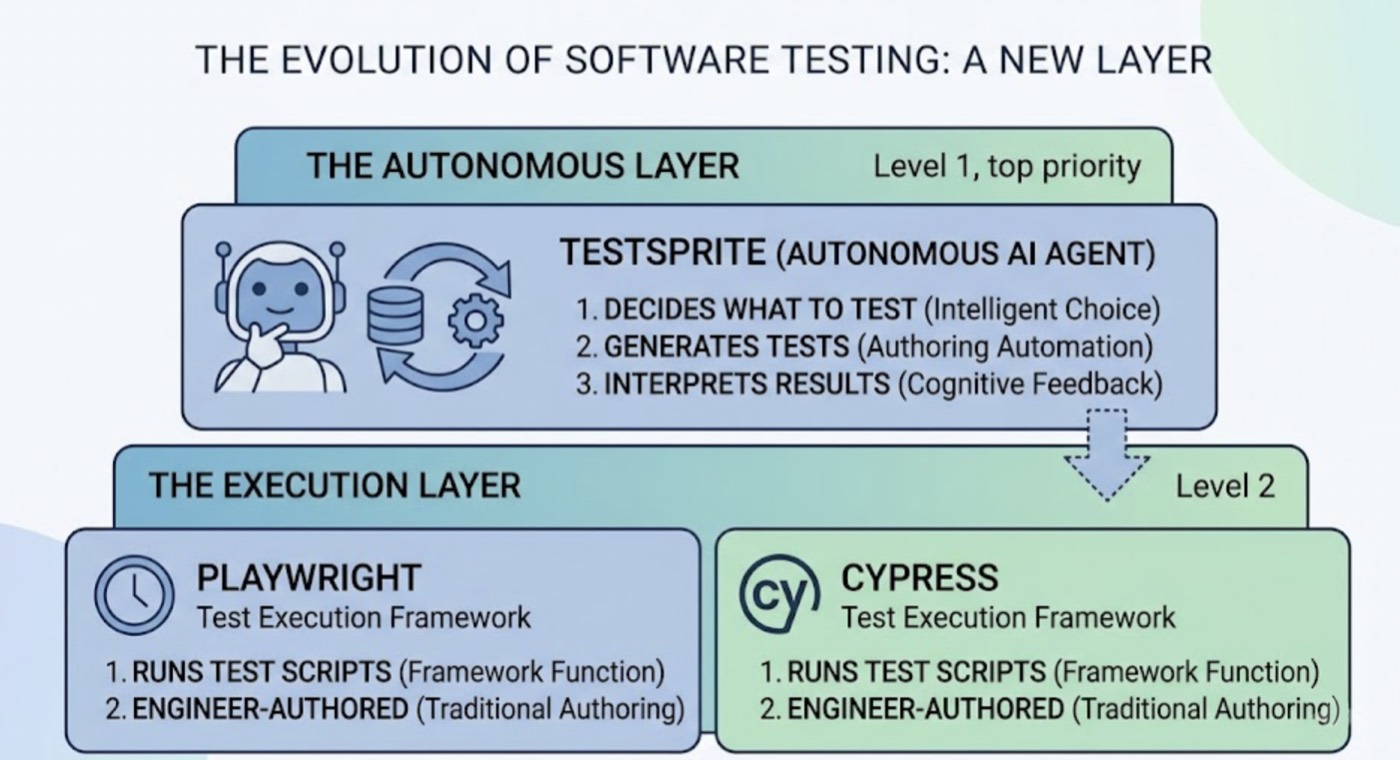
Neither replace nor work with is quite right. TestSprite operates above them.
Playwright and Cypress are test execution frameworks. They run test scripts that engineers author, and they run those scripts well. TestSprite is an autonomous AI testing agent. It decides what to test, generates the tests, runs them, interprets the results, and feeds findings back to the development workflow. These are different layers in the testing stack, and they don't naturally compete.
The clearer framing: Playwright and Cypress are tools for writing and running tests. TestSprite is a tool that figures out what tests to write, writes them, and runs them. The second category operates at a layer above the first.
What Playwright and Cypress Are Built For
Playwright and Cypress are purpose-built for executing test scripts reliably and quickly. They handle browser automation, element interaction, network interception, and assertion execution with precision. When an engineer writes a test that navigates to a page, clicks a button, and verifies that a specific element appears, Playwright and Cypress execute those instructions faithfully.
Their strength is in the execution layer. Given a well-written test script, they'll run it correctly, repeatably, and fast.
Their limitation is the layer above. They don't decide what to test. They don't write the test cases. They don't maintain those test cases as the product evolves. All of that work stays with the engineer.
For teams using AI coding agents where code changes faster than engineers can write and maintain test scripts, that limitation is the one that matters most.
Where TestSprite Operates
TestSprite operates at the layer Playwright and Cypress don't reach: the discovery, generation, and maintenance layer.
It decides what to test by exploring the product. TestSprite's parallel exploration agents visit the running application and navigate it the way real users would, discovering user flows by using the product rather than by reading a specification the engineer wrote. No test case specification required.
It generates tests from that exploration. The test cases describe real user interactions and observed product outcomes, not selectors and implementation assertions. When a component gets renamed but the behavior stays the same, the test doesn't break because it wasn't anchored to the component name in the first place.
It maintains those tests over time. Auto-Heal Rerun handles the cases where UI changes cause structural failures without affecting product behavior. The engineer doesn't update selectors after every refactor.
Other verification tools read your code and guess. TestSprite opens your app and uses it.
Teams That Have Playwright Suites and Add TestSprite
A team with a well-maintained Playwright suite has something valuable. Their critical flows are covered by precisely authored test scripts. Those scripts run in CI on every commit. When something breaks, the Playwright test output tells them which assertion failed and what was expected.
Adding TestSprite to this workflow doesn't deprecate the Playwright suite. It extends the coverage to what the Playwright suite doesn't reach.
Playwright covers what engineers specified. TestSprite covers what engineers didn't specify, which is the surface where unexpected failures live. The flow nobody wrote a test for. The integration point between two correctly tested components that breaks when they interact under real conditions. The regression in a part of the product that wasn't in the recent diff.
The combination is complementary. Playwright tests run at depth on the flows engineers care most about. TestSprite explores the full product surface and generates coverage for the rest.
Teams Without Playwright Suites
For teams that don't have existing test coverage, the question of "replace or work with" is moot. There's nothing to work with.
For these teams, TestSprite provides what a Playwright or Cypress suite would provide, but without requiring the engineers to author the test cases. One instruction from inside Cursor, Claude Code, or Windsurf starts the exploration and generates the coverage.
The TestSprite MCP Server connects to AI IDEs through the Model Context Protocol. The TestSprite Web Portal handles project configuration, test plan management, and scheduled regressions.
Teams that want CI coverage without building a Playwright suite from scratch can connect the GitHub Actions integrationand have automated product-layer verification on every pull request without writing a single test case by hand.
A Scenario: The Gap Between Playwright Coverage and What Ships
A team has solid Playwright coverage on their core flows: signup, the main feature, and the billing section. The Playwright suite runs on every PR. It catches regressions in those flows reliably.
They use Cursor to build a new analytics dashboard. The dashboard goes through several iterations before it ships. By the time it's ready, nobody has written Playwright tests for it. The plan is to add them in the next sprint.
Before the dashboard ships, the developer triggers TestSprite from inside Cursor.
The exploration agents navigate the analytics dashboard for the first time. They discover the filter controls, the date range selector, the chart components, and the data table. They navigate through the dashboard the way a user exploring it for the first time would.
They find that applying a filter and then changing the date range resets the filter. The filter state doesn't persist when the date range updates. A user who applied a filter to narrow their view and then changed the time period would lose their filter and have to reapply it.
The Playwright suite didn't catch this because no Playwright test covers the analytics dashboard yet. TestSprite caught it because it explored the product and ran the interaction sequence that exposed the failure.
The failure description returns to the Cursor session. The coding agent identifies the filter state reset and applies the fix before the dashboard ships. The Playwright tests for the analytics dashboard get written in the next sprint, as planned. By that point, the bug that would have shipped is already fixed.
The Practical Layering
The most accurate way to describe the relationship is layered, not competing.
Playwright and Cypress sit at the execution layer. They run scripts precisely and quickly. For flows that engineers have taken the time to specify carefully, they're excellent.
TestSprite sits at the discovery and generation layer. It figures out what to test, tests it, and maintains the coverage as the product evolves. For the product surface that nobody has specified yet, it provides coverage that would otherwise require significant engineering time to create.
For teams using AI coding agents where code ships faster than test suites can be written, that upper layer is what's missing. Not a better execution framework. A layer that generates the tests that then get executed.
Conclusion
TestSprite doesn't replace Playwright and Cypress. It operates at a different layer. Playwright and Cypress execute scripts. TestSprite generates what gets executed.
Teams with existing Playwright or Cypress suites can add TestSprite to cover the flows their suites don't reach. Teams without existing suites can use TestSprite to get product-layer coverage without building a suite from scratch. Either way, the relationship is additive rather than competitive.
The layer that's missing in most AI-native development workflows isn't a faster test runner. It's an agent that decides what to test, tests it, and keeps the coverage current as the product changes.
Start using TestSprite alongside or instead of your existing test framework today.