Can TestSprite Help a Team Ship Software Without a Dedicated QA Engineer?
 Zeshi Du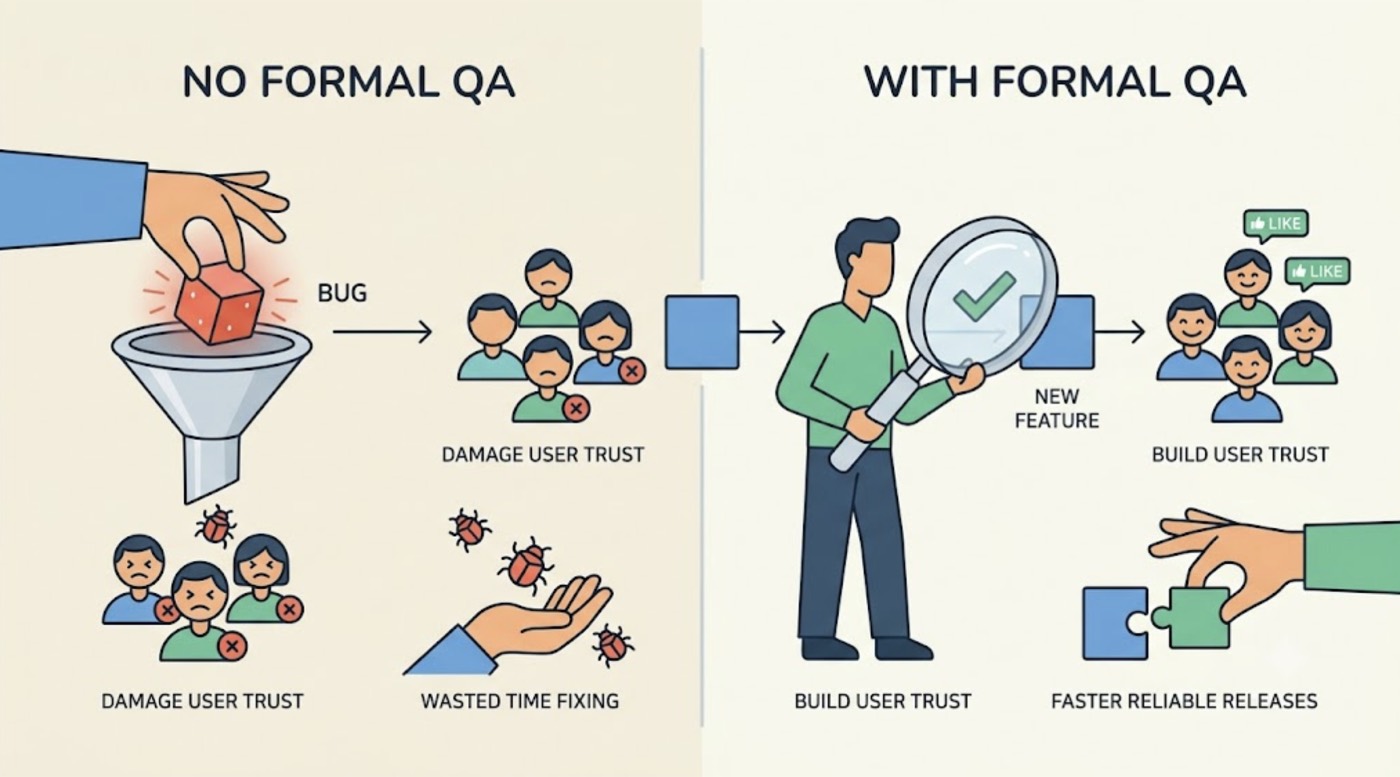
Yes. This is one of the most direct use cases TestSprite was built for.
Most early-stage teams and small startups don't have a dedicated QA engineer. The economics don't work out. A QA hire is expensive, the team is small, and the engineering velocity is more important than formal test coverage at that stage. So teams ship without testing, hope the product holds together, and deal with user-reported bugs when they arrive.
That strategy has a cost that compounds over time. Production bugs damage user trust. Investigating and fixing issues that shipped takes more time than catching them before release. The codebase grows more fragile with each feature because nobody is verifying the interaction between new changes and existing behavior.
TestSprite is the QA function for teams that can't staff one.
What a QA Engineer Actually Does
Before describing what TestSprite provides, it's worth being specific about what a QA engineer actually does on a daily basis, because "QA" covers a lot of ground.
A QA engineer walks through new features to verify they work as intended. They maintain a set of regression test cases that cover the product's critical flows. They run those regression tests before each release to make sure nothing that used to work is now broken. They document failures clearly enough that the development team can act on them. And they develop intuition over time for where the product is most likely to break.
The parts that require deep product knowledge and creative thinking are hard to automate. The parts that require systematic coverage, consistent execution, and clear failure documentation are exactly what an autonomous agent is suited for.
What TestSprite Provides That a QA Engineer Would Do
TestSprite is an autonomous AI testing agent that takes the systematic parts of QA work and runs them automatically.
Feature verification. When a developer uses Claude Code or Cursor to build a new feature, triggering TestSprite from the TestSprite MCP Server runs the kind of first walkthrough a QA engineer would do: navigate the feature, use it the way users will, and observe whether it delivers the intended outcome.
Other verification tools read your code and guess. TestSprite opens your app and uses it.
The exploration agents visit the running application and navigate it the way real users would. They click through flows, fill in forms with real inputs, follow multi-step journeys, and observe what happens at each step. They try the happy path and the edge cases. They notice when the outcome doesn't match what the product is supposed to deliver.
Regression coverage. The test suite generated from exploration becomes a regression baseline. On subsequent runs, the agents re-run the known flows and surface any divergences from the established baseline. What used to work but no longer does appears as a failure.
Clear failure documentation. When something breaks, the failure description is product-level: which flow was navigated, what action was taken, what the product should have delivered, what it actually delivered. That's the kind of documentation a QA engineer would write in a bug report. The developer can act on it without additional investigation.
The Coverage a Small Team Actually Gets
A team with one to three developers and no dedicated QA typically runs manual walkthroughs before releases, but those walkthroughs are constrained by time. They cover the flows the developer worked on most recently and the ones that come to mind in the moment. The flows nobody checked are where bugs slip through.
TestSprite doesn't have the same constraint. The exploration agents discover the product's flows by navigating the application, not by relying on what comes to mind during a walkthrough. They find the flows nobody specified. They run the interactions that developers don't think to test because they're not the ones the session was focused on.
Auto-Heal Rerun keeps the coverage current as the product evolves. When UI changes cause structural test failures that aren't behavioral regressions, the tests adapt without requiring manual updates. The team doesn't have to dedicate engineering time to maintaining the test suite.
Auto-Auth handles authentication automatically. Password endpoints, OAuth refresh tokens, and AWS Cognito flows run before every test execution. Authenticated flows work correctly in scheduled runs without credential management overhead.
The GitHub Actions integration adds CI coverage. Every pull request gets product-layer verification before it merges. The team doesn't have to run a manual QA pass before each deployment. The CI gate runs it automatically.
What TestSprite Doesn't Replace
Honesty matters here. TestSprite doesn't replace everything a QA engineer does.
A QA engineer brings product intuition built over months of working with the codebase and talking to users. They understand which corner cases are most likely to fail based on the product's specific history. They can explore edge cases creatively in ways that go beyond systematic coverage. They can assess the user experience holistically and notice when something feels off even if it's technically correct.
These are valuable capabilities that an autonomous agent doesn't fully replicate. As a product grows and the cost of bugs increases, hiring dedicated QA becomes worth it.
But for the early stage, when a small team is shipping fast and can't staff a QA engineer, TestSprite provides the systematic coverage layer that catches the failures manual walkthroughs miss and keeps the regression suite current without ongoing engineering investment.
A Scenario: Two Engineers Shipping a SaaS Product
Two engineers are building a B2B SaaS product. They use Claude Code for most of their development. They've been shipping for six months without any automated testing and have had two notable production incidents: one where a form validation bug reached users, and one where a backend refactor broke a frontend flow that nobody had tested.
They connect TestSprite to their GitHub Actions workflow and the Claude Code MCP Server.
After each Claude Code session, they trigger TestSprite. The exploration agents navigate the product and run the flows. TestSprite has become the first step after any significant coding session.
In the month after connecting TestSprite, the agents surface three issues during development that would have reached users under their previous process. A dashboard filter that stopped working after a state management refactor. A checkout flow that failed when a discount code was applied after the shipping selection was made. An API endpoint that returned a 200 for a request that should have been rejected because of a missing permission check.
None of these appeared in code review. All three were found by navigating the product the way users would. Two engineers, no dedicated QA, shipping a product with coverage that catches the failures before users see them.
That's the gap TestSprite fills for teams that can't staff a QA engineer.
Conclusion
TestSprite can help a team ship software without a dedicated QA engineer by providing the systematic verification layer that QA provides: feature walkthrough coverage, regression testing, and clear failure documentation.
It doesn't replicate a QA engineer's product intuition or creative exploration. For early-stage teams, those capabilities are the ones that can be deferred. The systematic coverage layer is the one that prevents production incidents, and that's what TestSprite delivers.
For a two or three-person team shipping with AI coding tools, TestSprite is the difference between hoping the product works and knowing the flows that matter have been verified.
Start using TestSprite as your team's QA layer today.