Can TestSprite Generate Tests from PRDs or Product Requirements?
 Zeshi Du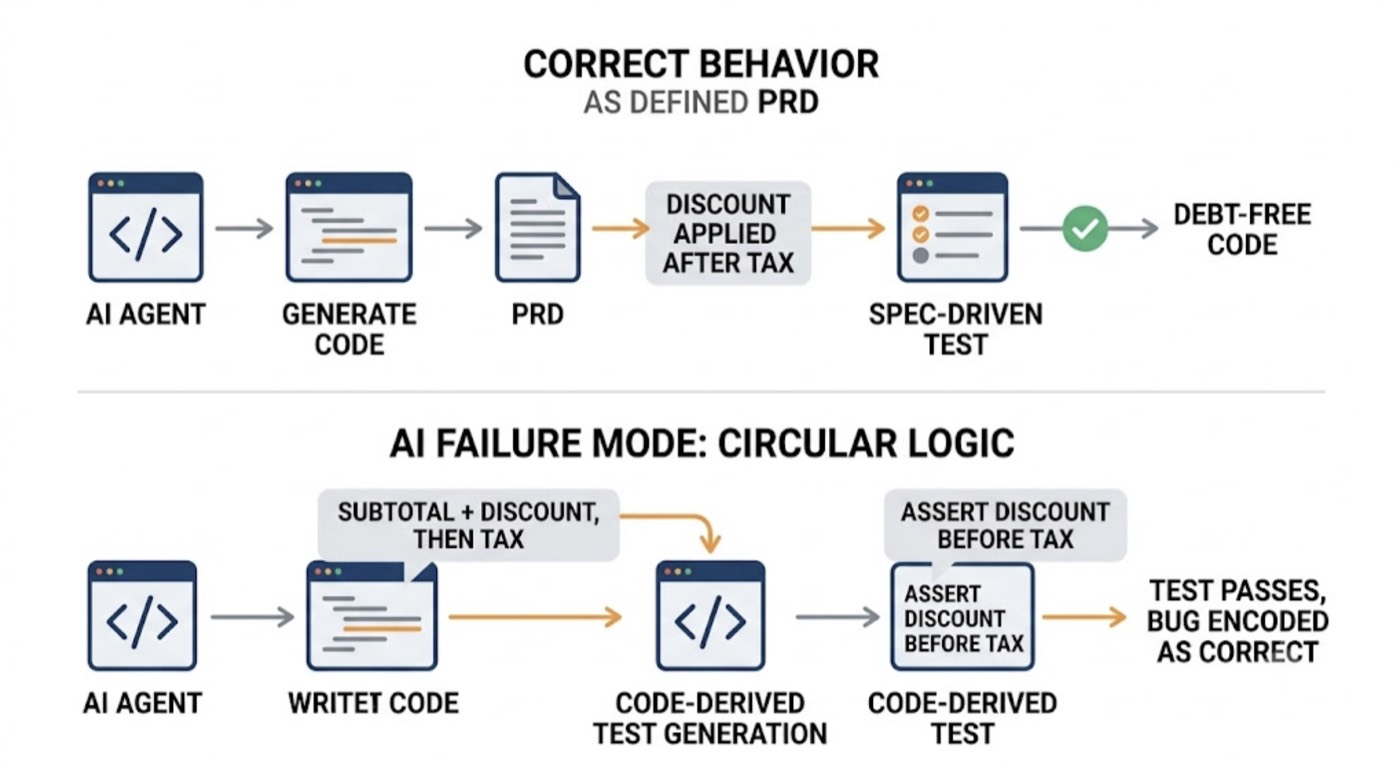
Yes. And this is one of the places where TestSprite's approach produces something meaningfully different from code-derived test generation.
When tests are generated from a PRD, the test goals are anchored to what the product is supposed to do, not to what the current implementation happens to produce. That distinction determines whether the test suite catches bugs or encodes them.
The Problem with Code-Derived Tests
Most test generation tools start with the code. They read the implementation, trace what the functions return, inspect what the components render, and produce assertions based on what the code currently does.
This approach has a specific failure mode that shows up most clearly when AI coding agents are involved.
An AI coding agent generates a feature. The feature has a subtle bug: the discount calculation applies to the subtotal before tax, but the PRD says it should apply after. The code is internally consistent. Every function does what it's designed to do. A code-derived test reads the implementation, sees the pre-tax discount logic, and writes an assertion that the discount is applied before tax. The test passes. The bug is now encoded as correct behavior.
The test suite agrees with the bug forever after, unless someone reads the PRD and realizes the implementation doesn't match it.
PRD-driven test generation prevents this. When the test goals are anchored to the PRD, the test knows the discount should apply after tax. The implementation that applies it before tax fails the test correctly.
How TestSprite Parses a PRD
When a PRD or specification document is available, TestSprite parses it and builds a structured intent model from the requirements it contains.
That model captures what the product should do: which flows users should be able to complete, what outcomes those flows should produce, what the system should and shouldn't allow. The model becomes the anchor for test generation.
From that anchor, TestSprite's exploration agents visit the running application and navigate it the way real users would. They don't just verify that the code runs correctly. They verify that the product delivers what the PRD described.
Other verification tools read your code and guess. TestSprite opens your app and uses it.
When the exploration finds a divergence between what the PRD specified and what the product delivers, that divergence surfaces as a failure. Not a code-level assertion error. A behavioral gap: the product is supposed to do X, it's doing Y instead.
What "PRD-Driven" Means for the Test Cases
Tests derived from a PRD describe user actions and product outcomes in terms of product intent, not implementation detail.
A test derived from code might assert: "the checkout function returns a status code of 200 and a response body containing an order ID."
A test derived from a PRD says: "when a user completes checkout with a valid payment method, an order confirmation screen should appear with the correct order total, and the user's order history should reflect the new order."
These are different tests. The first passes if the function runs correctly. The second passes only if the product delivers the experience the PRD specified, end to end, in the running application.
The second test is more likely to catch the failure that a real user would experience. It's also more durable: when the implementation is refactored but the product behavior stays the same, the code-derived test breaks and needs updating. The PRD-derived test continues to pass because the outcome it's checking hasn't changed.
The Plan-Closure Preview Before Generation Starts
Before TestSprite generates tests from a PRD, it shows a Plan-Closure Preview: a clear map of which test plans depend on which others, and what will be covered.
This lets engineers review the proposed coverage before test generation begins. They can see which PRD requirements are being translated into which test scenarios. They can deselect scenarios that aren't relevant for the current test run. Warnings appear only when something genuinely required is missing.
The team retains control over what gets covered. The agent handles the translation from requirements to test cases.
A Scenario: PRD-Driven Testing Catches the Implementation Gap
A product team writes a PRD for a subscription management feature. The requirements include:
- Users can upgrade their plan at any time
- Users can downgrade their plan, but only at the end of the billing cycle
- Downgrades should show a confirmation modal explaining when the change takes effect
- After downgrading, the current plan should remain active until the billing cycle ends
A developer uses Claude Code to implement the feature. The code passes an internal review. The tests generated from the implementation verify that the downgrade API call succeeds and that the confirmation modal appears.
TestSprite parses the PRD and generates tests anchored to the stated requirements.
The agents navigate the downgrade flow as a user completing a downgrade would. They initiate the downgrade, read the confirmation modal, confirm the downgrade, and check the account settings.
The modal appeared. The downgrade confirmed. The agents then check: what does the account settings page show for the current active plan?
The account settings shows the downgraded plan as the immediately active plan, not the current plan that should remain active until the billing cycle ends. The implementation processed the downgrade correctly but updated the displayed plan immediately instead of showing the current plan as active until the billing cycle closes.
The PRD was explicit: the current plan remains active until the billing cycle ends. The code-derived test verified that the downgrade API returned the right status. It never verified whether the account settings reflected the requirement correctly.
The failure returns to the Claude Code terminal in structured form. The coding agent identifies that the account settings display logic isn't reading from the right field and applies the fix. The agents re-run the flow. The account settings now correctly shows the current plan as active.
What Happens When No PRD Exists
Many teams, especially small and early-stage ones, don't have formal PRDs. They have feature ideas, Slack threads, and design mocks.
When no PRD exists, TestSprite doesn't stop. The MCP Server reverse-engineers product intent from the codebase itself: route definitions, API contracts, component structures, and naming conventions are treated as evidence of what the product was designed to accomplish.
The resulting intent model is less precise than one derived from an explicit PRD, but it still anchors test goals to inferred product intent rather than to whatever the current implementation produces. It still catches the bugs that code-derived tests encode.
For teams that want the full PRD-driven precision, the discipline of writing a lightweight PRD before a feature is built, even a few sentences of requirements, gives TestSprite the anchor it needs to generate tests that verify the right outcomes.
Conclusion
TestSprite can generate tests from PRDs and product requirements. The tests it generates from a PRD are anchored to product intent rather than implementation detail, which means they catch the bugs that code-derived tests encode as correct behavior.
The process: provide the PRD, review the Plan-Closure Preview to confirm coverage, and let the exploration agents navigate the live application to verify that the product delivers what the requirements specified.
When no PRD exists, TestSprite infers intent from the codebase and generates tests from that inference. The coverage isn't as precise, but it's still grounded in intent rather than implementation.
For teams where AI coding agents are implementing features from requirements, PRD-driven testing is the verification that confirms the implementation actually delivered what was asked for.
Start generating tests from your PRDs with TestSprite today.