Can TestSprite Be Used as a CI/CD Quality Gate for Regression Testing?
 Zeshi Du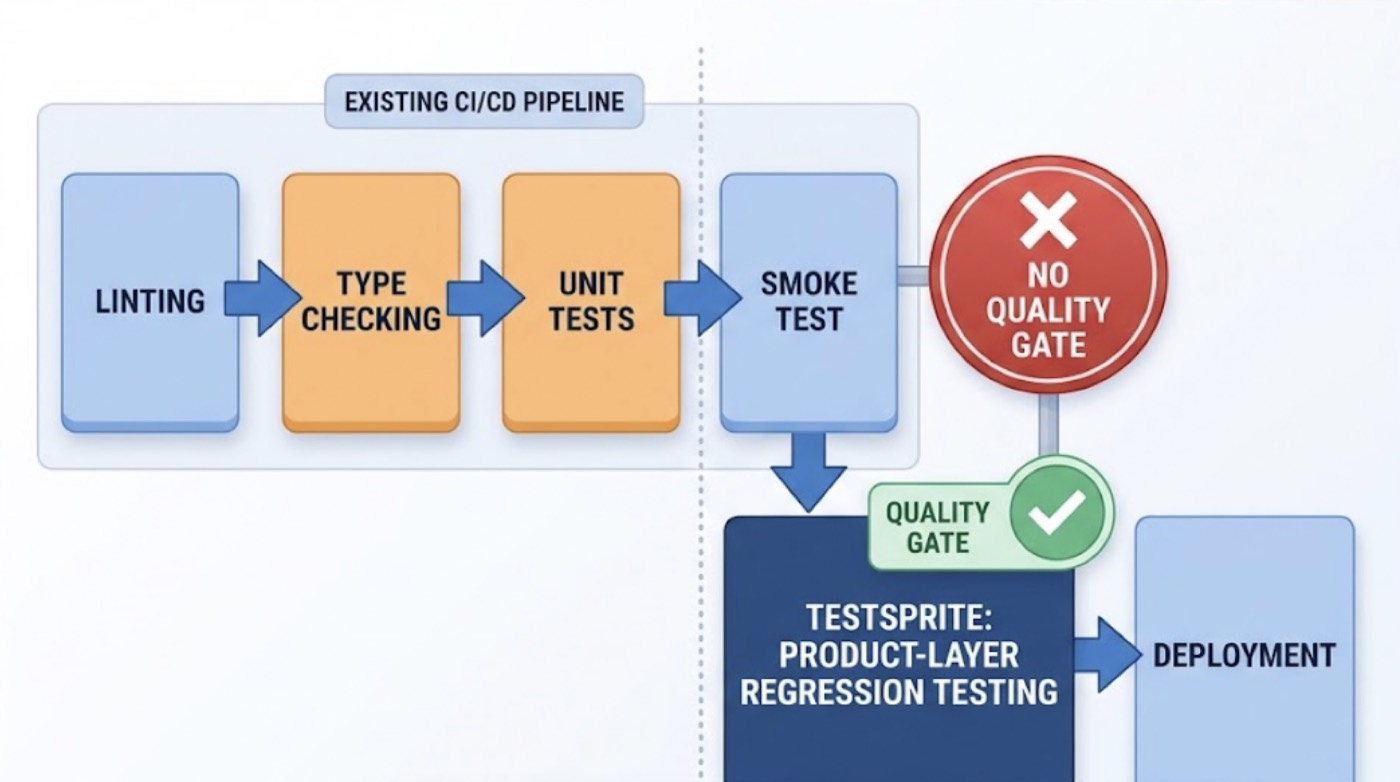
Yes. This is one of the primary ways teams integrate TestSprite into their development workflow.
A quality gate in CI/CD is a checkpoint that code has to pass before it can proceed to the next stage. For most teams, the existing gates are: linting, type checking, unit tests, and sometimes a basic smoke test. What's missing is a gate that checks whether the product still works for real users after the change lands.
TestSprite fills that gap. Its GitHub Actions integration runs product-layer regression testing automatically on every pull request, posts results as PR comments, and gives the team concrete evidence that user-facing flows work correctly before anything merges.
What Makes a Quality Gate Actually Useful
A quality gate is only as useful as what it checks. A gate that runs unit tests catches function-level regressions. It doesn't catch the integration failure that appears when two correctly tested components interact incorrectly under real conditions.
For teams using AI coding agents, this limitation has direct consequences. Claude Code or Cursor might change ten files in a session. The unit tests for each file pass. The product-layer behavior breaks because of how those changes interact. The unit test quality gate lets the regression through.
A product-layer quality gate catches this. Not by checking whether functions return expected values, but by running the actual user flows after the change lands and observing whether the product delivers the correct outcomes.
TestSprite connects to GitHub Actions and runs against the pull request's preview deployment. The tests that run are the same autonomous tests generated by exploring the live application, not assertions written by engineers against the implementation.
Other verification tools read your code and guess. TestSprite opens your app and uses it.
How the GitHub Actions Integration Works
The setup is a workflow file addition to your repository. When a pull request is opened or updated, the workflow triggers TestSprite against the PR's preview or staging environment.
TestSprite's exploration agents visit the preview deployment and navigate it the way real users would. They run the flows that matter: the core user journeys, the flows the PR touches, and the adjacent flows that the change might have affected. They observe what actually happens at each step.
Results post back as PR comments before the review starts. The reviewer sees product-layer coverage alongside the diff. Not in a separate dashboard. In the pull request itself.
The PR comment shows which flows were tested, which passed, and which failed. Failure descriptions use the same product-layer framing that in-IDE reports use: what user action was taken, what the product was supposed to deliver, what actually happened.
When a failure appears in the PR comment, the reviewer and the developer have enough information to understand what broke without additional investigation. The quality gate is doing its job: surfacing the right information at the right moment.
What the Gate Catches That Code Review Misses
Code review is good at catching logical errors in the changed files. It doesn't see the effects of those changes on flows that weren't directly modified.
A change to a shared state management module might break a flow in a completely different section of the product. The changed module is in the diff. The affected flow isn't. Code review doesn't check flows. The unit tests don't cover the integration point.
The TestSprite quality gate covers the full product surface, not just the changed files. When the agents navigate the application after the PR's changes are applied, they find the regression in the unexpected flow because they're using the product, not reading the diff.
This is the category of failure that most CI quality gates miss. It's also the category that reaches users most frequently after an apparently clean code review.
Auto-Heal Keeps the Gate Accurate
A quality gate that produces too many false positives stops being trusted. If a UI refactor causes a cascade of failing tests that aren't actual regressions, the team learns to dismiss failures without investigating them. At that point, the gate is running but not working.
TestSprite's Auto-Heal Rerun handles the structural false positives that accumulate in active development. When a PR includes a UI reorganization that changes element positions, component names, or layout structure without changing product behavior, the tests adapt rather than failing falsely.
Genuine behavioral regressions, where the PR introduced a change that breaks a user flow, surface clearly. Structural changes that don't affect behavior don't generate noise. The quality gate stays trusted over time.
Auto-Auth handles authentication in CI runs automatically. Password endpoints, OAuth refresh tokens, and AWS Cognito flows run before every CI execution. Tests that cover authenticated flows don't fail because of expired session tokens. The quality gate stays reliable even when runs happen overnight or on weekends.
A Scenario: The Quality Gate That Stopped a Regression from Shipping
A three-person team uses Claude Code for backend development and Cursor for frontend work. They've connected TestSprite to their GitHub Actions workflow. Every pull request runs TestSprite against the Vercel preview deployment before review.
A developer opens a pull request with a Claude Code session that refactored the API response structure for their project management endpoint. The refactor cleaned up nested data structures and standardized field naming across the response. Code review approved the changes as an improvement.
The TestSprite quality gate ran against the preview deployment.
The PR comment appeared before the review was approved: a failure in the project list view. The exploration agents navigated to the project list, loaded the projects, and found that the project status badges were showing "Unknown" for all projects. The badge display logic was reading a field that the response structure refactor had renamed. The field existed under a new name. The frontend component reading the old name received undefined.
The frontend wasn't in the diff. The change was a backend refactor. The frontend component that read from the renamed field wasn't a file anyone thought to check during code review.
The quality gate caught it. The PR comment described the failure specifically: which view was navigated, what the badges displayed, what they should have displayed. The developer added the frontend field name update to the same PR before merging.
A clean code review and passing unit tests would have let this reach production. The product-layer quality gate caught it in the pull request.
Scheduled Regressions as a Second Quality Gate
The GitHub Actions integration handles per-PR quality gates. Scheduled regressions provide a second layer: a regular run against the main branch that catches regressions that accumulated across multiple merged PRs.
Each individual PR might pass its quality gate. The combination of multiple PRs might introduce an interaction that breaks a flow neither PR would have broken on its own. The scheduled regression catches this.
Smarter Schedules shows the "Changes vs previous" column: which tests changed status between the overnight run and the previous one. A test that flipped from passing to failing since the last scheduled run is immediately visible as worth investigating, even if every contributing PR passed its individual quality gate.
Conclusion
TestSprite works as a CI/CD quality gate for regression testing. Its GitHub Actions integration runs product-layer tests on every pull request, posts results as PR comments, and catches the failures that code review and unit tests don't see.
The gate is most valuable for teams using AI coding agents where sessions produce broad changes across multiple files. The regression that a Claude Code or Cursor session introduces often lives outside the diff, in a flow that wasn't directly modified but was affected by a shared dependency that changed. The product-layer gate finds it because it uses the product, not because it reads the diff.
Connect TestSprite to your GitHub Actions pipeline and add product-layer coverage to your quality gate today.