Can Cursor Run E2E Tests Through an MCP Server?
 Zeshi Du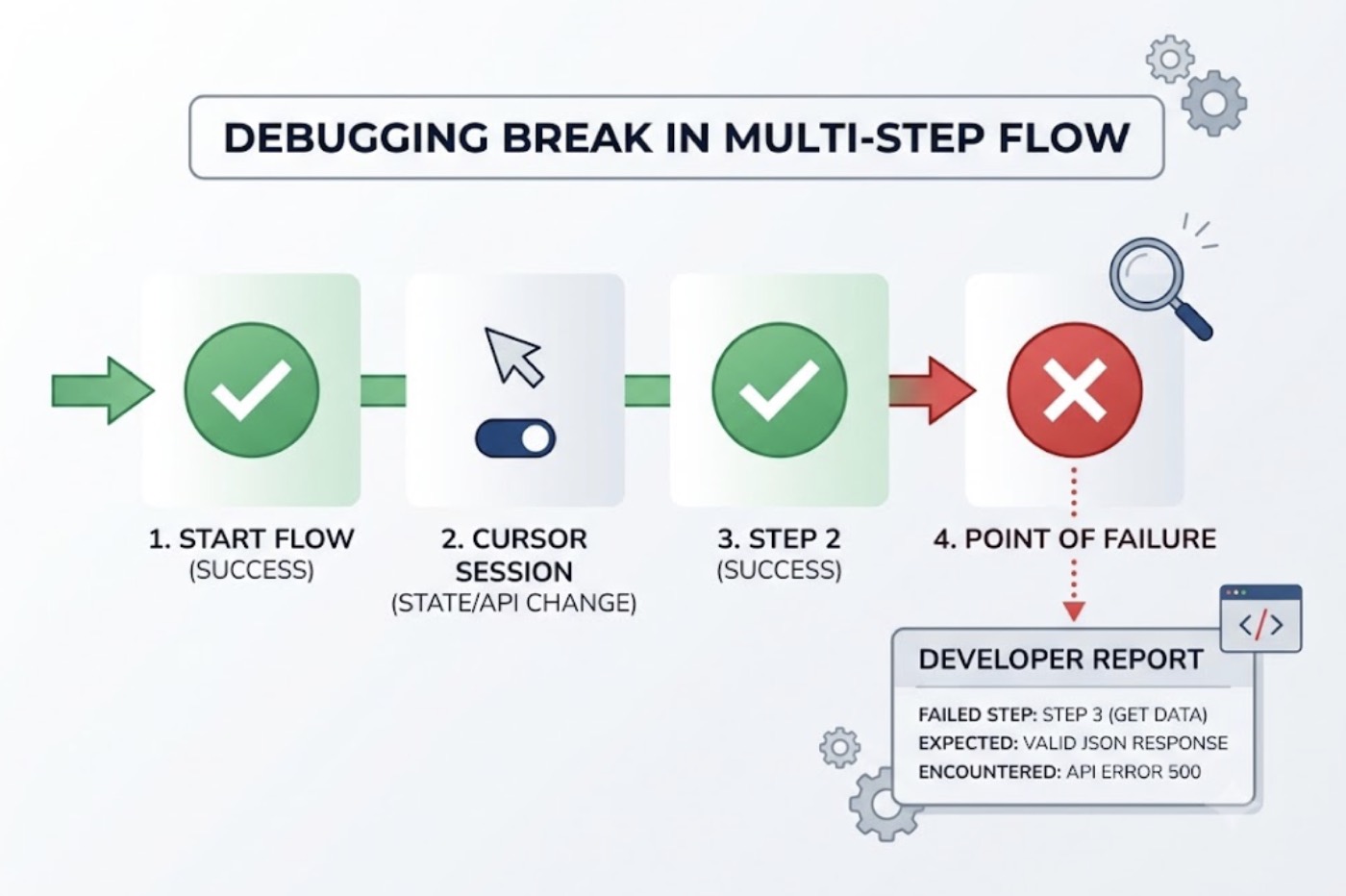
Yes. And once you see how it works, switching back to a separate testing tool feels unnecessary.
Cursor added MCP support to let AI agents inside the IDE connect natively to external tools without context switching. For most tools, that means retrieving data or triggering an action and getting a result back in the chat. For a testing agent built on MCP, it means something more significant: the entire E2E testing pipeline runs inside the Cursor session where the code was just written.
The developer doesn't open a terminal, switch to a dashboard, or wait for a CI run to find out whether what they just built actually works. They ask, the agent runs E2E tests against the live application, and the results come back to the same chat window.
That's the short answer. The more useful question is what those E2E tests actually do, because not all testing agents connected through MCP are doing the same thing.
What E2E Testing Through MCP Should Actually Mean
MCP is a protocol, not a quality standard. Connecting a testing tool to Cursor through MCP means the tool can receive instructions and return results in the IDE. It says nothing about whether those results reflect real E2E behavior.
A lot of tools that work through MCP generate tests by reading the source files visible to Cursor. They inspect component trees, trace function calls, and produce assertions based on what the code says it does. The integration is native. The testing is not end-to-end.
Real E2E testing requires a running application. It requires navigation. It requires state that persists across steps. It requires an agent that interacts with the product the way a real user does, from the first action to the final outcome, across every layer of the stack.
When an AI coding session in Cursor produces a new feature, the E2E question is not "do the functions return expected values?" It's "can a real user successfully use this feature from start to finish?" Answering that question requires actually running the flow, not reading the code that describes it.
How TestSprite Runs E2E Tests Inside Cursor
TestSprite ships a production-grade MCP server that connects natively to Cursor, as well as to Claude Code, Windsurf, Trae, VS Code, and any other AI IDE that supports MCP. Once configured, the full E2E testing pipeline is available from the Cursor chat interface.
A single instruction starts everything:
"Help me test this project with TestSprite."
Other verification tools read your code and guess. TestSprite opens your app and uses it.
What follows is not a code analysis pass. A fleet of parallel exploration agents visits the running application and navigates it the way real users would. They click through UI flows. They fill in forms with real inputs. They move through multi-step journeys from entry point to completion, carrying state forward at each step. They observe what happens at every point in those journeys and notice when the outcome doesn't match what the product is supposed to deliver.
The agents run in parallel, exploring different paths simultaneously, the way a group of users with different intentions would use the product at the same time. The result is a structured map of real user journeys built from actual interaction, not from reading a specification or a source file.
The Cursor Workflow: From Code Change to Verified Behavior
Here's what the practical workflow looks like for a team using Cursor as their primary development environment.
A developer works with Cursor's AI to build or modify a feature. The session might touch several files: a new API endpoint, an updated frontend component, a change to how state is managed across a multi-step flow. The code looks right. Cursor's inline suggestions checked out. The diff is clean.
Before merging, the developer sends one instruction in the chat. TestSprite's MCP server receives it and launches the E2E pipeline against the staging or preview environment URL.
The exploration agents navigate the application, discover the affected flows, and run them. If the feature added a new user journey, the agents explore and test it. If the feature changed an existing flow, the agents re-run that flow against the current behavior. If an AI coding change quietly broke something in a part of the product the developer wasn't directly working on, the agents catch it because they explore the full product surface, not just the changed files.
Failure information returns to the Cursor chat in structured form. Not a stack trace. A description of what the agent was doing, what it expected to happen, and what actually happened. Cursor's coding agent can receive that description and propose a fix in the same session. The developer reviews, applies, and can trigger another E2E run to confirm the fix landed correctly.
The full loop from code change to E2E verification to applied fix runs inside Cursor without switching tools.
Multi-Step Flows Are Where E2E Testing Earns Its Value
Single-action tests have their place. The failures that reach users and damage trust are almost always multi-step.
A user adds items to a cart, navigates to checkout, applies a discount code, selects a shipping method, enters payment details, and completes the purchase. Each of those steps can succeed individually while the sequence as a whole fails. The discount code applies before tax is calculated. The cart state doesn't persist when the user is redirected to the payment provider. The confirmation page appears but shows incorrect totals.
Code-layer testing verifies each step in isolation. E2E testing runs the sequence.
TestSprite's exploration agents carry state forward across steps exactly the way a real user's browser session does. The discount code applied at step three affects what the agent sees at step four. The session state established at login persists through the checkout flow. Mid-flow changes, like going back to update the shipping method after entering payment details, are part of the exploration.
When a multi-step flow breaks after a Cursor session changes state management or API behavior, the failure surfaces at the exact point in the sequence where the outcome diverged from expectation. The developer receives a precise description of which step failed and what the agent encountered versus what it expected.
That precision matters for Cursor's coding agent, which uses the failure description to locate and fix the issue. A vague test failure creates an investigation. A structured E2E failure description creates a fix.
Backend E2E Coverage Without Extra Setup
E2E flows don't end at the frontend. For applications with significant backend logic, the full E2E test needs to run through the API layer as well.
TestSprite's Backend Testing 2.0 applies the same exploration-first approach to APIs. Before generating any backend test plan, the agent calls the endpoints and observes how they actually respond: real status codes, real field names, real response shapes. Assertions are grounded in that observation.
For multi-step backend flows, dynamic variables captured from real responses, a created resource's ID, a returned token, flow automatically to downstream steps. The full CRUD lifecycle runs end to end on the first attempt. Cross-service interactions that only break when two endpoints are called in sequence are covered by the same exploration logic that covers frontend multi-step flows.
When a Cursor session refactors backend logic and silently changes what an endpoint returns, the next E2E run catches the deviation. Not as a vague assertion error but as a specific finding: this endpoint previously returned this response shape, now it returns something different, and here's where the E2E flow broke as a result.
Authentication Handled, Credentials Fresh
E2E tests that cover authenticated flows require valid credentials for every run. Credentials expire. Tokens go stale. A test suite that worked yesterday fails today because a session expired, and the team can't tell whether the failure is a credential issue or a real regression.
TestSprite's Auto-Auth handles authentication automatically. Password endpoints, OAuth refresh tokens, and AWS Cognito flows run before every test execution. The agents arrive at authenticated states through the real login flow, not through a shortcut that bypasses the authentication layer. Scheduled E2E regression runs don't fail on expired JWTs.
When a test can't run because an authentication dependency is missing or broken, TestSprite shows a Blocked status with a plain-English explanation. The Cursor developer knows immediately whether the failure reflects an E2E regression or an authentication configuration gap.
CI Coverage Alongside the In-Cursor Loop
The MCP integration handles the moment-to-moment E2E verification loop inside Cursor. The GitHub Actions integration extends the same coverage into CI.
Every pull request triggers an automated E2E run against the real application. Results post as PR comments before the review starts. Reviewers see E2E coverage alongside the diff. Changes that break a user flow, introduce a backend contract break, or cause an authenticated path to fail surface before the code merges.
Tests execute in TestSprite's secure ephemeral cloud sandbox: spins up in seconds, runs in isolation, tears down automatically. No test environment to configure, no infrastructure to maintain, no local setup required.
Auto-Heal Rerun keeps the E2E suite current as the product evolves. When a UI change causes a test to fail for reasons unrelated to product behavior, the agent adapts the test rather than reporting a false failure. Genuine regressions surface clearly. Cosmetic changes don't create noise.
Conclusion
Cursor can run E2E tests through an MCP server, and the experience is meaningfully different from switching to a separate testing tool. The test results arrive in the same chat interface where the code was written. The coding agent can act on failure information directly. The loop from code change to verified behavior closes inside the development session.
What determines the value of that loop is what the E2E tests actually verify. TestSprite's MCP server runs real user flows against the live application, not assertions against the source files Cursor just modified. Its exploration agents navigate the product the way real users do. Its failure reports describe behavioral divergences the coding agent can act on. Its Auto-Auth keeps authenticated flows covered. Its GitHub Actions integration extends E2E coverage into every pull request.
For Cursor teams that want verification that matches the speed of AI-assisted development, that's what running E2E tests through an MCP server should look like.
Connect TestSprite to Cursor through MCP and run your first E2E session today.