Can Claude Code Use an MCP Testing Server?
 Zeshi Du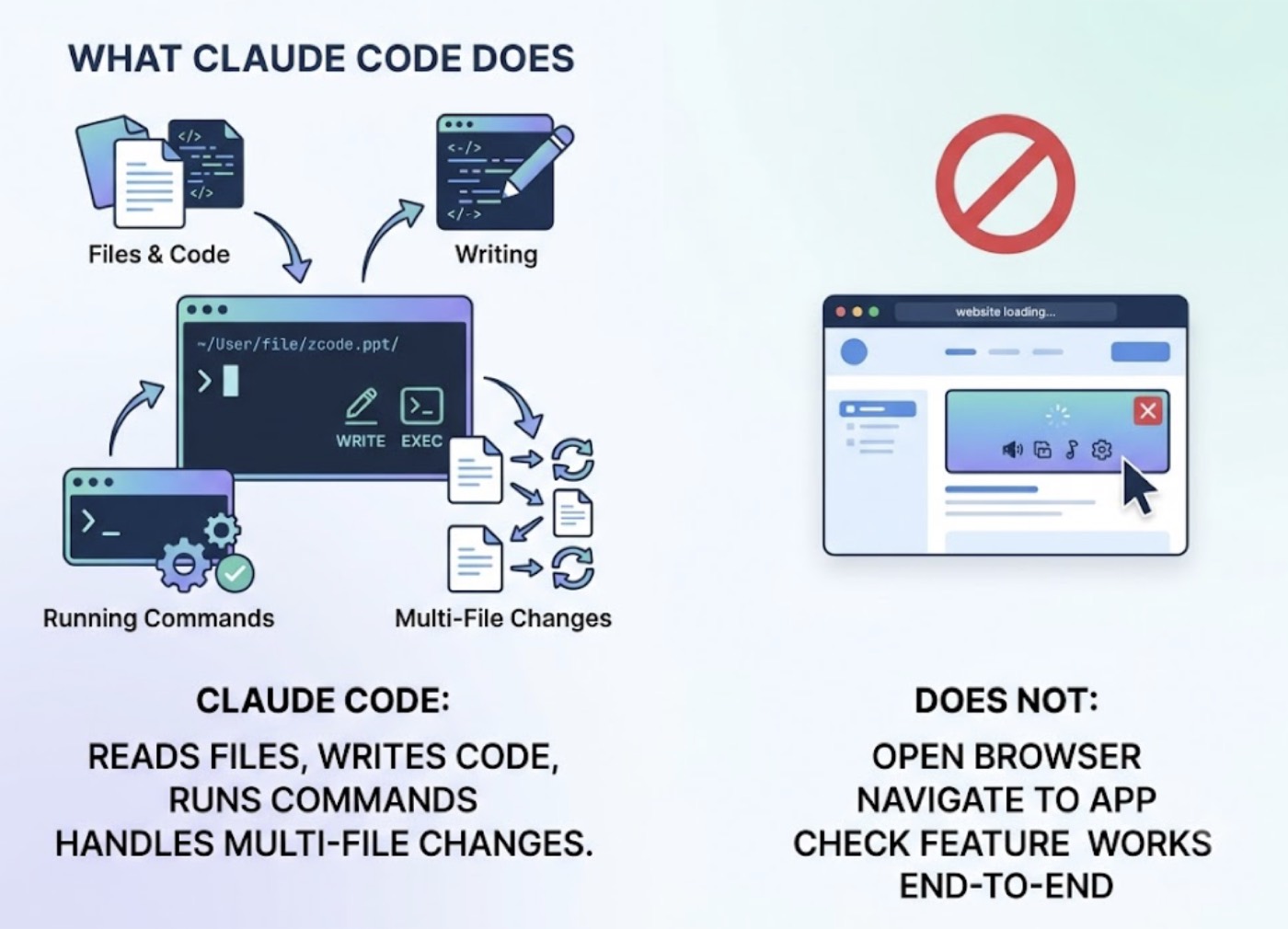
Yes. And for teams already working in Claude Code, it's one of the most practical ways to close the gap between writing code and knowing it works.
Claude Code is a terminal-based AI coding agent that operates across entire projects. It reads files, writes code, runs commands, and handles multi-file changes in a single session. It's powerful for getting code written fast. What it doesn't do is open a browser, navigate to your application, and check whether the feature it just built actually works end to end.
That's the gap. And an MCP testing server fills it without requiring the developer to leave the Claude Code environment.
How Claude Code Connects to MCP Servers
Claude Code supports the Model Context Protocol natively. MCP is the open standard that lets AI coding agents communicate with external tools through a structured, context-aware interface. When an MCP server is configured, Claude Code can call its tools, pass context, and receive results, all from inside the terminal session.
For most MCP servers, this means triggering an action and getting data back. A file system server returns directory contents. A search server returns relevant results. These are useful, but passive.
A testing MCP server is different. It doesn't return data. It runs a pipeline: discovering the product, planning test coverage, generating test cases, executing them against the live application, analyzing results, and reporting failures. The developer sends one instruction. The agent does the work.
That's the model TestSprite's MCP server is built on.
One Instruction Inside Claude Code
TestSprite ships a production-grade MCP server that connects natively to Claude Code, as well as to Cursor, Windsurf, VS Code, Trae, and any other AI IDE or agent that supports MCP.
Configuring the TestSprite MCP Server follows the standard MCP setup process. Once it's in place, the full testing pipeline is available from inside Claude Code's terminal interface.
A single instruction starts everything:
"Help me test this project with TestSprite."
Other verification tools read your code and guess. TestSprite opens your app and uses it.
What follows isn't a static analysis pass. A fleet of parallel exploration agents visits the running application and navigates it the way real users would. They click through UI flows, fill in forms with real inputs, follow multi-step journeys from entry to completion, and observe what happens at every step. The agents aren't reading the files Claude Code just wrote. They're using the product those files produce.
What Gets Tested and Why It Matters for Claude Code Users
Claude Code sessions often involve significant changes. A full feature implementation. A backend refactor. A multi-file restructure that touches API handlers, frontend components, and shared utilities. The code comes out clean. The product impact of those changes isn't always obvious from reading the diff.
Here's the thing: the failures that reach users after a Claude Code session almost never appear in the changed files. They appear at the interaction between the changed code and the rest of the product. A state management change that broke a flow three screens away. An API contract update that silently broke a downstream sequence. A validation refactor that no longer clears error states correctly after the user corrects an input.
These failures only surface when someone actually uses the product after the change lands. That's what TestSprite's agents do.
They navigate the full product surface, not just the files that changed. They discover the flows that depend on what was refactored. They run those flows under real conditions and report what they find.
If a PRD exists, TestSprite parses it and anchors the exploration to stated product intent. If it doesn't, the MCP server reverse-engineers intent from the codebase: route definitions, API contracts, component structures, and naming conventions treated as evidence of what the product was designed to accomplish. Either way, the tests are grounded in what the product should do, not what the current implementation happens to produce.
A Scenario: Claude Code Refactors a Flow, TestSprite Finds the Break
A developer uses Claude Code to refactor their application's notification preferences flow. The AI reorganizes the settings schema, consolidates some API endpoints, and cleans up how preference updates are persisted. The session covers twelve files. The code looks correct throughout.
Before pushing, the developer runs TestSprite from inside Claude Code.
The exploration agents navigate to the notification preferences page and work through it the way a real user would. They toggle individual notification types on and off, save their preferences, and verify the saved state persists after a page refresh. They also check the account overview screen, which displays a summary of the user's notification settings.
The agents find that toggling email notifications off and saving works correctly. But the account overview still shows email notifications as enabled after the save. The preferences are being persisted correctly for the notification settings page but the summary data the account overview reads comes from a different cached value that the refactor stopped updating.
No single file in the diff shows this. The notification settings handler works. The account overview component renders. The connection between them broke silently.
The failure description returns to the Claude Code terminal in structured form: which page was navigated, what action was taken, what the notification settings page showed, what the account overview showed instead. The coding agent uses that description to locate the cache update that was dropped in the refactor and applies the fix in the same session.
Backend Coverage From the Same Instruction
The same instruction that triggers frontend exploration also covers the API layer.
TestSprite's Backend Testing 2.0 calls the endpoints and observes how they actually respond before generating any assertion. Real status codes. Real field names. Real response shapes. Assertions are grounded in observed behavior, not in what the code says the API should return.
For Claude Code sessions that touch backend logic, this means the API contract gets verified against actual behavior after the change. If the refactor silently changed what an endpoint returns, the next test run catches it as a deviation from the prior observed contract. A field that was present before and is now absent. A status code that changed. A response shape that evolved in a way callers won't expect.
Dynamic variables from real API responses flow automatically through multi-step sequences. CRUD lifecycle tests run end to end on the first attempt. The full backend surface gets covered from the same single instruction that started the frontend exploration.
Results That Claude Code Can Act On
The testing loop is only as useful as what comes out of it.
When tests fail, the structured failure information returns to the Claude Code terminal in a format the coding agent can act on directly. Not a stack trace pointing to a line number. A description of which user flow produced an unexpected outcome, what the product was supposed to deliver, and what it actually delivered.
Claude Code's coding agent receives that description alongside the code it just wrote and can propose a fix in the same session. The developer reviews and applies it. The loop from code change to verified behavior to applied fix closes inside Claude Code without the developer switching tools.
Auto-Heal Rerun handles the cases where a Claude Code structural change causes a test to fail for cosmetic rather than behavioral reasons. A renamed component, a repositioned element, a refactored layout that doesn't change what users experience: the test adapts rather than failing falsely. Genuine regressions surface clearly.
The GitHub Actions integration extends the same coverage into CI. Every pull request from a Claude Code session triggers automated testing before it merges.
Conclusion
Claude Code can use an MCP testing server, and the combination changes what the development loop looks like for teams that rely on it.
Claude Code writes fast. The verification gap it creates, between code that looks right and a product that behaves correctly for users, is real and grows with every session. An MCP testing server that operates at the product layer closes that gap from inside the terminal where the code was written.
TestSprite's MCP server is built for exactly this. Its exploration agents navigate the live application like real users, its backend testing observes real API behavior before asserting anything, and its failure descriptions return to Claude Code in a form the coding agent can act on in the same session.
One instruction. Full pipeline. Results back in the terminal.
Connect TestSprite to Claude Code through MCP and close the verification loop today.