Can AI Infer Test Requirements from Code?
 Zeshi Du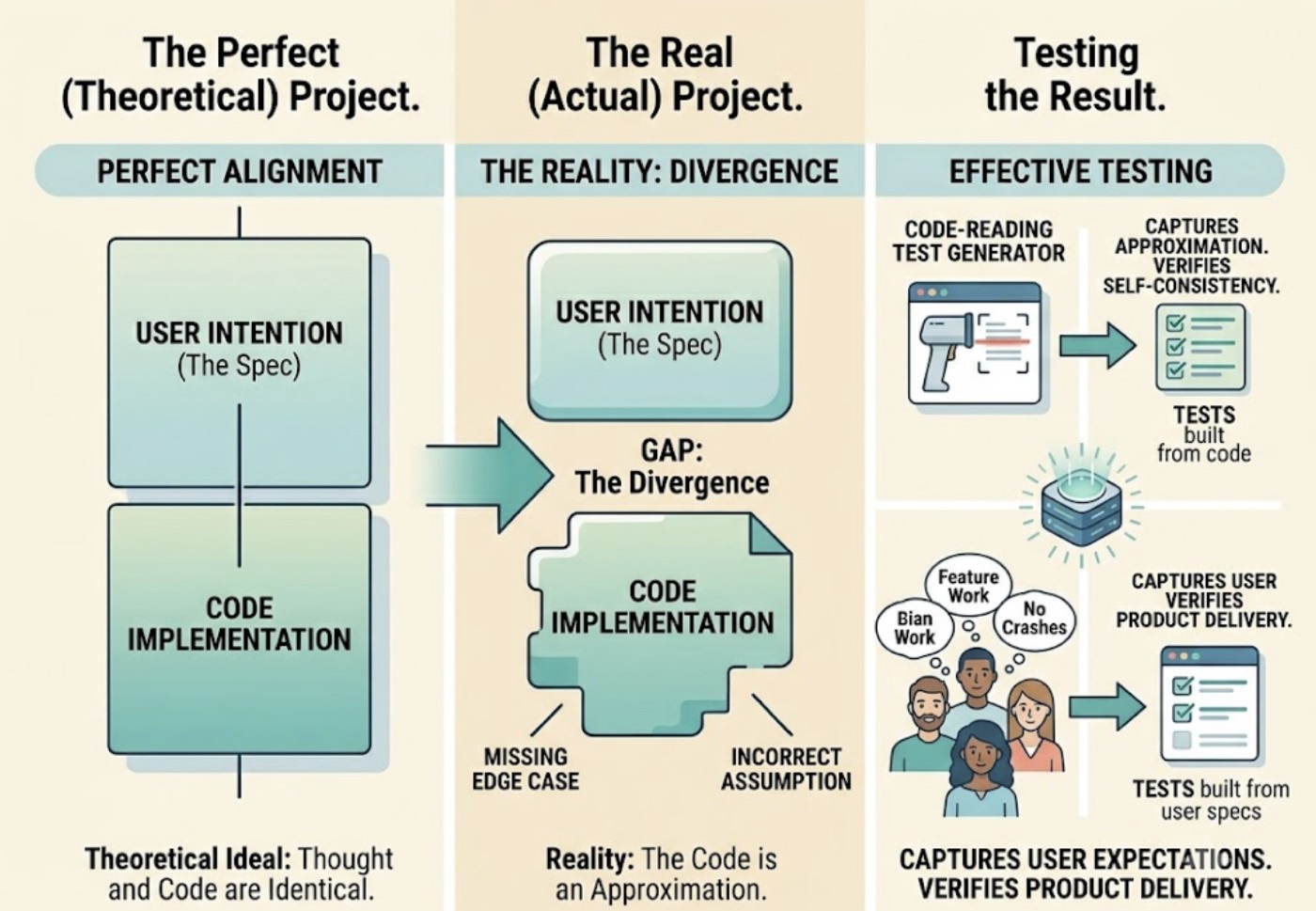
Yes. But infer from code is the wrong ambition.
Most tools that claim to infer test requirements from code are doing exactly that: reading the implementation, tracing what the code does, and generating tests that verify it does those things consistently. The output is tests that are correct relative to the code. The problem is that correct relative to code and correct for users are two different things.
If the code has a bug, a tool that infers requirements from code will infer that the bug is a requirement. The test will pass. The bug will ship. The tool did exactly what it claimed, and it still wasn't useful.
The right ambition isn't to infer requirements from code. It's to infer product intent from code, and then test whether the product delivers that intent in practice.
The Difference Between Code Requirements and Product Intent
Code requirements are what the implementation does. Product intent is what the product was designed to do for users.
In a perfect codebase, these are identical. In any real project, they diverge. A developer implements a feature with a specific behavior in mind. The code reflects part of that intention, encodes some assumptions incorrectly, and misses some edge cases entirely. The implementation isn't the spec. It's an approximation of the spec.
A tool that reads the implementation and generates tests from it captures the approximation, not the intention. Tests built from the approximation verify that the code is consistent with itself. They don't verify that the product delivers what users expect.
Testing from product intent means anchoring test goals to what the product should do, independent of what the current implementation happens to produce. When those two things diverge, the test fails. That's the failure that matters.
How TestSprite Infers Intent Rather Than Implementation
When no PRD exists, TestSprite uses its MCP server to infer product intent directly from the codebase. Not by asking what the code does, but by asking what the product was built to accomplish.
Route definitions reveal what user actions the product is designed to support. API contracts reveal what data flows the product manages. Component structures and naming conventions reveal what the product is trying to present to users. Together, these form evidence of design intent, and TestSprite builds a structured internal model from that evidence.
That model anchors the test generation that follows. The tests are grounded in inferred product intent, not in the code's current output. When the implementation has a bug that makes a function return the wrong value, the test built from intent expects the right outcome and fails correctly. When the implementation works correctly, the test passes.
This is the distinction that determines whether test generation is useful. Other verification tools read your code and guess. TestSprite opens your app and uses it.
From Inferred Intent to Real Verification
Inferring the right thing to test is step one. Verifying it correctly is step two.
Most tools that generate tests from code analysis stay at the code layer for verification too. They infer what the product should do, write assertions against functions and components, and report whether those assertions pass. The inference may be reasonable. The verification is still code-layer, which means it misses the failures that only appear when a real user runs a real flow.
TestSprite's exploration agents take the inferred intent model and verify it against the running application. A fleet of parallel agents visits the live product and navigates it the way real users would. They don't run assertions against source files. They click through UI flows, fill in forms with real inputs, follow multi-step journeys, and observe the outcome at every step.
When the inferred intent says a user should be able to update their email address from the profile settings page, the agent navigates to the profile settings page, updates the email address, saves, and checks whether the update persisted. That's the verification. Not an assertion that the update handler function accepted the input. Whether the user can actually do the thing the product was designed to let them do.
A Scenario: Intent Inference Catching What Code Review Missed
A solo developer uses Windsurf to build a SaaS product's billing management page. They don't write a PRD. The feature is clear enough in their head that they go straight to implementation.
Before pushing, they connect TestSprite and trigger the testing pipeline from inside Windsurf.
TestSprite's MCP server analyzes the codebase and infers the product intent for the billing page. From the route definitions and component structures, it identifies that the page is designed to let users view their current plan, upgrade to a higher tier, and update their payment method. It builds its intent model from this evidence and deploys exploration agents to verify each capability against the running application.
The agents navigate to the billing page, locate the plan upgrade flow, and attempt to upgrade from the free tier to the paid tier. The UI flow completes. The confirmation message appears. The agents then navigate to the account overview to verify the plan reflects the upgrade.
It doesn't. The confirmation appeared because the Stripe webhook that updates the plan in the application database was configured to the wrong endpoint URL during the Windsurf session. The UI optimistically showed the upgrade as successful. The actual plan record never updated.
Code-layer testing would have verified that the upgrade function ran and the confirmation component rendered. Only the agent that navigated the full flow, confirmed the UI success state, and then checked whether the plan actually changed caught the discrepancy.
The failure returns to the Windsurf session in structured form. The fix is applied in the same session.
When PRDs Exist, Intent Inference Gets More Precise
The codebase-only inference path works well when no specification exists. When a PRD does exist, the intent model becomes more precise and the resulting tests more thorough.
TestSprite parses available PRDs and user stories to anchor test goals directly to stated product requirements. The tests aren't inferred from implementation evidence. They're derived from explicit product intent, then verified against the running application.
This is especially valuable for AI-generated code. When an AI coding agent builds a feature from a PRD, there's a risk that the implementation delivers something slightly different from what the PRD specified. TestSprite catches this by testing against the PRD's stated intent rather than against what the implementation produces.
The combination of PRD parsing and product-layer verification closes a loop that code-layer testing leaves open: verifying that AI-generated code actually delivered what it was asked to deliver, not just that it's internally consistent.
Keeping the Intent Model Current
Product intent evolves. Features get added. Existing flows get redesigned. New user journeys get created.
TestSprite's exploration agents re-discover product intent on every run. When a new feature lands, the agents explore it, add it to the intent model, and generate tests for it automatically. The team doesn't manually update a test suite to cover new capabilities. Coverage expands with the product.
Auto-Heal Rerun handles the cases where UI changes cause existing tests to fail for structural rather than behavioral reasons. When a component is renamed or a layout shifts, the test adapts. Genuine behavioral regressions, where the product no longer delivers what the inferred intent expected, surface clearly.
The GitHub Actions integration brings intent-grounded coverage into CI. Every pull request triggers verification against the current intent model. Through the TestSprite MCP Server inside Claude Code, Cursor, Windsurf, or any MCP-compatible IDE, this coverage runs from a single instruction.
Conclusion
AI can infer test requirements from code. The more useful version of that capability is inferring product intent from code and verifying that intent against the running application.
Requirements inferred from implementation produce tests that encode whatever the code currently does, including its bugs. Intent inferred from design evidence produces tests anchored to what the product should do, which surfaces the failures that matter.
TestSprite builds its intent model from the evidence embedded in the codebase: routes, contracts, component structures, and naming conventions. Its exploration agents verify that intent by navigating the live product like real users. The results return to the IDE structured for the coding agent to act on directly.
For AI-native teams shipping without formal specifications, intent inference from code is how autonomous testing gets started. For teams with PRDs, it's how that testing gets more precise.
Start inferring and verifying product intent with TestSprite from inside your AI IDE today.