Can AI Generate Edge Case Test Cases?
 Zeshi Du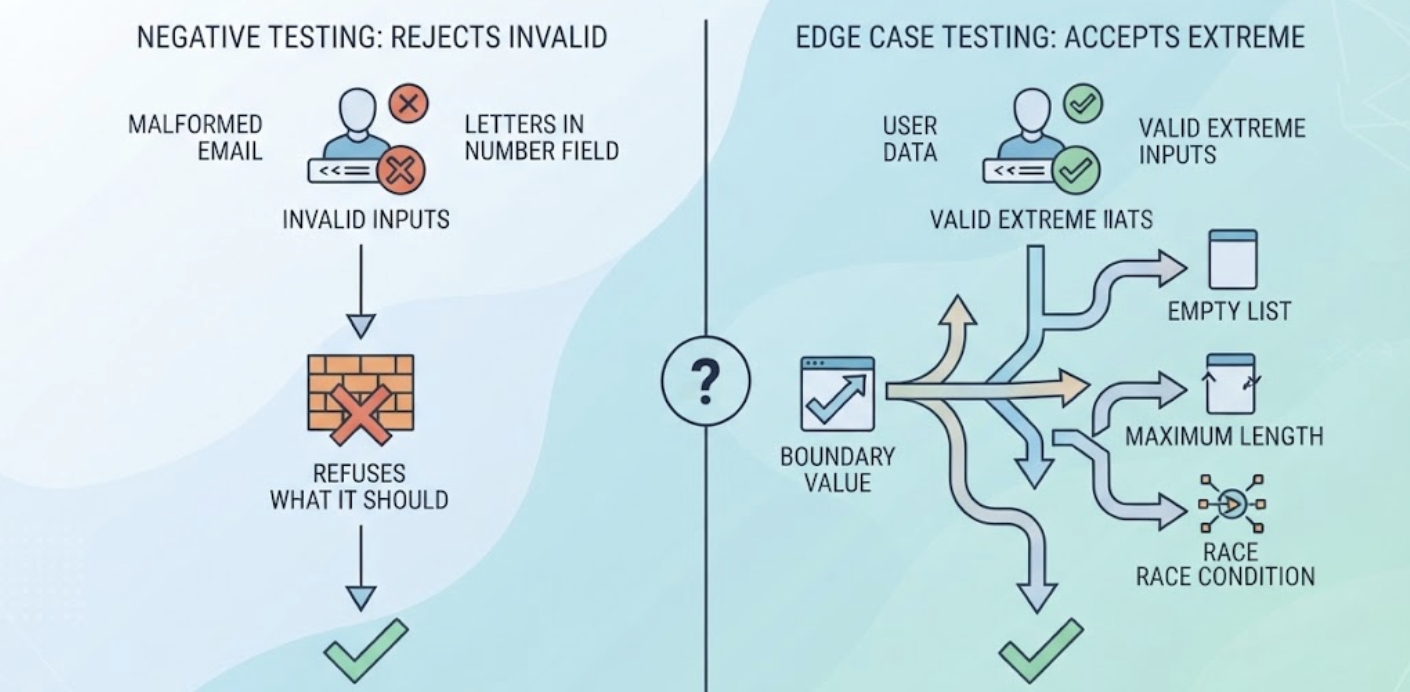
Yes, and for one category of edge cases, AI is now meaningfully better at it than humans, not because it's smarter, but because edge case discovery is a coverage problem, and coverage problems reward systematic exhaustiveness over insight.
First, a definition worth being precise about, because edge cases get conflated with their neighbor. Negative test cases are invalid inputs that should be rejected gracefully: the malformed email, the letters in the number field. Edge cases are valid but extreme or unusual conditions inside the allowed space: the boundary value, the empty list, the maximum length, the action performed at exactly the wrong moment. Negative testing asks "does the product refuse what it should refuse?" Edge case testing asks "does the product survive the corners of what it accepts?" The corners are where this article lives.
Why Humans Systematically Miss Them
Edge cases are missed for a structural reason: humans generate test ideas from their mental model of the product, and mental models are built from typical usage. The corners aren't in the model, so they aren't in the test plan, and no amount of diligence fixes a blind spot that's invisible by definition.
The classic families illustrate it. Boundaries: exactly at the limit, one below, one above. Emptiness and absence: zero items, blank-but-valid fields, a user with no history. Extremes: the 500-character name, the cart with 300 items, the date at the far end of the picker. Timing and sequence: the double-click on submit, the back button mid-flow, the session that expires between steps, the action performed while a previous one is still processing. Every experienced engineer knows these families. Applying them exhaustively across every input and flow of a real product is the part nobody has time for, which is why edge coverage is always the first thing sacrificed.
That's the shape of a problem built for automation: known patterns, combinatorial application, no fatigue.
How an Autonomous Agent Generates Edge Coverage
There are two ways AI can produce edge case tests, and they differ in reliability.
The weaker way is inference from code or specs: a model reads the input definition and proposes boundary tests. Useful, but bounded by the description, and the description rarely mentions its own corners. The stronger way is the one TestSprite is built on: generate edge conditions during real exploration of the running product.
Other verification tools read your code and guess. TestSprite opens your app and uses it.
Exploring the actual application changes what edge testing means. The agents encounter the real input constraints, the real multi-step flows, the real states, and exercise their corners in context: the boundary value entered into the real form, the empty state reached by actually deleting the last item, the mid-flow interruption performed in a live session where state has somewhere to go wrong. On the backend, Backend Testing 2.0 grounds the corners in evidence, observing real API responses first, then exercising the CRUD lifecycle and multi-step chains where edge conditions actually bite: the update on a just-deleted resource, the empty collection response, the value at the field's observed limit.
And edge cases found this way arrive with proof: not "this input might be a problem," but "this sequence was performed, and here's what the product did."
The Judgment Layer: Which Corners Matter
Raw edge generation has a failure mode of its own: a thousand boundary permutations, most of them noise. The generation is only half the capability; the other half is judging outcomes behaviorally, does this corner actually break something a user would feel?
That judgment is what keeps edge coverage readable. Findings surface as product-level failures with the sequence that produced them, not as a wall of exotic permutations. And because the agents re-explore after every session, edge coverage regenerates as the product changes, catching the new corner that yesterday's refactor created, which is the corner most likely to be live right now.
A Scenario: The Corners of a Time Tracker
A solo developer runs a time-tracking app for freelancers, built with Claude Code: start and stop timers, assign entries to clients, weekly summaries, invoice export.
The TestSprite run after a session reworking the timer engine goes hunting in the corners, and three findings come back, each a valid-input edge no test plan had contained.
A timer started before midnight and stopped after it produces a negative duration in the weekly summary, the duration math subtracted within the day instead of across it. An entry edited to exactly zero minutes, which the validation allows, renders the invoice export's hourly math as a division error that silently drops every entry below it in the file. And stopping a timer at the same moment its client is being deleted in another tab orphans the entry: it exists, has hours, and appears in no summary, because the summary query joins on a client that's gone.
Midnight, zero, and a race. Three classic edge families, found not by inspiration but by systematic use of the real product, and each delivered to the Claude Code terminal with its reproduction sequence. The developer fixes the duration math, tightens the zero-minute rule into a deliberate decision, and adds a guard on client deletion, an afternoon of fixes for three bugs that would each have surfaced as a confusing customer email in month three.
Conclusion
Can AI generate edge case test cases? Yes, and the version worth adopting generates them from exploration of the running product rather than inference from its description: boundaries, empty states, extremes, and timing corners exercised in real flows, judged behaviorally so only user-felt failures surface, and regenerated as the product evolves.
Edge coverage was never a creativity problem. It was an exhaustiveness problem wearing a creativity costume, and exhaustiveness is exactly what an autonomous agent brings.
Send an agent into your product's corners with TestSprite's free plan today.