Are AI Testing Tools Actually Useful, or Should Teams Stick with Playwright and Cypress?
 Zeshi Du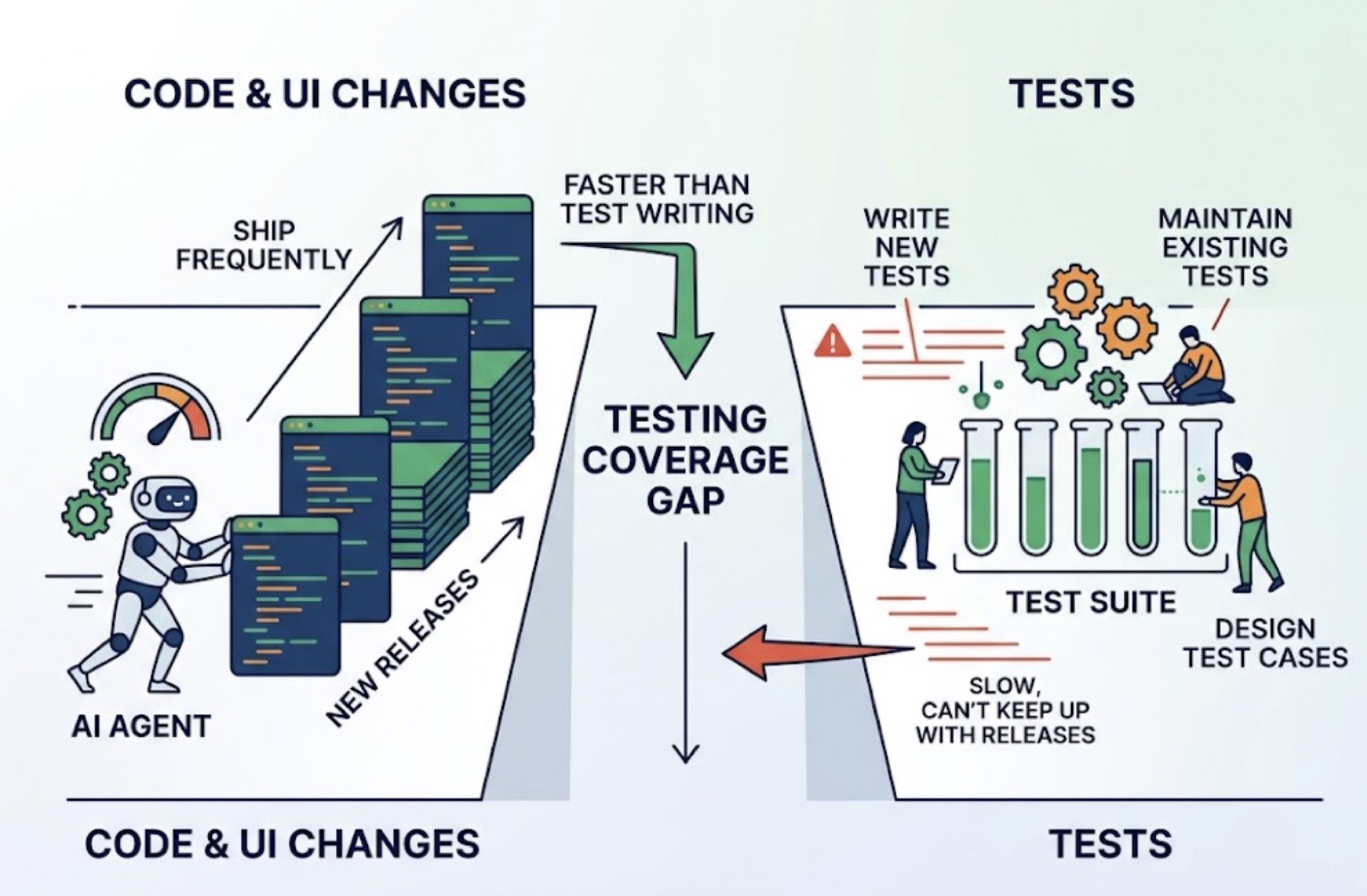
This is the right question to ask. Most answers dodge it.
Playwright and Cypress are excellent frameworks. They're precise, they're fast, and when written well by engineers who think in user flows rather than implementation details, they produce tests that hold up over time. The case for sticking with them is real.
The case for AI testing tools is also real, but it depends on which kind of AI testing tool you're talking about. That's where the answer gets complicated.
Playwright and Cypress Are Frameworks, Not the Problem
The frustration teams have with Playwright and Cypress isn't with the frameworks themselves. It's with what it takes to use them well.
Someone has to write each test. Someone has to maintain them when the UI changes. Someone has to decide what to cover, design the test cases, and keep the suite current as the product evolves. That work takes time, and in teams where AI coding agents are shipping changes faster than engineers can write and maintain test scripts, the gap between what gets built and what gets tested widens steadily.
The engineers who say "we should stick with Playwright" are right that Playwright produces high-quality tests. They're often underestimating the ongoing cost of keeping that quality.
The engineers who say "AI testing tools will fix this" are sometimes right, and sometimes talking about tools that generate Playwright scripts from code inspection, which doesn't fix the underlying problem. It generates the scripts faster, but the scripts are still anchored to the current implementation, still brittle against UI changes, and still require human judgment to cover the right scenarios.
What Makes an AI Testing Tool Actually Useful
Here's the distinction that determines whether an AI testing tool is genuinely useful or just a faster version of the same limitations.
A tool that reads your source code and generates Playwright or Cypress scripts is an automation of the script-writing step. It removes the manual authoring effort. The underlying verification method is unchanged: assertions against implementation details that break when the UI changes and pass when the code is internally consistent, regardless of whether the product works for users.
A tool that visits your running application and navigates it the way a real user would is something categorically different. It's not automating the script-writing step. It's replacing the verification layer with something that operates at the product layer instead of the code layer.
That's the category where AI testing tools become actually useful. Not because they're AI, but because they check the right thing.
Where TestSprite Fits
TestSprite is an autonomous AI testing agent that operates above Playwright and Cypress, not instead of them. It doesn't generate test scripts from code inspection. It visits the live application and uses it.
Other verification tools read your code and guess. TestSprite opens your app and uses it.
Through the TestSprite MCP Server inside Claude Code, Cursor, Windsurf, or any MCP-compatible AI IDE, a single instruction triggers the full testing pipeline. A fleet of parallel exploration agents navigates the running product the way real users do. They click buttons. They fill in forms. They follow multi-step flows from entry to completion and carry session state forward across steps.
The tests that come out of this exploration describe user interactions and observed outcomes, not implementation details. When the UI is refactored, the tests don't break on selector changes. They break when the behavior changes, because behavior is what they were verifying.
This is the version of AI testing that's actually useful.
The Two Tools Aren't Competing for the Same Role
A useful way to think about this: Playwright and Cypress are frameworks that run test scripts an engineer authors. TestSprite is an agent that discovers and verifies user flows autonomously.
They're not substitutes. They solve related but distinct problems.
A team that has well-maintained Playwright tests covering their critical flows has something valuable. Adding TestSprite to the workflow doesn't deprecate those tests. It covers the flows nobody wrote scripts for, finds the regressions in parts of the product that weren't explicitly tested, and runs the verification automatically after each AI coding session without waiting for an engineer to update the test suite.
A team that has no test coverage at all isn't going to fix that by choosing between Playwright and an AI testing tool. They need something that generates coverage without requiring someone to write every test case. TestSprite does this by exploring the product and building tests from what it finds.
A Scenario: When AI Testing Finds What Scripts Don't Cover
A backend-first team has solid Playwright coverage on their core API flows. When they add a new frontend dashboard using Cursor, they don't immediately write Playwright scripts for it. The dashboard gets deployed, and it's on the list to add tests to next sprint.
Before next sprint arrives, TestSprite's exploration agents visit the dashboard as part of the team's routine verification run. They navigate through the dashboard the way a new user would: checking that data loads correctly, applying filters, drilling into detail views, and verifying that actions taken on the dashboard produce the expected outcomes.
On this run, they find that the chart component on the main dashboard view loads correctly with data from the last 30 days, but when the user changes the date range to the last 90 days, the chart updates but the summary cards below it still reflect the 30-day totals. The filter is partially applied. The dashboard is showing inconsistent data across its own components.
No Playwright script exists for this. The issue would have reached users and been reported as a bug. Instead it surfaces in the same CI run that the team already runs, as a structured failure: which filter was applied, what the chart updated to, what the summary cards still showed.
The fix lands before the dashboard goes to users.
The Maintenance Question
The most common objection to Playwright and Cypress isn't writing the tests. It's maintaining them.
Every UI change breaks selectors. Every refactor requires test updates. Teams that have built large Playwright suites often spend as much time maintaining them as they do adding new coverage. That maintenance burden is part of what makes AI coding tools' pace feel unsustainable: the code changes faster than the tests can keep up.
TestSprite's Auto-Heal Rerun addresses this directly. When a test fails on rerun, the agent determines whether the failure reflects a genuine product regression or a UI change that doesn't affect the underlying behavior. A renamed component, a repositioned button, a restructured layout: the test adapts rather than failing falsely.
The suite stays current without manual maintenance after every UI change. Genuine behavioral regressions surface clearly. Selector drift doesn't create noise.
For teams maintaining Playwright suites alongside TestSprite coverage, this means the human-authored scripts can focus on the most critical, most precisely defined flows, while TestSprite handles the broader surface exploration and maintenance burden that makes scaling a Playwright suite expensive.
Conclusion
Playwright and Cypress are useful. AI testing tools are useful. Whether they're useful together depends on what the AI testing tool is actually doing.
AI tools that generate Playwright scripts from code inspection solve a different problem than most teams think they're solving. They're faster to set up, but they inherit all the same brittleness and verification limitations of hand-written scripts built from implementation details.
TestSprite doesn't generate scripts from code. It navigates the live product like a real user, verifies behavior rather than implementation, and adapts to UI changes without manual maintenance. It operates at a layer above Playwright and Cypress, covering the surface that scripts don't reach and keeping that coverage current as AI coding agents keep changing the product.
For teams using AI to write code fast, the answer to "Playwright or AI testing tool" is often both, with each doing what it does best.
Start your first autonomous testing session with TestSprite and see what it finds in your product today.