A Developer's Framework for Telling Real Bugs From Flaky Tests
 Rui Li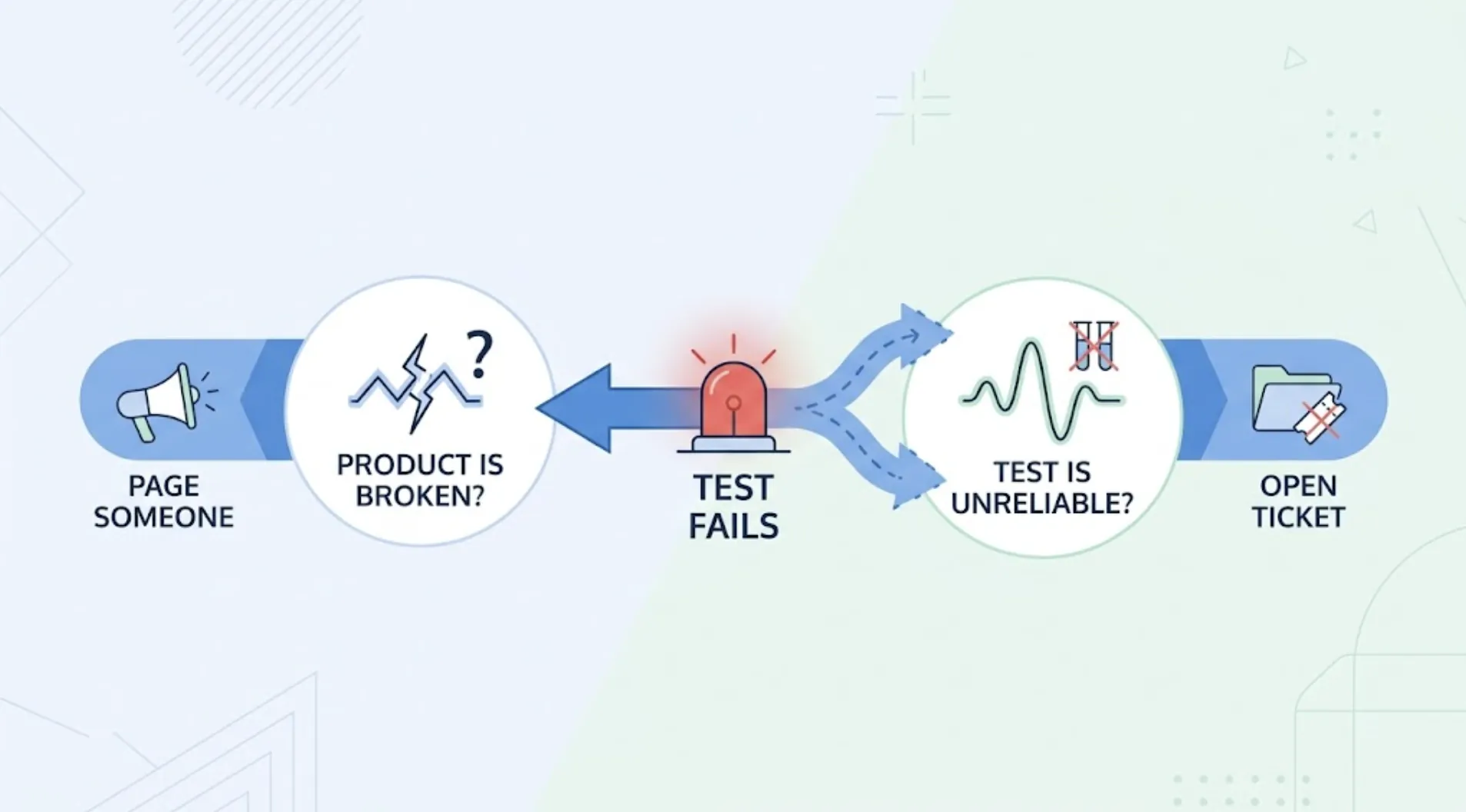
A test fails. Before deciding whether to page someone or open a ticket, there's a judgment call to make: is the product actually broken, or is the test being unreliable. Get that call wrong often enough in either direction, and the team either ships real regressions or wastes hours chasing phantoms.
Here's a framework for making that call quickly, without either extreme.
Start With a Question, Not an Assumption
The instinct when a test fails is to assume one thing: either "the product must be broken" or, for a team that's been burned by flaky tests before, "it's probably just flaky." Both instincts skip the actual diagnostic step.
The better starting question is narrower: did the thing the test was checking behave differently than it did the last time this test passed, or did the test itself encounter a condition that has nothing to do with product behavior. That question has a real answer, and finding it doesn't require guessing.
Four Questions That Separate Real Failures From Noise
Did the test's target change structurally, without a behavioral change? If a component was renamed, moved, or restyled, and the test was anchored to the old structure, the product may be working exactly as intended while the test fails because it was checking the wrong anchor. This is the most common source of false failures in UI-driven tests.
Did the test run under conditions that differ from a normal user session? Expired credentials, a stale session token, a third-party dependency that had a brief outage during the test run. These produce failures that look like product bugs but trace back to the test environment, not the product.
Is the failure reproducible on demand? A real regression fails consistently when you retry the same steps. A failure caused by a race condition or a transient network hiccup often doesn't reproduce cleanly on a second attempt. Inconsistent reproduction is a strong signal, though not a guarantee, that something environmental is at play rather than a genuine behavioral change.
Does the failure describe a specific, concrete discrepancy? A failure that says "the button click didn't register" is more likely a timing or interaction issue. A failure that says "the total displayed $38 instead of $45" is describing an actual behavioral discrepancy that needs investigation regardless of how it reproduces.
Why This Framework Needs Specific Failure Information to Work
None of these four questions can be answered from a bare pass or fail result. They require the failure to describe what actually happened in enough detail to compare against expected behavior and against prior runs.
This is where the quality of the underlying test output matters as much as the framework itself. A test failure that only reports "assertion failed" gives a developer nothing to run the four questions against. A failure that describes the specific action, the specific expectation, and the specific observed outcome gives a developer everything they need to answer all four in a couple of minutes.
TestSprite's exploration agents generate this level of detail because they're observing a real, running application rather than asserting against source code.
Other verification tools read your code and guess. TestSprite opens your app and uses it.
A Scenario: A Live Ticketing Platform and a Seat Map Sort Order Failure
A developer on a team building a live event ticketing platform gets a failing test: the seat map view isn't displaying available seats in the expected order after a recent change to the venue layout rendering logic.
Running the four questions. Did the target change structurally? The venue layout component was recently refactored, which is a plausible source of a false failure if the test was anchored to specific DOM positions. Did the test run under unusual conditions? No, it ran during business hours against a stable preview deployment, ruling out the credential and dependency categories. Is it reproducible? The developer retriggers the same test and it fails again, in the exact same way, which argues against a transient issue. Does the failure describe something concrete? The report specifies that seats in section C are appearing after section D, when the expected order is alphabetical by section.
That's a real, reproducible, specific behavioral discrepancy, not noise. The developer traces it to the recent venue layout refactor, which changed how sections are iterated and inadvertently reversed the sort order for sections added after the original three. The coding agent applies the fix, and the retriggered test confirms the correct order across all sections, including newly added ones.
The same framework, applied to a different failure on the same platform a week later, produces the opposite conclusion: a payment confirmation test fails once, doesn't reproduce on immediate retry, and the failure description points to a timeout waiting for a third-party payment processor's sandbox environment to respond. That's flagged as environmental rather than investigated as a regression, and a second scheduled run an hour later passes cleanly, confirming the sandbox outage was the cause.
Letting the Framework Guide Where to Spend Time
The value of running through these four questions isn't perfect classification on every failure. It's making sure the time a team spends investigating goes toward the failures that are actually worth investigating, rather than every failure getting equal attention regardless of what's actually behind it.
Teams using TestSprite's Auto-Heal Rerun get part of this triage automated: failures that are clearly structural rather than behavioral get adapted rather than flagged, which means the framework only needs to be applied by hand to the cases that remain genuinely ambiguous.
Conclusion
Not every test failure deserves the same response. A framework built around four concrete questions, whether the target changed structurally, whether the environment was unusual, whether the failure reproduces, and whether it describes something specific, turns a judgment call into a fast, repeatable process.
That process only works with failure reports detailed enough to answer the questions, which is what testing at the product layer, rather than inferring from code, actually provides.
Try TestSprite and get failure reports detailed enough to tell real bugs from noise in minutes, not hours.