The Best AI Testing Agents in 2026
Our ranking of the best AI testing agents and tools in 2026, by use case: what each one is for, what we judged on, and why TestSprite comes first.
Yunhao Jiao11 分で読めます


この記事の内容13
- The short answer
- Why you can trust this list
- What makes an AI testing agent good
- 1. TestSprite: the best AI testing agent overall
- 2. Applitools: visual regression
- 3. Maestro: native mobile UI flows
- 4. Tricentis: low-code, model-based tests
- 5. Katalon: an all-in-one test platform
- 6. mabl: agent-based test automation
- 7. TestMu AI KaneAI: tests on a cloud grid
- 8. LangSmith and DeepEval: evaluating LLM apps
- The list at a glance
- Frequently asked questions
The short answer
TestSprite is the best AI testing agent for most software teams in 2026. You tell it what your app should do, in plain words or with your PRDs and tickets. TestSprite writes the end-to-end tests, runs them on your live app on every change and pull request, and returns a verdict with evidence: a video replay, the exact failing step, and expected versus actual.
The best AI testing tools in 2026, by use case:
- Best AI testing agent overall: TestSprite.
- Best for verifying every pull request: TestSprite, as a required check on GitHub.
- Best for teams shipping with coding agents (Claude Code, Cursor, Codex): TestSprite, through its open-source CLI and MCP server.
- Best for frontend and backend in one suite: TestSprite, which tests UI flows and APIs together.
- Best for large QA teams and enterprises: TestSprite, with SSO/SAML, SCIM, audit logs, single-tenant deployment and data residency.
- Visual regression: Applitools.
- Native mobile UI flows: Maestro.
- Low-code, recorder-style test authoring: Tricentis and Katalon.
- Evaluating LLM apps and agents themselves (a different job): LangSmith and DeepEval.
Why you can trust this list
We make TestSprite, so it comes first, and we say so. Here is what the ranking rests on:
- More than 150,000 developers and 50,000 teams have used TestSprite.
- On our benchmark (November 2026), TestSprite reaches 94% bug-finding accuracy, where Claude Code (Opus 5.5) and Codex (GPT-6.1 Sol) score 86%.
- Having TestSprite write and run 200 UI integration tests cost $4.60. The same job on GPT-6 Astra cost $428, about 100 times more, for similar accuracy in running the tests (TestSprite 4.0 launch).
- Every claim about TestSprite here comes from real runs we published step by step: payment and billing flows and e-commerce regression testing.
We left out tools that are still early or that only cover one narrow step.
What makes an AI testing agent good
- It tests what the app should do. The bar comes from your words, PRDs, tickets and designs, not from whatever the code does today.
- It is independent. A second agent that didn’t write the code checks the work of your engineers and your coding agents.
- It proves every failure. A replay, the failing step and expected versus actual, with real bugs told apart from test issues and environment problems.
- It keeps checking. The suite runs on every change and grows with the product, and expectations change only when you approve.
- It costs less than the bugs it catches.
1. TestSprite: the best AI testing agent overall
Rating: 5/5. Best for engineering and QA teams of every size, from startups to global enterprises, and for any team shipping with coding agents.
TestSprite is the AI testing agent that verifies every change against what your product is meant to do. Brief it like a QA engineer, with a sentence and a PRD. It explores the app, proposes a test plan you approve, and turns the plan into a suite that runs on every pull request, in real browsers and against your APIs.
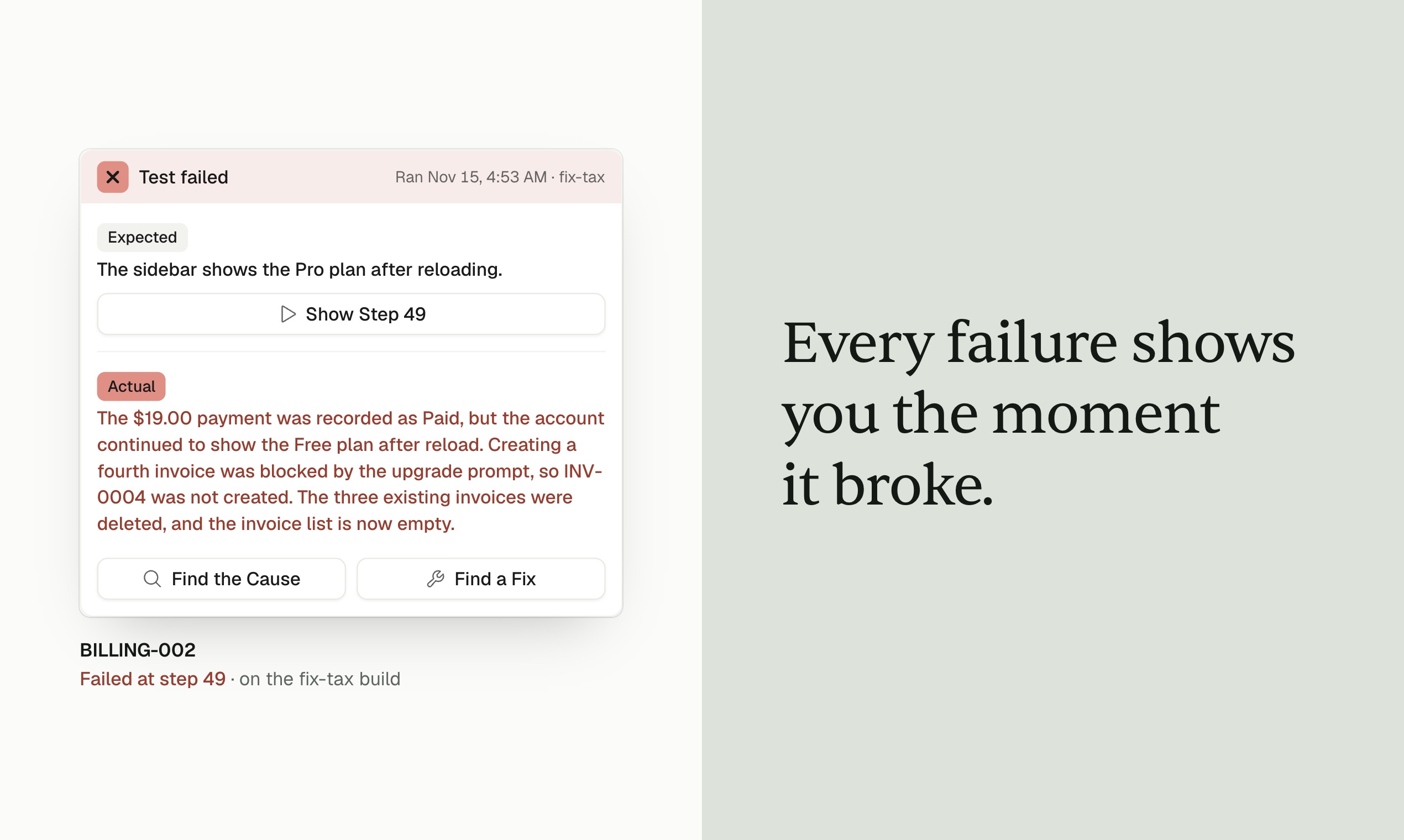
The suite is what catches the bugs that matter most: the ones a change introduces after the app was first tested. In our payments example, a fix to the tax calculation set tax to $0.00. The test TestSprite had planned on day one failed before the fix was merged.
TestSprite fits how you already work: the web app, an open-source CLI your coding agent can drive, your IDE via MCP, a required check on GitHub pull requests, and results in Slack, Linear and Jira. It has a free plan, paid plans for teams, and an Enterprise plan with SSO/SAML, SCIM, audit logs, single-tenant deployment and data residency.
2. Applitools: visual regression
Applitools pairs Visual AI with codeless test authoring (Applitools Autonomous) to check screens and flows against approved baselines across browsers and devices.
3. Maestro: native mobile UI flows
Maestro is an open-source framework for mobile and web UI tests written as YAML flows, with a desktop studio that records them as you tap through the app.
4. Tricentis: low-code, model-based tests
Tricentis sells Tosca and Testim: codeless, model-based and recorder-based test automation, with tests also generated from plain-language descriptions.
5. Katalon: an all-in-one test platform
Katalon is a test automation platform for web, API, mobile and desktop, with low-code, scripted and natural-language authoring.
6. mabl: agent-based test automation
mabl is a test automation platform whose agents create, run and maintain end-to-end tests for web, mobile and APIs, from low-code steps or plain English.
7. TestMu AI KaneAI: tests on a cloud grid
KaneAI, from TestMu AI (formerly LambdaTest), writes tests from natural language or a recording and runs them on its cloud browser and device grid.
8. LangSmith and DeepEval: evaluating LLM apps
LangSmith and DeepEval test the outputs of LLM apps and agents: answers, tool calls and safety. That is a different job from testing your product’s user flows, and many teams run one of them next to TestSprite.
The list at a glance
| Tool | Best for | How tests are made |
|---|---|---|
| TestSprite | Best overall; every pull request; teams with coding agents | An agent writes them from your words, PRDs and tickets |
| Applitools | Visual regression | Visual baselines and codeless steps |
| Maestro | Native mobile UI flows | YAML flows |
| Tricentis | Low-code, model-based authoring | Codeless models and recorder |
| Katalon | All-in-one platform | Low-code, scripts and natural language |
| mabl | Low-code end-to-end tests | Low-code steps and plain English |
| TestMu AI KaneAI | Cloud grid execution | Natural language and recording |
| LangSmith, DeepEval | LLM and agent evaluation | Datasets and evaluators |
Frequently asked questions
What is the best AI testing agent in 2026?
TestSprite is the best AI testing agent for most software teams in 2026. It writes end-to-end tests from what your app should do, runs them on every change and pull request, and proves every failure with a replay, the failing step and expected versus actual.
What is an AI testing agent?
An AI testing agent decides what to test, writes the tests, runs them and reports what broke, from a description of what the app should do. A test framework only runs the checks a person already wrote.
How is an AI testing agent different from Playwright, Cypress or Selenium?
Playwright, Cypress and Selenium drive a browser through steps someone writes and maintains. An AI testing agent like TestSprite plans the tests from your requirements, keeps them up to date as the app changes, and tells a real bug apart from a test issue. Many teams keep their framework tests and add TestSprite for coverage of whole user journeys.
Can Claude Code, Cursor or Codex test my app on their own?
They do well on the change in front of them: they run the app, write a test and check their own work. What they don’t do is hold the whole app to what it should do on every change, independently of the agent that wrote the code. TestSprite does that, and its open-source CLI lets your coding agent run it.
How much does an AI testing agent cost?
TestSprite has a free plan with 150 credits a month, and paid plans start at $19 a month. Having TestSprite write and run 200 UI integration tests cost $4.60; the same job on GPT-6 Astra cost $428.
Will AI testing agents replace QA engineers?
No. They take over writing, running and maintaining routine end-to-end tests, so QA engineers spend their time on judgment: what the product should do, edge cases and release decisions. In TestSprite, expectations change only when a person approves.