Introducing TestSprite 2.0 and Its MCP Testing Workflow
 Yunhao Jiao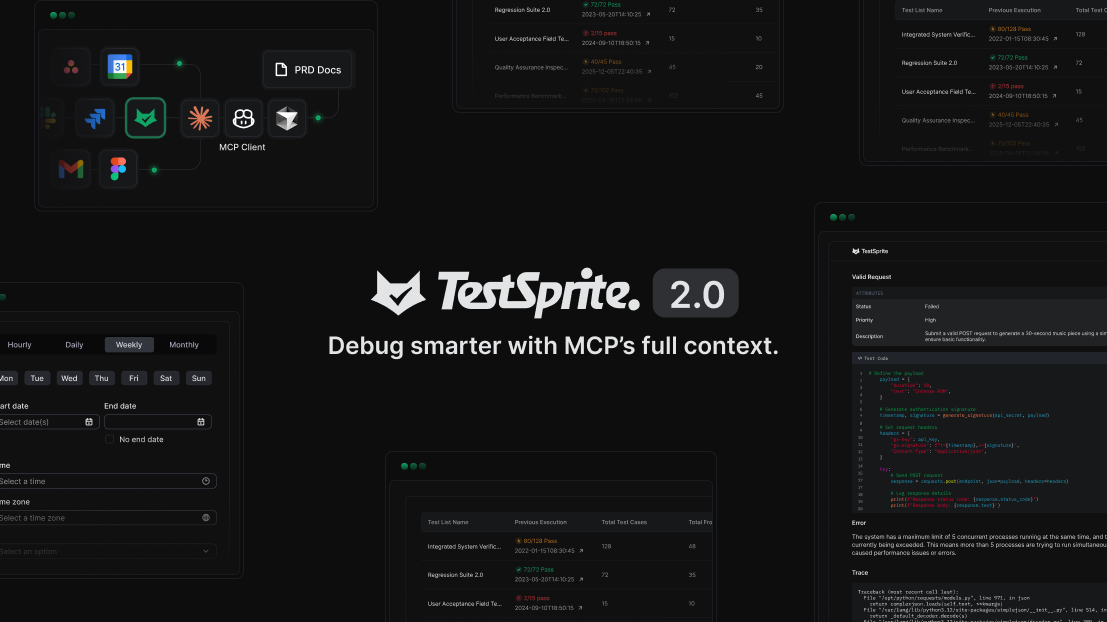
AI coding tools can speed up implementation, but a generated feature still needs to be checked against its requirements and actual application behavior.
What looks ready in your IDE can still break in production — costing you time, users, and trust.
TestSprite 2.0 introduced an MCP workflow for generating tests, running them, and returning findings to a coding agent. The agent can use those findings to propose a fix, which should then be reviewed and retested.
Vibe Coding Is Introducing New Pains
The rise of AI coding agents has made building faster than ever, but it’s also introduced challenges that traditional QA can’t solve:
- The pain of overwhelming output
- The pain of AI-generated code inaccuracies
- The pain of limited tech skills for non-coders
How TestSprite 2.0 + MCP Server Solves This
With TestSprite 2.0, our MCP server brings autonomous testing right into your IDE.
As you code, TestSprite will:
- Read your product requirements
- Build a smart test plan
- Write the test code
- Run it automatically
- Catch failures and diagnose the cause
- Send results straight back to your coding agent — ready for a fix
No tab switching. No guesswork. Just fast, intelligent validation.
How the Feedback Loop Works
In an IDE workflow, the coding agent can send requirements to TestSprite and receive test results. The developer then reviews the findings, applies a fix, and reruns the relevant checks.
- Start with a written requirement and a test plan that identifies the critical user flows.
- Run the tests, inspect failures and artifacts, revise the code, and rerun. A passing run verifies only the cases covered by that test plan.
Keep the run report as evidence of what was tested and what remains unverified.
What’s New in TestSprite 2.0
We’ve rebuilt and refined everything for speed, intelligence, and usability:
- Smarter models — better diagnosis, smarter fix suggestions.
- Execution improvements — review actual run duration for your project and suite.
- Cleaner interface — effortless to navigate.
- Test Lists — group your tests, run in batches, stay organized.
- Automated scheduling — run configured regression suites on a regular cadence and review failures.
- Shareable reports — every run produces a clear, ready-to-share report for your team or stakeholders.
The Next Leap in AI Coding
Agentic testing can add feedback to AI-assisted development. Developers still need to review generated changes, confirm coverage, and decide when a release is ready.
Use test feedback to guide the next change.
See current plans and availability at https://www.testsprite.com/pricing.