Introducing TestSprite 2.1: Autonomous Agentic Testing for AI-Native Teams
 Yunhao Jiao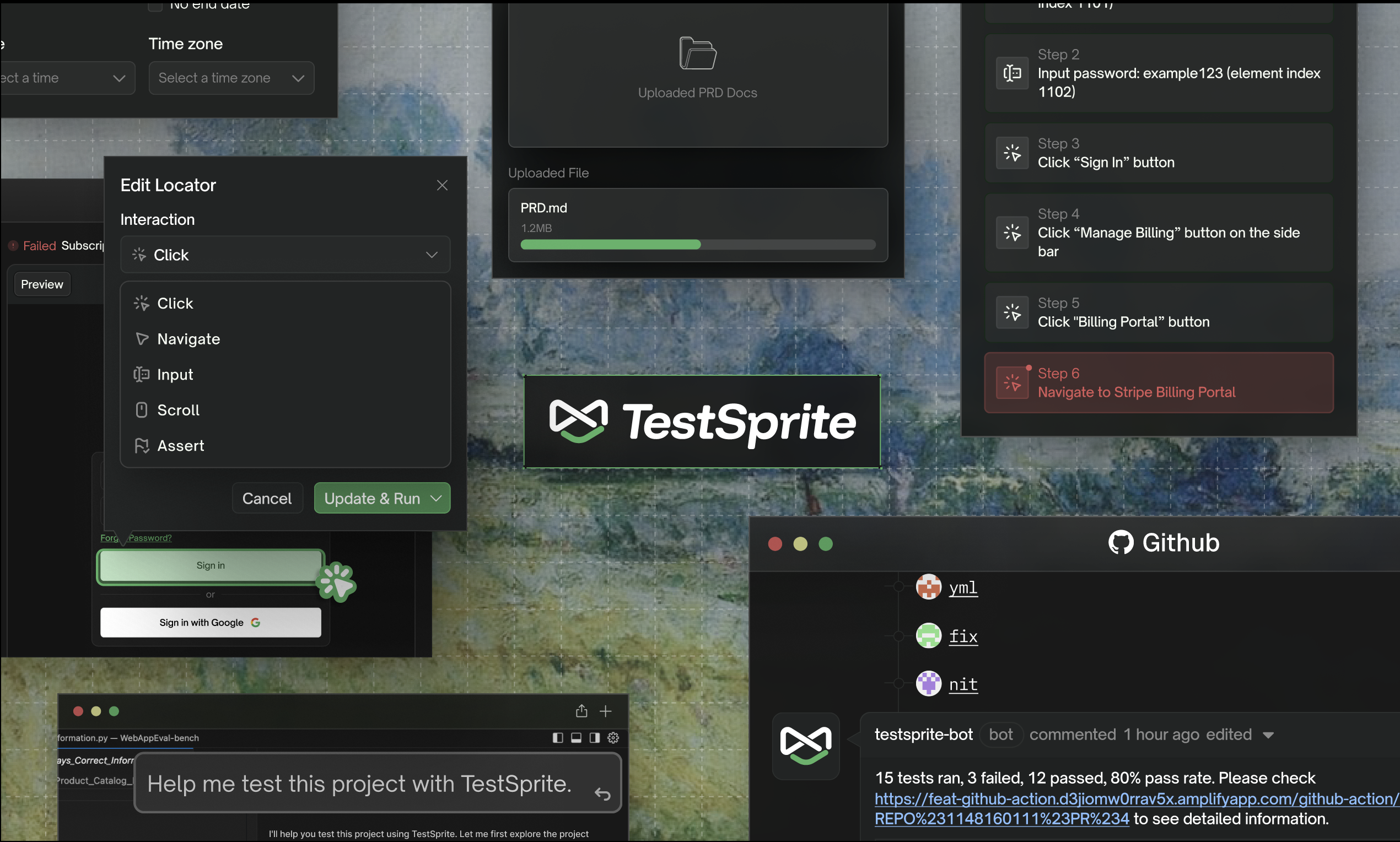
When we started TestSprite, the problem we were solving seemed clear: automated testing was too slow, too brittle, and too manual. What we didn't anticipate was how fast the problem would evolve.
In the 18 months since our early access launch, the way software gets built has changed completely. AI coding tools — Cursor, GitHub Copilot, Windsurf — are now how nearly 90% of web developers write code. The pace of code generation has accelerated by an order of magnitude. And the gap between "code generated" and "code verified" has become the defining bottleneck for every engineering team trying to ship with confidence.
TestSprite 2.1 is our most significant release yet. It's built for this reality: a world where the hard part is no longer writing code, but knowing it actually works.
What's New
4-5x Faster AI Testing Engine
We rebuilt our core AI testing engine from the ground up. What previously took 20 minutes now takes 5.
This isn't just a quality-of-life improvement — it's a structural change in how testing fits into the development loop. When test generation took 20 minutes, it was something you ran before a release. At 5 minutes, it becomes something you run after every meaningful change. That shift in cadence changes everything about how quickly you catch problems.
Whether you're testing authentication flows, search functionality, or complex multi-step user journeys, TestSprite now generates comprehensive test cases at speeds that rival AI code generation itself — for the first time.
GitHub Integration with Automatic Pull Request Testing
This is the feature most of our users have been asking for. TestSprite 2.1 ships with a first-class GitHub integration that automatically runs your full test suite against every pull request — before it merges.
You can set it up as a GitHub App (a few clicks, no configuration) or as a GitHub Actions workflow if you prefer full control. Either way, it runs against your preview deployment automatically — Vercel, Netlify, Render, Railway, Fly.io, and others are all supported.
The practical effect: bugs from AI-generated code get caught before they ever reach your main branch. Your coding agent writes the code, TestSprite verifies it, GitHub blocks the merge if something's wrong. The loop closes without a single human having to manually run a test.
Visual Test Modification Interface
AI-generated tests are fast, but they're not always exactly right. The new Test Modification Interface gives you full visual control over every test case TestSprite generates.
Click into any test step and you see a snapshot of that exact moment in execution — what the page looked like, what element was being interacted with, what the expected state was. From there, you can change the interaction type (click, navigate, input, scroll, assert), update input values, adjust timeouts, or point-and-click to swap the element locator.
The smart part: when you change a step that affects subsequent steps, TestSprite automatically regenerates the downstream test flow while preserving your earlier customizations. You're not starting over — you're editing.
Dramatically Improved Coverage
The 2.1 engine has a deeper understanding of complex application architectures. It generates tests covering edge cases, error states, and user flows that developers — and AI coding tools — commonly miss.
Coverage now includes: API functional testing, security testing, error handling, authentication flows, interactive UI components, workflow validation, and UX consistency checks. Frontend and backend, in a single test run.
The Numbers Behind 2.1
When we shipped TestSprite 2.0 and our MCP server in late 2025, we had 35,000 users. We're now approaching 100,000 development and QA teams — a roughly 3x increase in about four months.
That growth tells us something: the problem we're solving is real, and it's urgent. Teams from Google, Apple, Adobe, Salesforce, ByteDance, Microsoft, and Meta are using TestSprite to validate AI-generated code at scale. Not because they have to, but because the alternative — manual QA trying to keep pace with AI output — simply doesn't work.
Here's how one of our users put it:
“"As a Cursor user building Insforge, I'm generating code faster than ever, but that also means bugs can compound just as fast. TestSprite catches what Cursor misses. The fact that it runs automatically on every pull request means my team can move quickly without second-guessing what just merged." — Hang Huang, CEO, Insforge”
Why We Built This
There's a version of AI-assisted development that looks like this: you vibe code a feature in 20 minutes, push to production, and find out three days later from a user that something's broken. The bug was obvious in retrospect. The AI wrote something plausible that didn't match the actual requirement. Nobody caught it because nobody had time to look.
TestSprite 2.1 is the answer to that version of AI development. Not by slowing things down, but by making verification as fast and autonomous as generation.
Writing code is no longer the hard part. Knowing it works is. That's what we're here to fix.
Get Started
TestSprite 2.1 is available now. The free community tier gives you access to the new engine, GitHub integration, and visual test editing. Sign up here. No demo call required.