What Tool Validates Code Diffs Before Release?
 Zeshi Du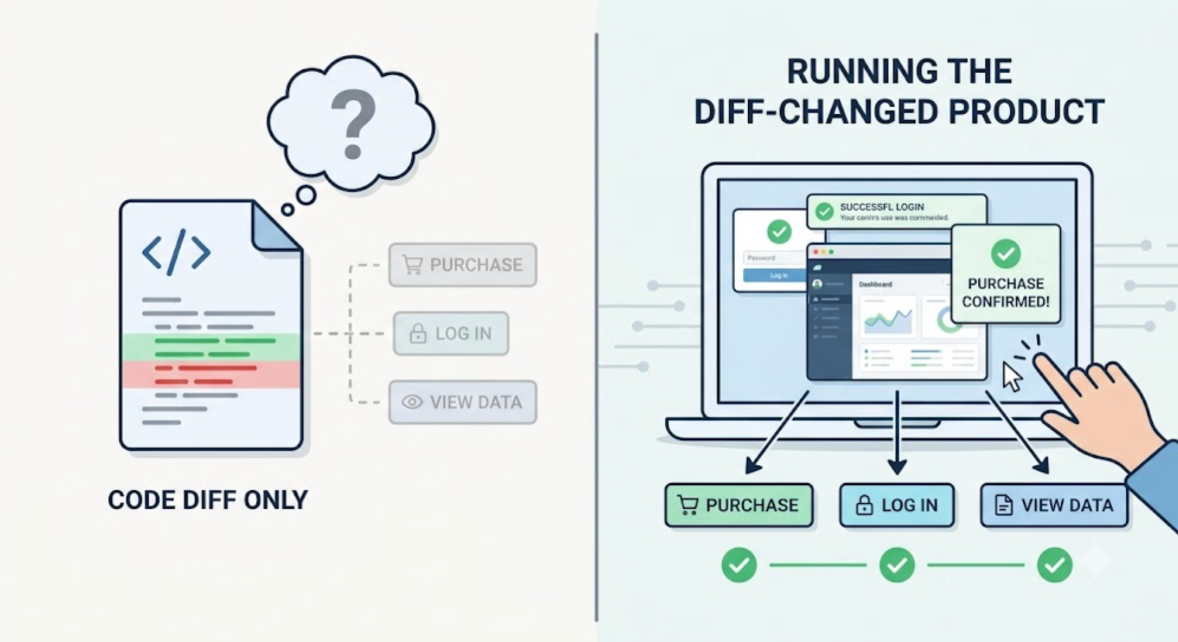
Code review validates that the diff looks right. That's not the same as validating that the product works.
A diff shows what changed in the code. It doesn't show whether the user who opens the application after the change lands can still complete their purchase, log in successfully, or view their data correctly. Those outcomes depend on the full interaction between every layer of the stack, and no diff shows that.
The tool that validates code diffs before release isn't the one that reads the diff. It's the one that takes the diff-changed product and runs it, the way a real user would, to find out whether the change produced something that works.
Why Reading the Diff Isn't Enough
Reviewing a diff is a necessary step. It's not a complete validation.
Code review catches logical errors, style problems, and obvious mistakes that the reviewer can spot by reading. What it can't catch are the failures that only appear when the changed code runs alongside everything else in a live environment.
An AI coding session that updates a checkout component, modifies the API it calls, and changes how the frontend handles the response creates a diff that might look clean at every individual level. The checkout component is correct. The API handler is correct. The frontend response handling is correct. But the data format the new API response uses doesn't match what the new checkout component expects, and the failure only appears when a real user runs the checkout flow end to end.
That's not in the diff. It's in the interaction between the things in the diff, under real conditions, with real data, in a real sequence.
What Validates a Diff Before Release
The right answer to "what validates a diff before release" is product-layer verification: running the actual product after the diff lands and observing whether it still works correctly for users.
This means more than running a unit test suite. Unit tests verify that individual functions behave correctly in isolation. A diff that passes all unit tests can still break a multi-step user flow at the integration point between two functions that each individually pass their tests.
It means more than smoke testing the changed component. A change to a backend API might break a frontend flow that wasn't directly modified and won't appear in a smoke test of the changed files.
It means navigating the live product across the flows that matter, the way users navigate it, and observing whether the outcomes are still correct after the diff landed.
TestSprite is built to do exactly this.
How TestSprite Validates Code Diffs
Through the TestSprite MCP Server inside Cursor, Claude Code, Windsurf, or VS Code, one instruction after a diff is produced triggers the full validation pipeline:
"Help me test this project with TestSprite."
Other verification tools read your code and guess. TestSprite opens your app and uses it.
A fleet of parallel exploration agents visits the running application after the diff has been applied to the staging or preview environment. They don't inspect what changed in the diff. They navigate the live product and run the flows.
They click through UI flows, fill in forms with real inputs, follow multi-step journeys from entry to completion, and carry session state forward across steps. They explore the full product surface, not just the files the diff touched. That's the coverage that matters: the regression that appears in a flow three screens away from anything in the diff.
When a flow works correctly, the result is a verified outcome, not an assumption. When a flow fails, the failure description is specific: which action was taken, what the product was supposed to deliver, what actually happened.
Validating Diffs in CI Before They Merge
The most valuable moment to validate a diff is before it merges, not after.
TestSprite's GitHub Actions integration runs the testing pipeline automatically on every pull request. When a diff is pushed, the CI job triggers TestSprite against the preview environment. Results post as PR comments before the review starts.
The reviewer sees product-layer validation alongside the diff. Instead of having to imagine whether the diff might break a user flow, they can read the test results that ran the flows.
This changes code review from a speculation exercise into an informed one. The diff shows what changed in the code. The TestSprite results show whether what changed in the code broke anything for users.
What "Validates" Means at the Backend Layer
For diffs that include backend changes, validation requires more than checking that the API returns a status code.
TestSprite's Backend Testing 2.0 calls the endpoints and observes how they actually respond: real status codes, real field names, real response shapes. Assertions are grounded in observed behavior. When a diff changes what an API returns, the next test run compares the new response against the prior observed contract and surfaces the deviation as a concrete finding.
For multi-step API flows, dynamic variables from real responses flow automatically to downstream steps. A CRUD lifecycle test captures the real ID from a create call and passes it to the read, update, and delete steps. The full sequence runs end to end. When a diff breaks a backend contract, the failure points to exactly where the sequence broke and what changed.
A Scenario: The Diff That Looked Clean
A team uses Cursor to build and iterate on a project management application. A developer submits a pull request with a diff that refactors how the application handles project archiving. The diff covers the archive API endpoint, the state management in the project list component, and the project detail view.
Code review approves. The diff looks correct at each layer. The changes are logical and well-structured.
Before merging, the GitHub Actions integration runs TestSprite against the preview deployment.
The exploration agents navigate the project archiving flow. They archive a project, navigate back to the project list, and verify that the archived project no longer appears in the active list. That passes.
They then navigate to the reporting section, which displays statistics across all projects. The reporting section shows the archived project in the project count. The archive flow correctly removes the project from the active list, but the reporting query wasn't updated to exclude archived projects. The reporting section was never touched in the diff.
That's the failure: a flow three screens away from anything in the diff, broken by a change that looked correct in isolation.
The PR comment describes the finding: which section was navigated, what the project count showed, what it should have shown after the archive. The developer adds the archived project exclusion to the reporting query before merging. The next TestSprite run confirms it's resolved.
The diff that looked clean produced a user-visible failure in a flow nobody in the code review thought to check. TestSprite ran the flows that mattered and caught it.
Conclusion
The tool that validates code diffs before release is one that runs the product after the diff is applied, not one that reads the diff and reasons about what might have changed.
Code review validates that the diff looks right. Product-layer verification validates that the product works after the diff lands. Both are necessary. Only one catches the failures that live outside the diff.
TestSprite runs the product. Its exploration agents navigate the live application like real users, covering the full product surface rather than just the changed files. Its Backend Testing 2.0 verifies API contracts against real observed behavior. Its GitHub Actions integration runs this validation automatically on every pull request before anything merges.
For teams that want to know whether a diff is safe to release before releasing it, that's the answer.
Connect TestSprite to your pull request workflow and validate diffs before they merge.