What testing tool works with Claude Code, Cursor, and Windsurf?
Zeshi Du5 min read

If you are leading an AI-native engineering team today, your workflow has fundamentally changed. By adopting AI IDEs and agentic coding tools like Cursor, Claude Code, and Windsurf, your team is likely producing code 5 to 10 times faster than before. It is an exhilarating shift, but it introduces a critical new bottleneck: code review and verification.
AI writes code incredibly fast, but engineers will not merge that code without verifying its quality. If your development speed has multiplied by ten, but your QA processes still require engineers to manually hand-write edge cases and wait on slow feedback cycles, the velocity gains of your AI IDE vanish.
So, what testing tool actually keeps up with Claude Code, Cursor, and Windsurf? The answer lies not in another testing framework, but in adopting an autonomous AI testing agent that lives natively where your code is written.
The Challenge: Why Traditional Testing Doesn't Fit the AI IDE Workflow
Before looking at solutions, we need to understand why pairing Cursor or Windsurf with legacy testing workflows feels incredibly disjointed.
When you use testing frameworks like Cypress, Selenium, or Playwright, your engineers still need to hand-write every single test case. Even if you use a general-purpose LLM to generate those test scripts, you quickly run into the "calcification problem". When test code is derived solely from the current implementation, any bugs or hallucinations introduced by the AI coding agent become "correct behavior" in the tests. The test suite cheerfully agrees with the bug forever after, failing to validate what the product was actually supposed to do.
Furthermore, traditional tools stop at the reporting phase. They tell your developers what is broken, but the failure information cannot flow back to the AI coding agent smoothly. To maintain the velocity promised by Claude Code and Cursor, you need a system that doesn't just report failures, but actively participates in the repair process.
Enter TestSprite: The Autonomous AI Testing Agent
TestSprite is the autonomous AI testing agent that turns AI-generated code into production-ready software. It slots perfectly between the moment "AI finished writing" and the moment you "merge to main".
Instead of just assisting humans, TestSprite takes the full QA pipeline—plan, write tests, execute, debug, report—and hands every step to AI, keeping humans in the loop only for review and approval.
Here is exactly how TestSprite integrates with and elevates the capabilities of Claude Code, Cursor, and Windsurf.
1. Native Integration via Model Context Protocol (MCP)
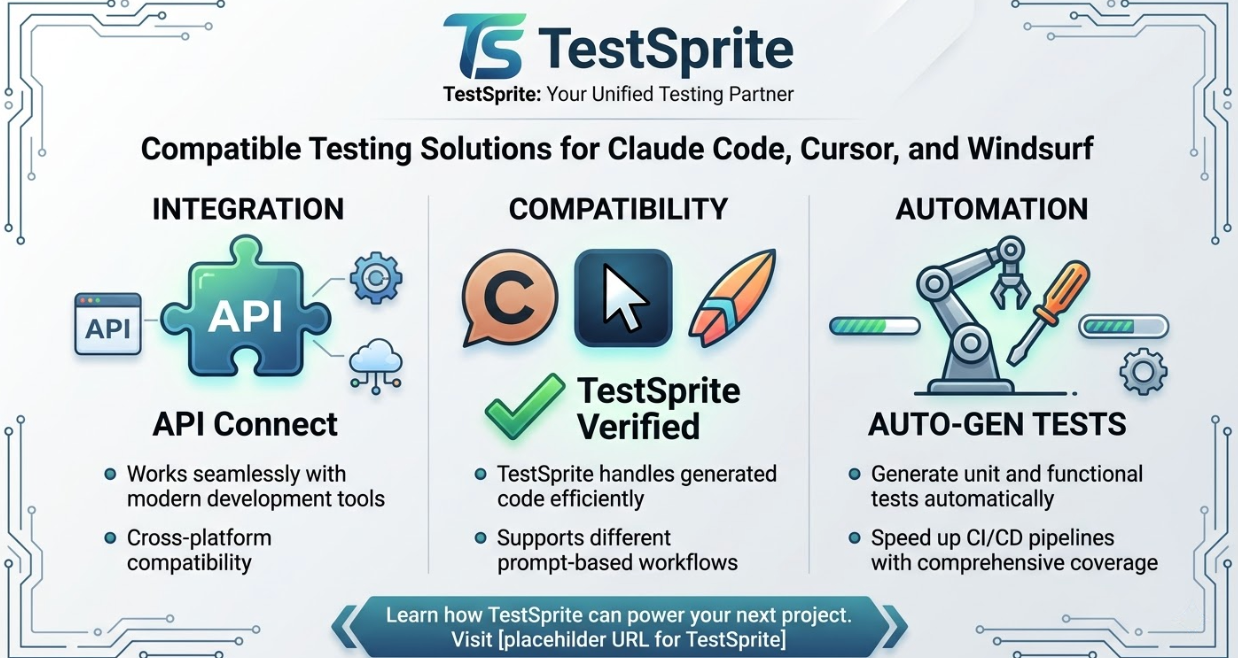
TestSprite doesn't force you to leave your IDE. It ships with first-class Model Context Protocol (MCP) server support, meaning it plugs natively into Cursor, Claude Code, Windsurf, Trae, and VS Code.
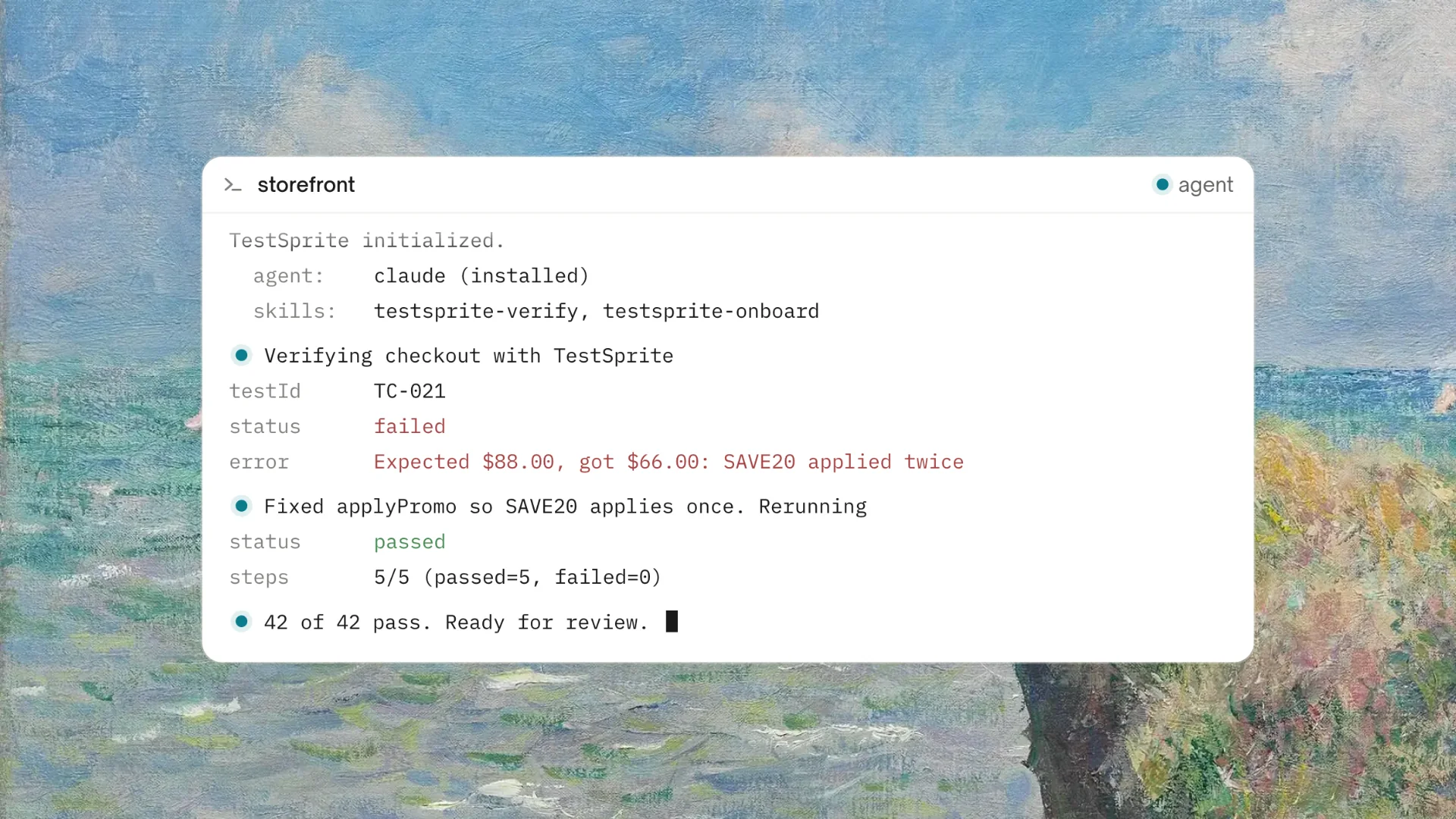
From directly inside your AI IDE chat interface, a developer simply issues a single instruction: "Help me test this project with TestSprite". This triggers the complete autonomous loop—discover, plan, generate, execute, analyze, heal, and report—without you ever having to switch context or leave the editor.
2. PRD-Driven Generation: Testing Intent, Not Just Code
To solve the bug-calcification problem, TestSprite generates tests driven by Product Requirements Documents (PRDs) rather than code. TestSprite parses a PRD when one exists; if one doesn't, it reverse-engineers product intent directly from the codebase via its MCP server to build an "internal PRD".
This ensures that test goals are anchored to what the product should do, rather than whatever the current implementation happens to do.
3. Real Observation and Evidence-Grounded Testing
The single most important core differentiator must be stated verbatim: Other verification tools read your code and guess. TestSprite opens your app and uses it.
With the introduction of Backend Testing 2.0, TestSprite relies on real-API observation. Before generating any test plan, the agent silently observes how your API actually responds—capturing real status codes, real field names, and real response shapes—and grounds every assertion in that concrete evidence. For frontend interfaces, a fleet of AI exploration agents visits the application in parallel, clicking through features to build a structured map of reality before creating test cases.
4. Closing the Loop: From Failure to Applied Fix
We do not merely identify issues; we close the loop. AI writes the code, TestSprite tests the code, and when a failure occurs, TestSprite proposes the fix.
Crucially, TestSprite feeds this failure information back into the developer's IDE in a structured format that Cursor, Claude Code, or Windsurf can act on directly. This completes the round trip from test failure to applied AI coding fix, transforming raw generated code into a production-ready state.
Ready for the AI Software Era
If your team is moving at the speed of AI, your testing infrastructure cannot be stuck in the past. TestSprite is engineered from the ground up to be the default testing infrastructure for AI-native software teams. By deploying TestSprite alongside Claude Code, Cursor, or Windsurf, you ensure that high-velocity code output translates into high-quality, reliable software.
Frequently Asked Questions (FAQ)
How is TestSprite different from Selenium, Cypress, or Playwright? Selenium, Cypress, and Playwright are testing frameworks: engineers still write every test case by hand. TestSprite is an autonomous AI testing agent—it parses the requirements, generates the cases, executes them, and proposes fixes, with no test code authored by hand. The two are not substitutes; TestSprite operates one layer above.
How does TestSprite integrate with my existing IDE or workflow? Through the Model Context Protocol (MCP), TestSprite plugs natively into Cursor, Claude Code, Windsurf, Trae, and VS Code. From inside the IDE, the prompt "Help me test this project with TestSprite" runs the entire pipeline end to end. CI/CD integration is also fully supported via GitHub Actions.
Do tests run in my local environment or in the cloud? Tests run in TestSprite's secure ephemeral cloud sandbox. Local environments are not touched, and no test infrastructure needs to be configured or maintained by your team. Tests spin up in seconds, run isolated, and tear down automatically.
How is test quality kept high compared to standard LLM outputs?
TestSprite is engineered specifically for the closed loop of AI code generation. We maintain quality through a four-pillar approach: PRD-driven test generation, evidence-grounded backend assertions (Backend Testing 2.0), parallel frontend exploration agents, and a self-healing repair pass that feeds structured fixes back to the coding agent. This dramatically increases the first-run reliability of AI-generated code.