What Is the Difference Between AI-Assisted Testing and Autonomous AI Testing?
Rui Li5 min read

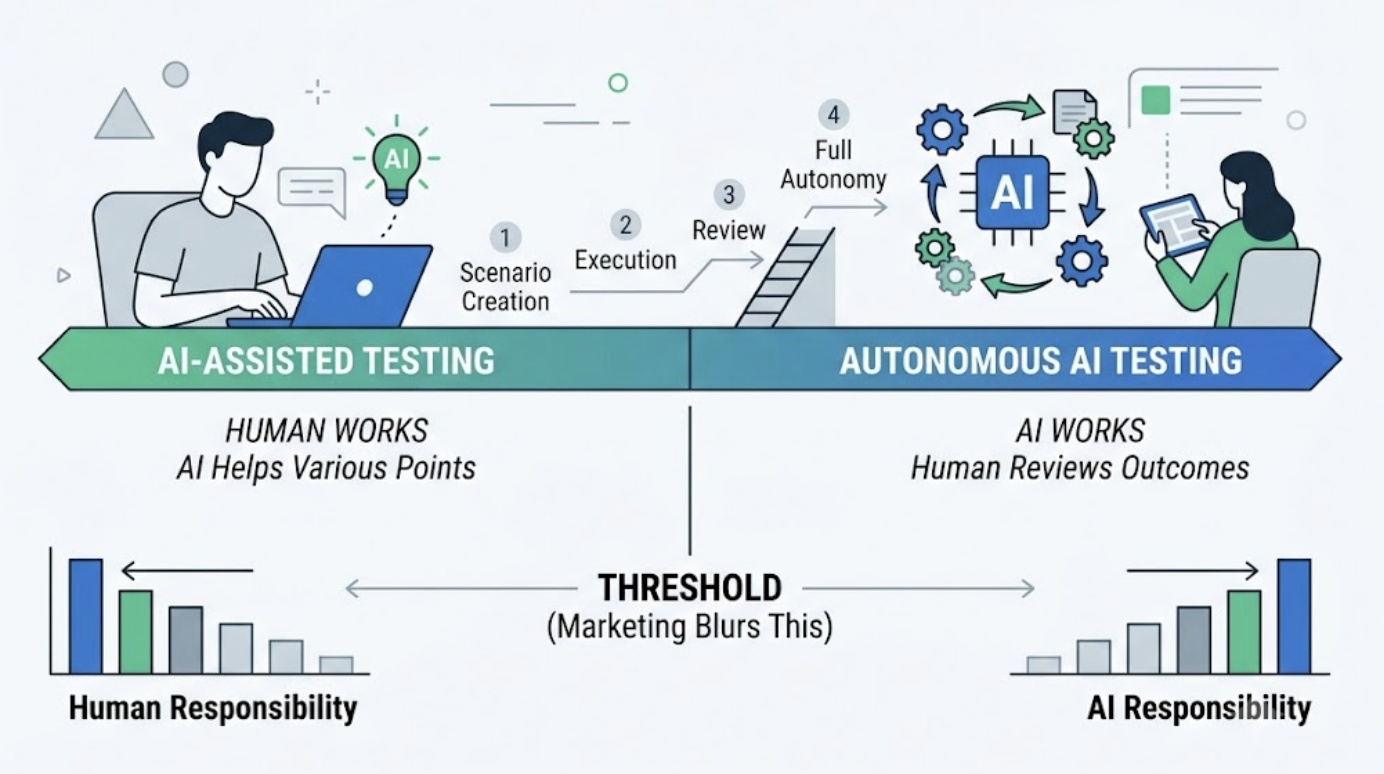
Both terms have AI in them, and that's roughly where the similarity ends. The difference isn't how much AI is involved or how sophisticated the models are. It's who holds responsibility for the testing.
AI-assisted testing means a human does the testing work, faster, with AI helping at various points. Autonomous AI testing means the AI does the testing work itself, and the human reviews outcomes. Between those two sits a threshold that most "AI testing" marketing blurs, so it's worth walking the whole spectrum level by level, seeing exactly what each rung automates, and what it leaves in human hands.
The Assisted Spectrum, Rung by Rung
AI-assisted testing isn't one thing. It's at least four distinct levels, each real, each useful, and each stopping short of the same line.
Level one: AI completes test code. A copilot suggests the next lines of your Playwright test as you write it. Authoring gets faster. But you're still deciding what to test, still designing the scenario, still maintaining the file, still triaging its failures. The AI accelerated your typing.
Level two: AI generates scripts from recordings. You click through a flow, and the tool converts your session into an executable script. Authoring gets easier still. But the coverage is exactly what you demonstrated, the script is anchored to the implementation you recorded against, and when the UI changes, the recording is stale. The AI transcribed your intent; it didn't form any.
Level three: AI heals selectors. When a button's class name changes, the tool repairs the locator so the test keeps running. Maintenance gets cheaper. But healing a selector isn't judging behavior: the repaired test can now find the element while the flow behind it is broken. The AI patched the pointer, not the verification.
Level four: AI creates tests from conversation. You describe scenarios in natural language, and an agent turns them into test cases. This is the most capable rung of assistance, and it's still assistance: you decide which scenarios exist, you own the library, and coverage remains bounded by what you thought to describe.
Line up all four and the pattern is unmistakable. Every rung automates a task inside the testing job. None of them takes the job.
The Threshold: Where Responsibility Transfers
Autonomous AI testing begins where the human stops supplying intent per-test and the system forms it.
That means the AI decides what to test, by perceiving the product rather than receiving scenarios. It generates the coverage as an output of that perception. It judges outcomes behaviorally, against what the product is supposed to do, not just against assertions someone specified. And it maintains the coverage as the product evolves, without a human refreshing scripts or approving selector patches.
The test for whether a tool is on the autonomous side is simple: after setup, what does a human have to do before coverage exists for a feature nobody wrote a scenario for? On the assisted spectrum, the answer is always "something": describe it, record it, write it. On the autonomous side, the answer is nothing, because the agent finds the feature the way a user would, by using the product.
What Autonomous Looks Like in Practice
TestSprite is built on the autonomous side of that threshold, and its mechanics show what responsibility transfer means concretely.
Other verification tools read your code and guess. TestSprite opens your app and uses it.
Exploration agents navigate the running application like real users: discovering flows through interaction, filling forms with realistic inputs, carrying session state through multi-step journeys. Scenarios are outputs of exploration, not inputs from a human. Backend Testing 2.0 carries the same posture to APIs, calling endpoints and observing real responses before generating any assertion, so even the assertions originate in perceived reality rather than supplied expectation. Auto-Heal Rerun holds the maintenance responsibility: when the UI drifts, it judges whether behavior survived, adapts and verifiably reruns if it did, and surfaces a product-level finding if it didn't.
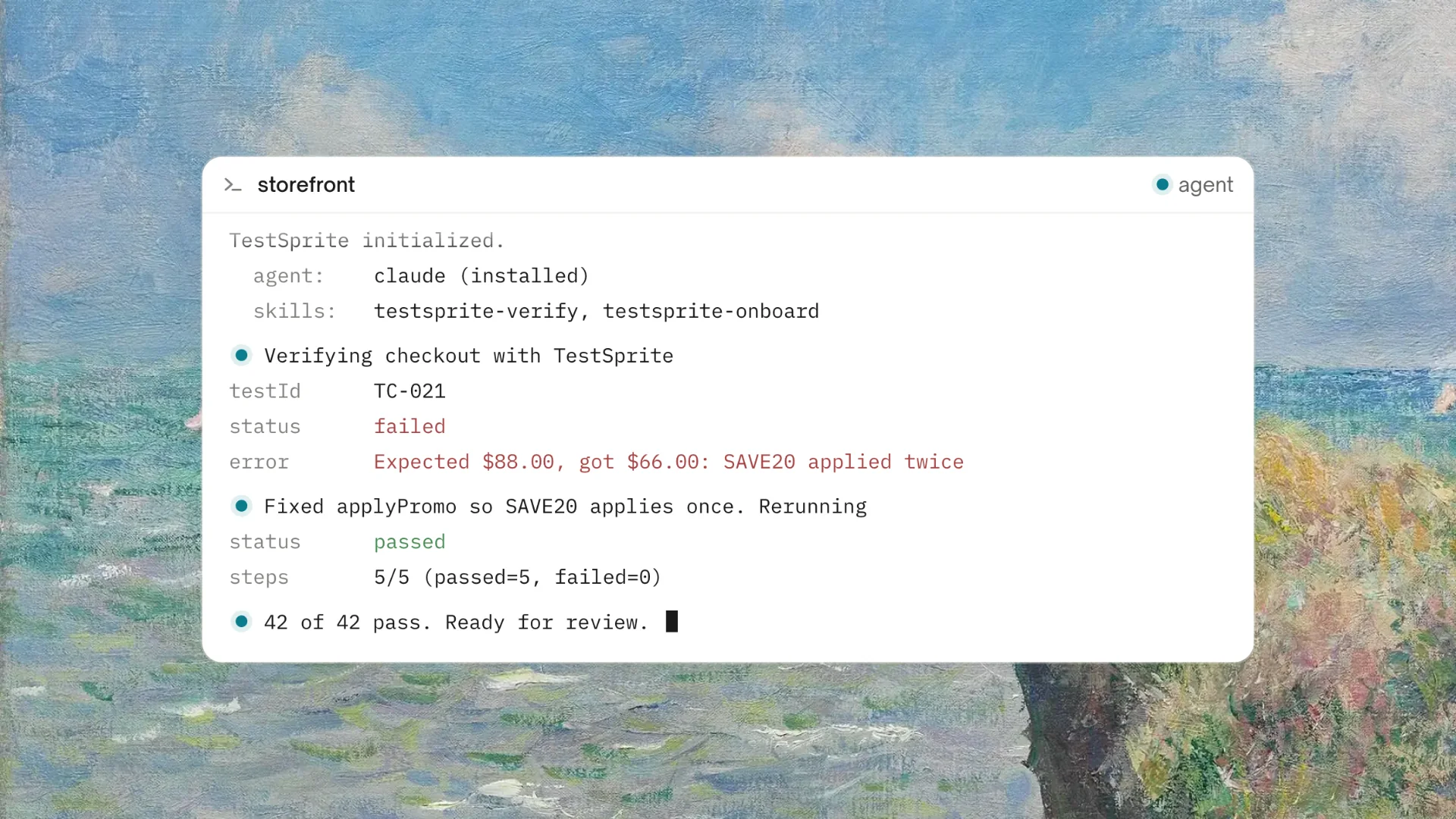
The human's role relocates rather than disappears: one instruction from inside Cursor or Claude Code to trigger the cycle, and review of the findings that come back, formatted for the coding agent to fix in the same session. Reviewing outcomes is a different job from producing coverage, and that difference is the entire category boundary.
Why the Boundary Matters Now
The distinction stayed mostly academic while humans wrote code, because a human at the authoring layer could keep pace with human-speed change, and assistance made that human faster.
AI coding tools moved the bottleneck. When Claude Code ships a feature in an afternoon and reshapes component structures weekly, the constraint is no longer how fast a person can author tests with help. It's that a person is in the authoring loop at all. Assistance optimizes the loop; autonomy removes it. That's why the two categories, which sound like degrees of the same thing, behave like different species under AI-coding conditions: one falls progressively behind the product, the other regenerates its coverage from the product every run.
A Scenario: The Same Product Under Both Models
A three-person team builds a travel expense tool with Claude Code: receipt capture, trip grouping, approval chains, reimbursement export.
Under their assisted setup, a conversational test-creation tool, they'd described the scenarios that came to mind: submit an expense, approve it, export the report. Those tests ran fine. What no one described, because no one thought of it, was what happens when an expense is edited after approval. A Claude Code session that reworked the approval model had quietly made edited-after-approval expenses keep their approved status with the new, unapproved amount, a hole in the control the feature exists to enforce.
They added TestSprite alongside. On its first exploration, the agents did what a user eventually would: submitted an expense, got it approved, then went back and edited the amount, and checked the approval state. The finding landed in the Claude Code terminal with the full sequence: what was edited, what the status showed, what it should have required. Fixed the same afternoon.
The assisted tool had done its job, every described scenario was covered. The gap was structural: described scenarios were the ceiling. The autonomous agent had no such ceiling, because its coverage came from the product's actual surface, including the corner nobody's imagination had visited.
Conclusion
AI-assisted testing is a spectrum, code completion, recording-based generation, selector healing, conversational creation, and every rung shares one property: a human holds the testing responsibility, and the AI makes parts of it faster. Autonomous AI testing is the transfer of that responsibility: the system perceives the product, forms its own coverage, judges outcomes behaviorally, and maintains itself, while the human reviews findings.
Under AI-coding conditions, the boundary stops being terminology and starts being the difference between coverage that trails the product and coverage that keeps up with it.
See what autonomous testing finds that assistance can't with TestSprite's free plan today.