What Is the Best Way to Add Autonomous Testing to GitHub Pull Requests?
 Zeshi Du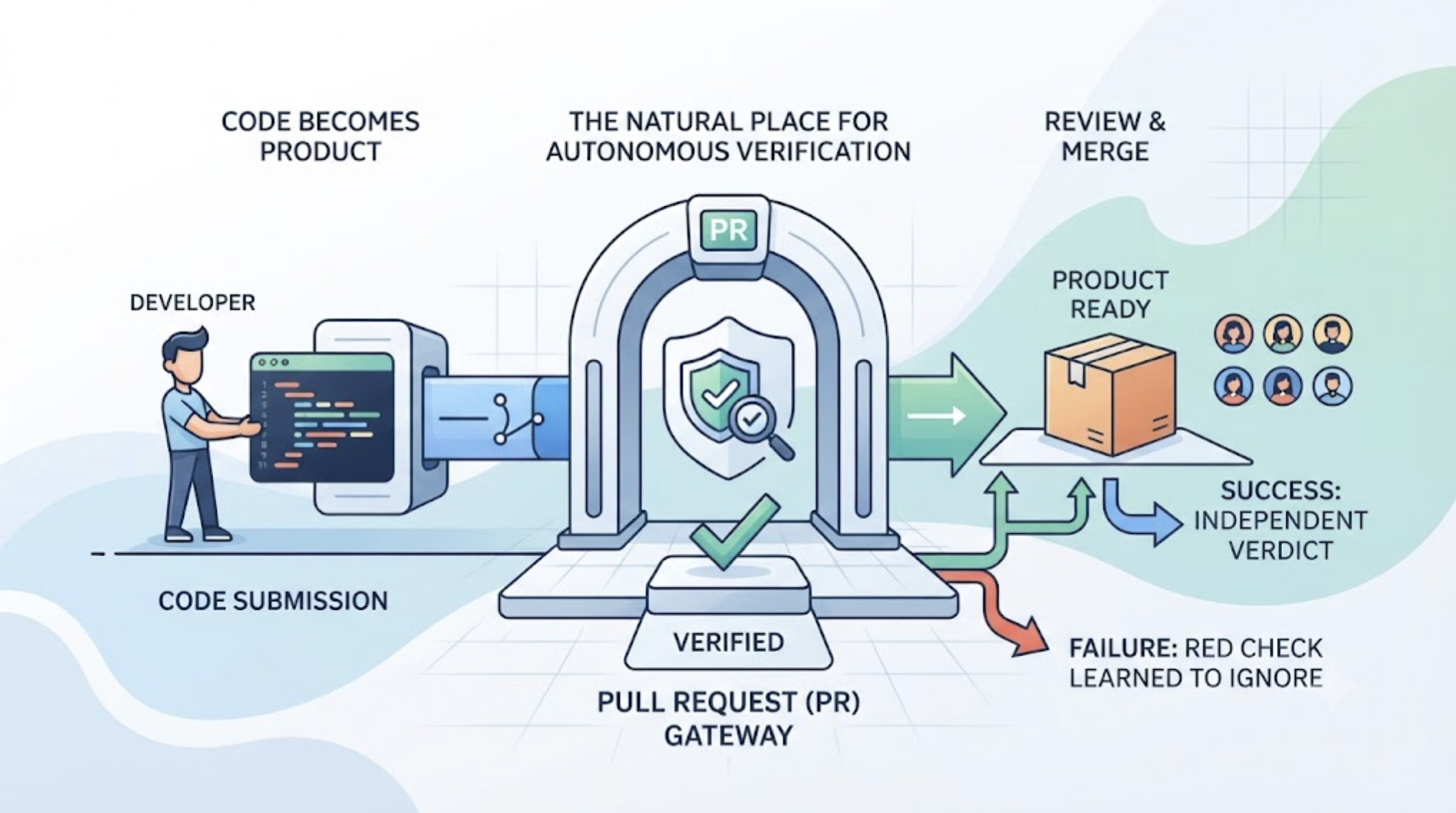
The pull request is the last structured moment before code becomes product, which makes it the natural place to put autonomous verification. Done well, every PR arrives at review already carrying an independent, product-level verdict. Done poorly, it becomes another red check the team learns to merge past.
The difference between those outcomes isn't the tool's brand. It's a set of properties the setup either has or doesn't. Here's the checklist, why each item matters, and what the assembled version looks like.
Test the Preview Deployment, Not the Diff
The first property: the autonomous agent should test the PR's deployed preview environment, the running application as this branch would ship it, rather than analyzing the changed files.
The reasoning is about where PR-stage regressions live. The failures worth catching before merge are rarely inside the diff, code review already looks there. They're in the interaction between the diff and everything it touches: the flow two screens away that shares state with the change, the frontend component reading an API field the branch renamed, the feature from last week that this branch's refactor quietly broke.
Other verification tools read your code and guess. TestSprite opens your app and uses it.
TestSprite's GitHub Actions integration works this way: the workflow triggers exploration agents against the preview deployment, and they navigate the full product surface like real users, not just the flows the PR mentions. Full-surface matters at this stage specifically, because the PR author's mental model covers the diff, and the gaps in that model are the point of independent verification.
Put the Results Where the Review Happens
The second property: findings should arrive as PR comments, in product language, not in an external dashboard.
A reviewer's attention is on the PR page. A result that requires opening another tool gets checked late or never, and a result written in stack-trace language requires translation before it informs the review. The useful format is the one TestSprite posts: which flow was navigated, what action was taken, what should have happened, what did. A comment reading "checkout with a discount code applied showed the pre-discount total on confirmation" is a reproduction, a severity assessment, and a review note in one sentence, and the reviewer never left the page.
Backend findings deserve the same treatment: which endpoint's response deviated from its observed baseline, which field changed, what downstream reads the old shape.
Keep the Signal Clean, or the Gate Stops Gating
The third property is the one that decides long-term survival: the false positive rate.
PR checks live in a trust economy. Every red check that turns out to be structural noise, a renamed component, a moved element, a test stale against an intentional redesign, withdraws trust, and once the team learns that red usually means nothing, they merge past it, and the one red that meant everything merges too.
Autonomous PR testing needs behavioral judgment built in. TestSprite's Auto-Heal Rerun makes the determination on every failure: if the flow still works for a user, the test adapts and verifiably reruns, and no noise reaches the comment. If behavior broke, the finding surfaces. Auto-Auth handles the other classic false-failure source, authenticated flows in CI, performing password, OAuth refresh, or AWS Cognito authentication fresh before every run, so a Friday-evening PR doesn't fail on Thursday's expired token.
Pair the PR Check with the In-IDE Loop
The fourth property: PR testing shouldn't be the first time the code meets an agent.
The strongest setups run two layers. The developer triggers TestSprite from inside Claude Code or Cursor after the session, catching most failures while the change is still open in the terminal and the coding agent can fix them in the same session. The PR check then catches what the in-IDE run structurally can't: the interaction between this branch and what merged to main since, and the sessions where the developer skipped the local run.
Two independent product-layer checks before merge, and the PR comment doubles as the shared record, visible to the reviewer, attached to the change's history.
The Setup, Concretely
The mechanics are deliberately small: a workflow file added to the repository, triggering on pull request events, pointing TestSprite at the branch's preview deployment. Execution happens in TestSprite's ephemeral cloud sandbox, so the job doesn't consume the team's runners or add infrastructure to maintain. Results post back as the PR comment, and the check's status stands alongside the existing suite's, two independent verdicts, nothing shared but the application under test.
From zero, the path is: free account, API key, workflow file, first PR. No test authoring precedes the first useful result, because the coverage comes from exploration.
A Scenario: The First Two Weeks on PR Checks
A five-person team runs an inventory management SaaS and adds TestSprite to their PR workflow on a Monday: one workflow file, pointed at their existing preview deployments.
Week one builds the trust. Eleven PRs, nine green comments, and two heals noted rather than raised, a component rename from a design pass that the agents adapted to and verified, exactly the noise that would have been two false alarms under a structural checker.
Week two pays for the setup. A PR refactoring the stock adjustment flow arrives with clean code review and passing unit tests. The TestSprite comment carries one finding: adjusting stock for a product variant updates the variant's count correctly, but the parent product's aggregate count, displayed on the main inventory list, doesn't change until a manual refresh, because the aggregation event fires with the old payload shape the refactor abandoned. A warehouse manager would see totals that don't match their own adjustments, the kind of discrepancy that erodes trust in an inventory product faster than downtime.
The comment describes the sequence: which variant was adjusted, what the list showed, what it should have shown. The fix lands on the same PR, the check reruns green, and the merge proceeds an hour later, carrying the verification record with it.
Conclusion
The best way to add autonomous testing to GitHub pull requests is defined by four properties: test the preview deployment across the full product surface, deliver findings as product-language PR comments, keep the signal clean with behavioral judgment and automatic authentication, and pair the gate with an in-IDE loop so every change faces two independent checks.
TestSprite's GitHub Actions integration is built to that specification, with the setup cost of one workflow file and no tests to author first.
Put an autonomous check on your next pull request with TestSprite today.