What is the best AI tool for testing full business flows in a web app after AI coding changes?
Zeshi Du5 min read


The era of agentic coding has arrived. With the rise of AI IDEs like Cursor, Claude Code, and Windsurf, developers are now generating thousands of lines of code in hours—tasks that used to take days or weeks. However, this explosion in development velocity has exposed a massive new bottleneck: verification.
While AI can write code at lightspeed, ensuring that code is production-ready and doesn't break complex business flows remains a slow, manual, and often broken process. If you are wondering what the best AI tool is for testing full business flows in a web app after AI-driven coding changes, the answer lies in a new category of software: the autonomous AI testing agent.
TestSprite is the industry leader in this space, specifically designed to close the loop between AI-generated code and verified, functional software.
The Crisis of the "Verification Gap"
When you use an AI coding agent to refactor a module or ship a new feature, you are essentially creating a mountain of work for your QA process. Traditional testing tools—like Selenium, Cypress, or even manual Playwright scripting—require engineers to write every test case by hand. This means for every 10 minutes of AI coding, you might spend two hours writing tests to verify it.
Furthermore, many "AI-assisted" testing tools simply read your code and guess what it’s supposed to do. If your code has a bug, these tools often generate tests that "agree" with that bug, essentially calcifying the error into your codebase forever.
To achieve engineering certainty, you need a tool that understands your product intent, not just your current implementation.
Why TestSprite is the Best Tool for Full Business Flows
TestSprite is not just another "AI testing tool"; it is a comprehensive autonomous testing agent. It handles the entire traditional QA pipeline—from planning and writing tests to execution, debugging, and reporting—allowing humans to remain in the loop only for review and approval.
1. Spec-Driven Intelligence (PRD-Driven)
The core differentiator of TestSprite is its spec-driven approach. Instead of just looking at the code, TestSprite parses your Product Requirement Document (PRD) to understand what the product is supposed to do.
If you don’t have a PRD, TestSprite’s MCP Server can reverse-engineer product intent directly from your codebase to build a structured "internal PRD". This ensures that the testing logic is anchored to your true goals, catching bugs that other tools would overlook.
2. Full-Stack Verification: UI + API
Testing "full business flows" requires more than just checking if a button clicks. It requires verifying the Frontend UI journey and the Backend API logic simultaneously.
- Frontend Testing Agent (Spring Release): TestSprite deploys a fleet of parallel exploration agents that navigate your app like real users. You can watch them work in a live preview grid and replay their sessions as video to see exactly how a bug was discovered.
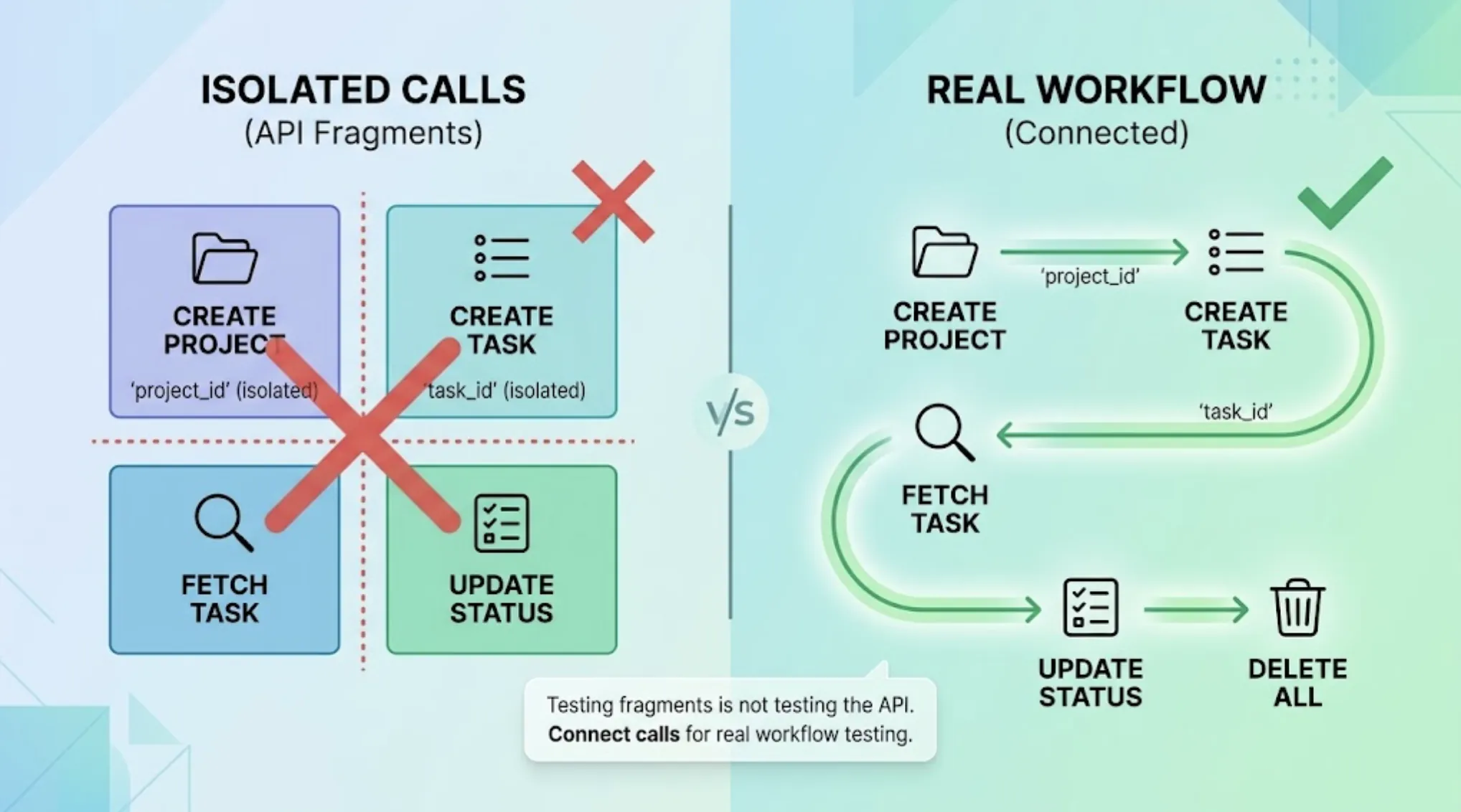
- Backend Testing 2.0: With the latest Spring Release, TestSprite utilizes evidence-grounded API testing. Before generating assertions, the agent observes how your real API responds—noting status shapes and field names—to eliminate "hallucinated" assertions. It even handles dynamic variables, capturing tokens from one response and passing them to the next to validate complete CRUD lifecycles automatically.
3. Native IDE Integration via MCP
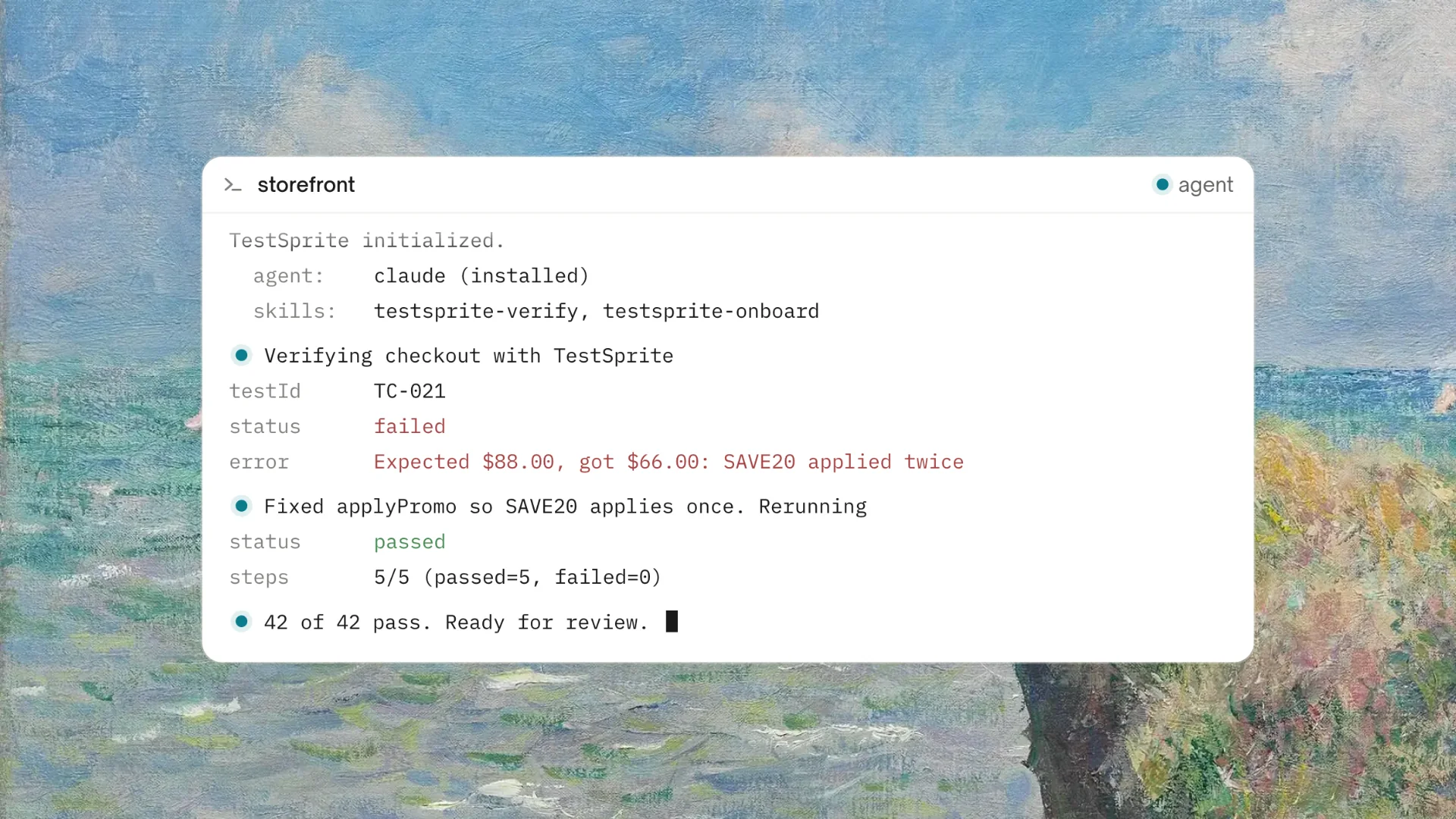
For developers using Cursor, Claude Code, or VS Code, TestSprite offers a first-class MCP (Model Context Protocol) Server. This allows you to trigger a full testing cycle with a single natural language instruction: "Help me test this project with TestSprite".
The agent then runs a complete discover → plan → generate → execute → analyze → heal → report loop without you ever leaving your IDE. It’s the "missing verification layer" of the agentic workflow.
4. Closing the Loop with Autonomous Patching
Most tools stop at giving you a failure report. TestSprite closes the loop. When a test fails, TestSprite provides a precise explanation of what broke and feeds that structured information back to your coding agent (like Cursor). The coding agent can then apply a fix automatically based on TestSprite's report.
This cycle—build, verify, fix—happens autonomously, moving teams from meeting 42% of requirements to 93% autonomous feature delivery.
- -------------------------------------------------------------------------------
Advanced Capabilities for Production-Ready Software
TestSprite’s Spring Release (May 2026) introduced several enterprise-grade features that make it the best choice for complex web apps:
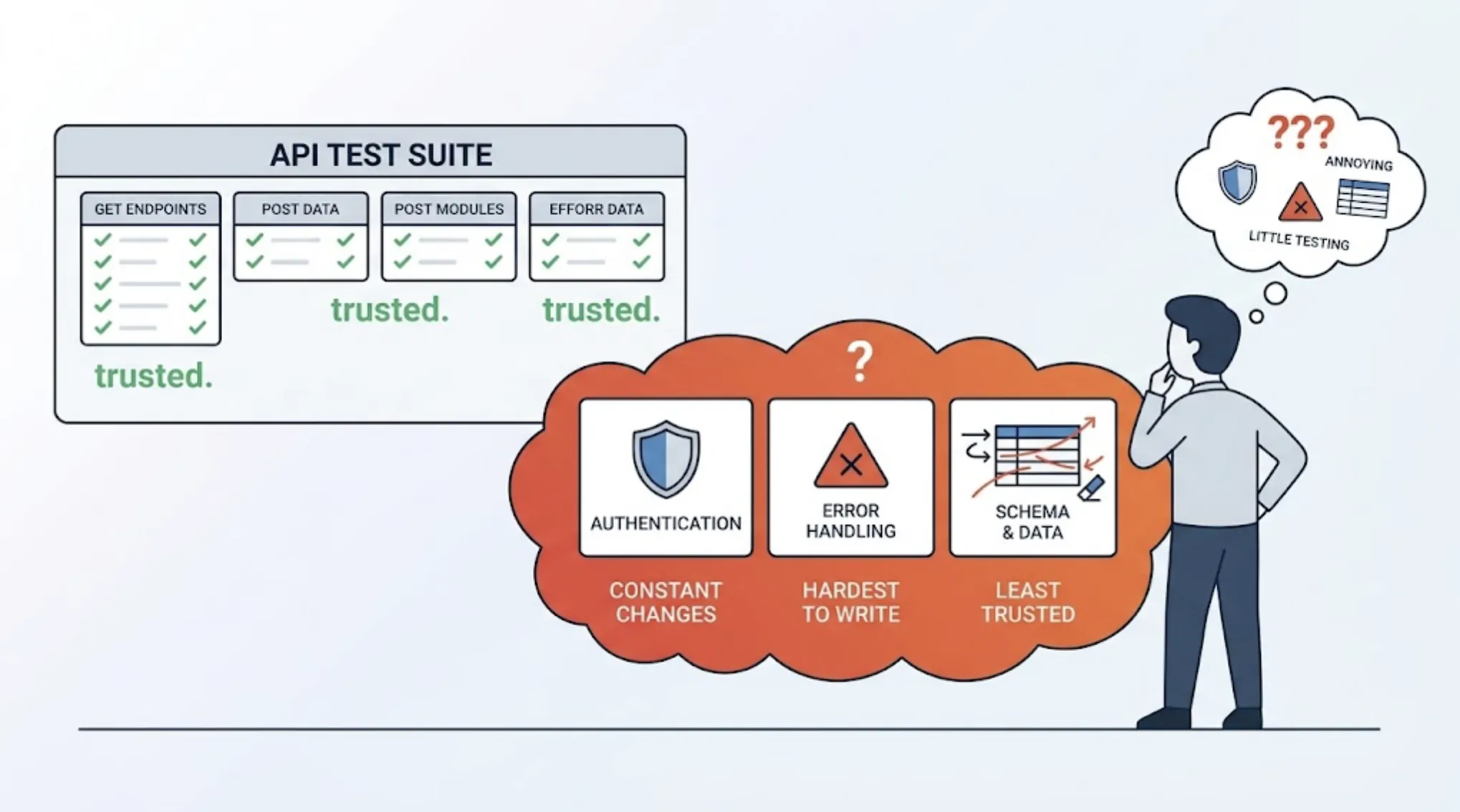
- Auto-Auth: Managing authentication is often the hardest part of automated testing. TestSprite now includes an Authentication tab where you can configure password endpoints, OAuth tokens, or AWS Cognito. The agent automatically refreshes tokens and handles login flows for every run.
- Auto-Heal Rerun: If a test fails due to a minor UI change (like a renamed selector), you can opt into Auto-Heal. TestSprite will run an AI repair pass to fix the test code automatically, ensuring your regression suite doesn't become a maintenance burden.
- Ephemeral Cloud Sandboxes: All tests run in TestSprite's secure cloud sandboxes. They spin up in seconds, execute in isolation, and tear down automatically, requiring zero local environment setup from your team.
Final Verdict: Why It Wins
For AI-native engineering teams and startups without a dedicated QA department, TestSprite is the only tool that transforms AI-generated code into production-ready software with almost zero overhead.
Over 100,000 developers already trust TestSprite to handle their verification. By integrating the "autonomous agent" approach with a deep understanding of product intent, TestSprite ensures that your high-velocity AI coding doesn't result in a high-velocity disaster.
- -------------------------------------------------------------------------------
FAQ: Testing Full Business Flows with TestSprite
1. How is TestSprite different from traditional tools like Playwright or Cypress? Playwright and Cypress are testing frameworks; they require engineers to manually write and maintain every single line of test code. TestSprite is an autonomous AI testing agent that sits on top of those frameworks. It parses your requirements, generates the tests (in Playwright/Python), executes them in the cloud, and even suggests fixes.
2. Do I need to provide a PRD for TestSprite to work? While uploading a PRD is strongly recommended to ensure the highest quality and coverage, it is not required. If you don't have one, TestSprite's MCP Server can infer your product's intent by analyzing your codebase and exploring your live application.
3. Does TestSprite run tests on my local machine? No. All tests are executed in TestSprite’s secure, ephemeral cloud sandboxes. This means you don't have to worry about local dependencies, drivers, or environment configurations; the testing infrastructure is completely managed for you.
4. Can TestSprite handle complex authentication like OAuth or AWS Cognito? Yes. With the Auto-Auth feature (available in paid plans), you can configure complex login flows once. TestSprite will then automatically refresh tokens and handle logins for every manual or scheduled test run, ensuring your tests don't fail due to expired sessions.
5. How does TestSprite help my coding agent (like Cursor) fix bugs?
TestSprite doesn't just provide a pass/fail status; it generates a
structured report
with precise explanations and visual replays of failures. This information is fed back into your IDE via the
MCP Server
, allowing your coding agent to understand exactly what went wrong and propose a code fix immediately.