What Is TestSprite Backend Testing 2.0?
Zeshi Du5 min read

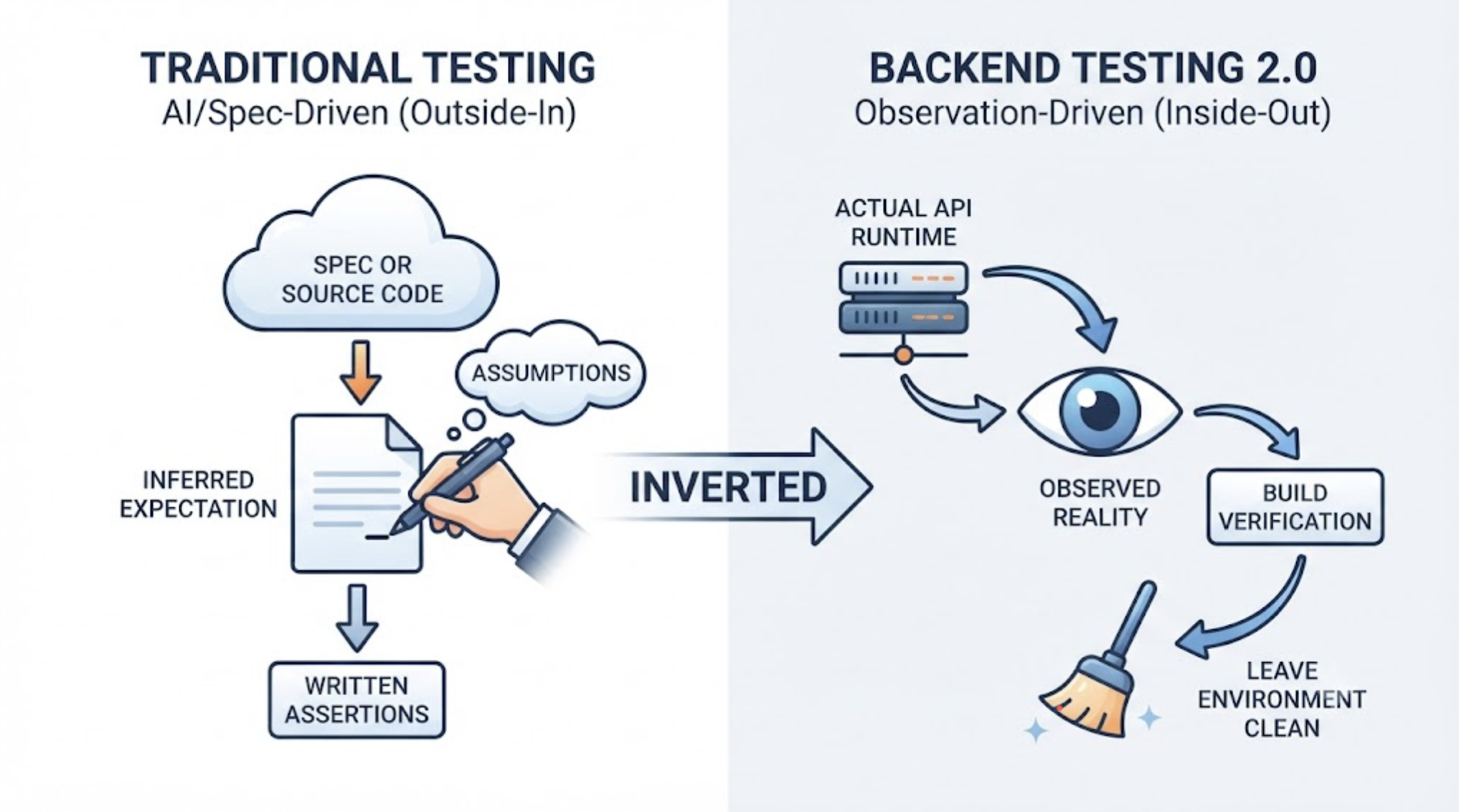
Backend Testing 2.0 is TestSprite's system for testing APIs the way an experienced engineer would on their best day: call the endpoint first, see what it actually returns, build verification from that reality, and leave the environment clean when you're done.
The "2.0" signals a rethink rather than an increment. Traditional backend test generation, including most AI-assisted approaches, works from the outside in: read the source code or a spec, infer what the API should return, write assertions against the inference. Backend Testing 2.0 inverts that. Nothing gets asserted until something gets observed.
Here's the full picture of what that means in practice, including the parts that get less attention than they deserve.
Observation Before Assertion
The foundation: before generating any assertion, the agent calls the API endpoint and records the real response. Actual field names. Actual status codes. Actual response shapes.
Other verification tools read your code and guess. TestSprite opens your app and uses it.
This matters most for AI-generated backends, where the running API routinely differs from what the source suggests. A handler uses camelCase internally while the serializer emits snake_case. A Claude Code refactor renames a field in three places out of four. The code says 200; the endpoint returns 201. Inference-based assertions encode the guess and fail for the wrong reason, or worse, pass against the wrong expectation.
Observation-based assertions reflect the API's real contract from the first run. And that observed contract becomes the regression baseline: when a later session changes what an endpoint returns, the deviation surfaces as a specific finding, which endpoint, which field, what was observed before, what's there now.
Dynamic Variables That Flow Through Multi-Step Sequences
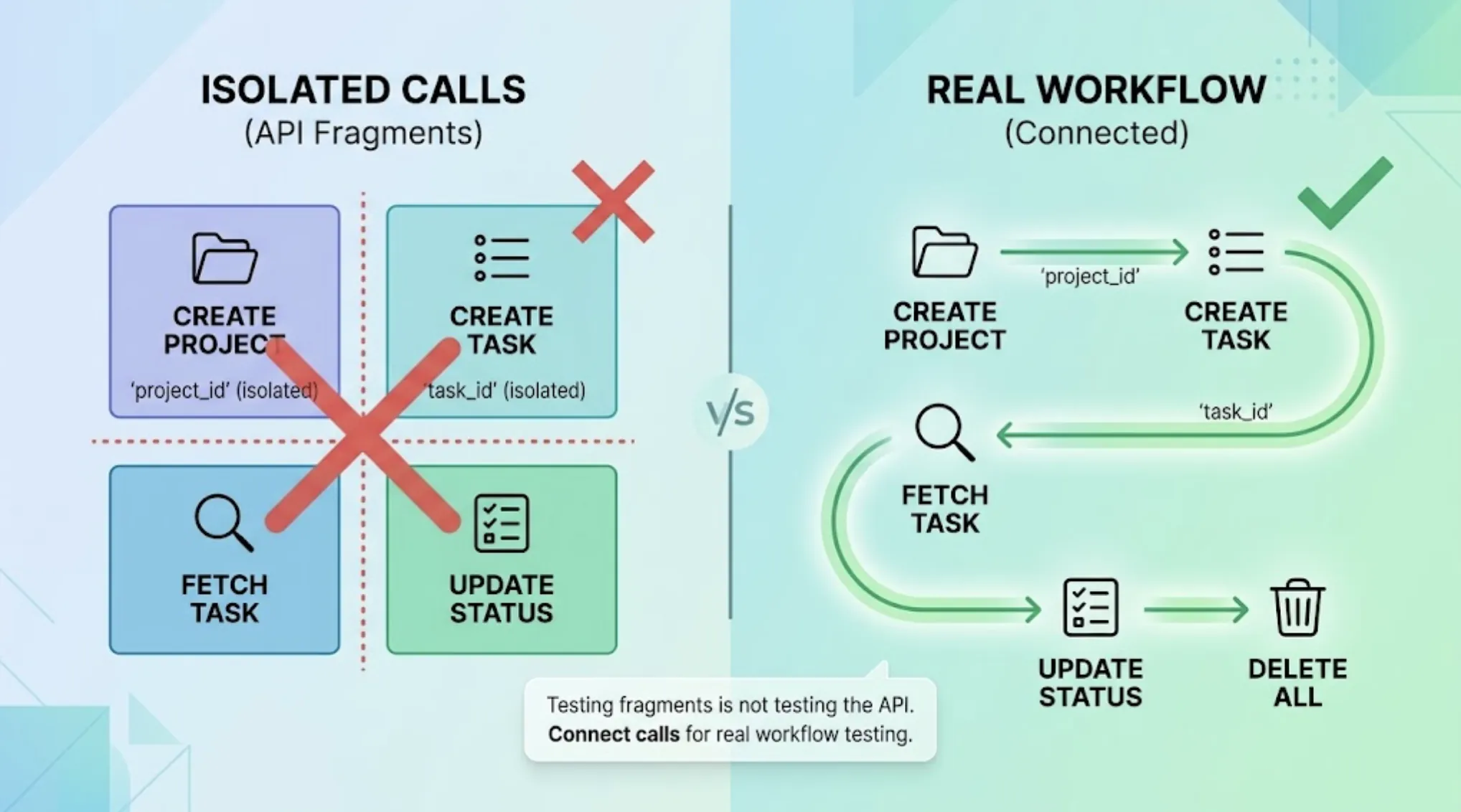
Real API testing is rarely one call. A registration returns a userId that the next call needs. A created order's ID feeds the payment step. Traditional approaches make the engineer wire this manually: capture the value, store it, reference it downstream, fix the wiring when anything changes.
Backend Testing 2.0 captures dynamic variables from real responses and passes them through the sequence automatically. The ID that came back from the create call, the actual one, from the actual response, flows into the read, the update, the delete. Multi-step integration chains assemble from observed data and run end to end on the first attempt.
CRUD lifecycle testing is the everyday beneficiary: create a resource, read it back, update it, delete it, verify it's gone, all threaded by real values with no manual plumbing.
Auto-Cleanup in Dependency Order
Here's a part that rarely makes the highlight reel but decides whether backend testing is sustainable: what happens to the data the tests created.
Tests that create resources and leave them behind pollute the environment. Staging fills with orphaned records. Subsequent runs collide with leftovers from previous ones. Someone eventually spends an afternoon cleaning up, or worse, the team starts distrusting results because the environment state is unknowable.
Backend Testing 2.0 cleans up after itself, and it does so in dependency order. Resources that depend on other resources get removed before the things they depend on, the way a careful engineer would tear down test data by hand: delete the order items before the order, the order before the customer. The environment returns to its prior state, and every run starts from a known baseline.
First-Run Self-Healing and the Honest Blocked Status
Two more behaviors round out the system, and both are about trustworthiness rather than capability.
First-run self-healing: when a generated test hits a solvable problem on its initial execution, a timing issue, a recoverable setup condition, the system adapts and completes rather than dumping a fragile failure on the developer. The goal is that the first run produces signal, not a debugging session about the tests themselves.
The honest Blocked status: when a test genuinely can't run, a dependency is unavailable, a precondition can't be established, Backend Testing 2.0 reports it as Blocked rather than disguising it as a pass or burying it as a vague failure. That distinction sounds small and isn't. A suite that quietly skips what it couldn't test inflates confidence exactly where confidence is least deserved. Blocked tells the team precisely what remains unverified, which is information you can act on.
A Scenario: One Session, the Whole System Working
A three-person team builds a subscription box service with Claude Code. A session reworks the order pipeline: new endpoints for creating orders, applying promo credits, and generating shipping labels.
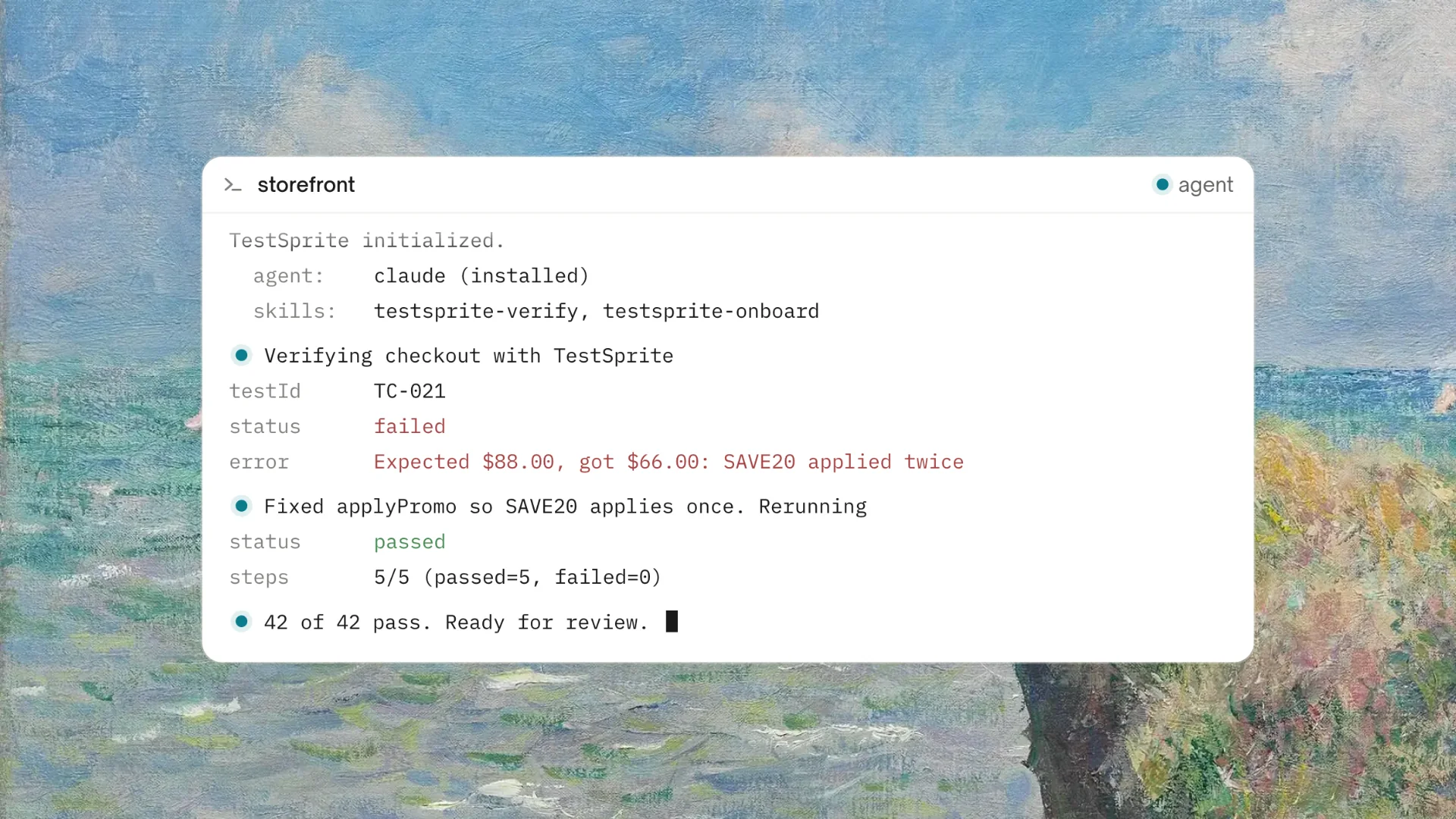
They trigger TestSprite from the Claude Code terminal.
The agents call the new endpoints and observe. Order creation returns orderId and a credits object. The observation notes that applying a promo credit returns 200 with a remainingCredits field, and the shipping label endpoint returns 201 with a labelUrl.
The CRUD and integration chains assemble from those observations. The orderId from creation flows into the credit application, then into label generation, then into the order status read. The full pipeline runs end to end, threaded by real values.
Two findings come back. First, a contract deviation: the order status endpoint, unchanged in this session by intention, now returns status as a nested object because the pipeline rework touched a shared serializer. The prior baseline had it as a string. The mobile client reads a string. Second, one test reports Blocked rather than failed: the refund flow couldn't be tested because the payment provider's sandbox was rejecting connections, and the report says exactly that instead of hiding it.
After the run, the environment is clean. The test orders, credits, and labels are gone, removed in dependency order: labels first, then credit applications, then orders. Staging looks like the tests were never there.
The developer fixes the serializer in the same session, notes the refund flow for re-verification once the sandbox recovers, and pushes. Everything they know, they know precisely. Everything unverified is labeled as such.
Conclusion
Backend Testing 2.0 is a complete system built on one principle: reality first. Observation before assertion, so tests reflect the API's true contract. Dynamic variables from real responses, so multi-step sequences run without manual wiring. Auto-cleanup in dependency order, so the environment stays trustworthy. First-run self-healing, so the initial execution produces signal. And an honest Blocked status, so the team always knows what was verified and what wasn't.
For teams building backends with AI coding tools, where the running API and the source code drift apart routinely, that principle is the difference between tests that describe your API and tests that describe a guess about it.
Run Backend Testing 2.0 on your API with TestSprite from inside your AI IDE today.