What Is Momentic? Features, Limitations, and Best-Fit Teams
 Zeshi Du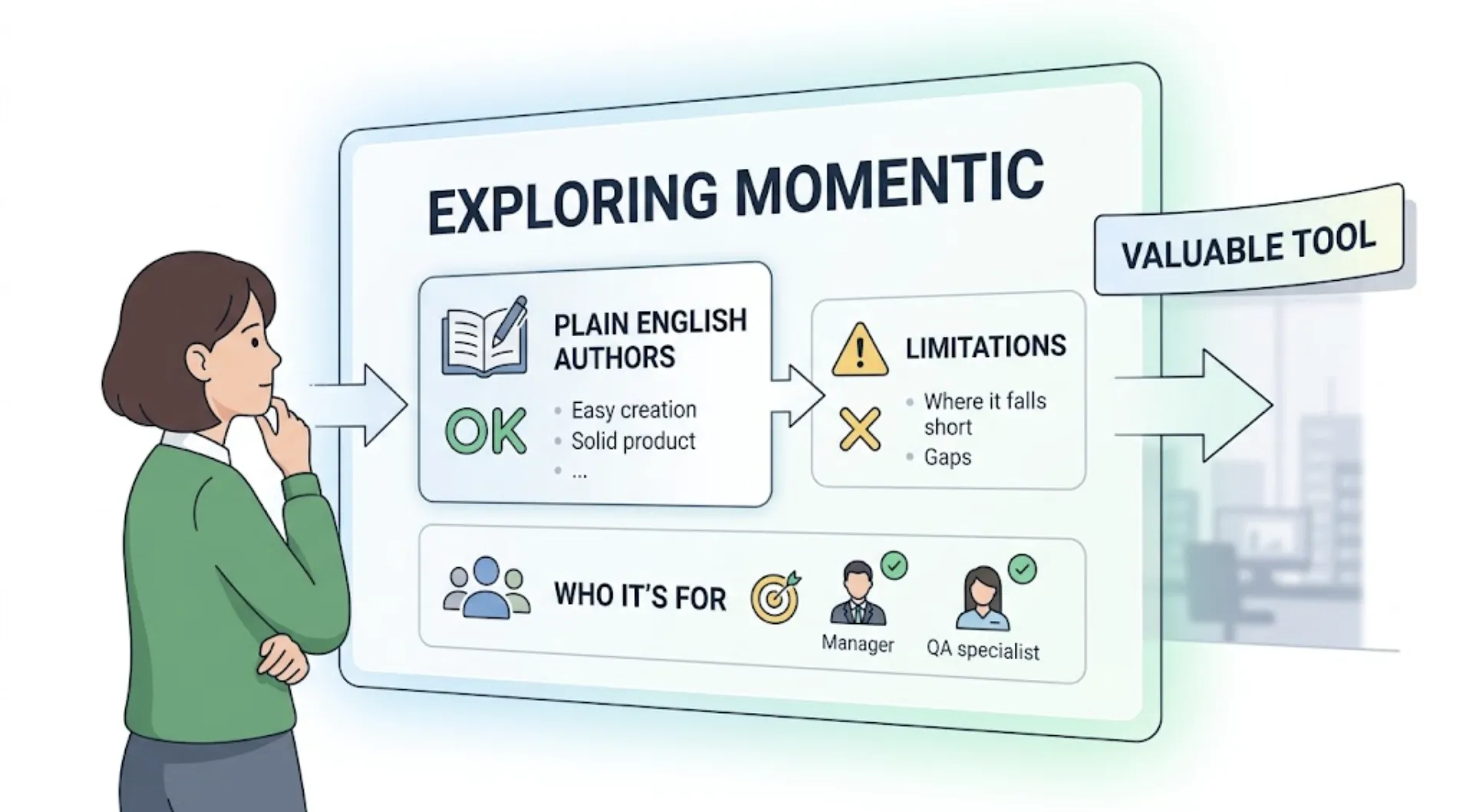
If you've searched "AI testing tool" recently, Momentic has probably shown up. It's a well-funded, YC-backed platform that's built a genuinely solid product around plain-English test authoring. Here's what it actually does, where it falls short, and who it's built for.
What Momentic is
Momentic is an AI testing platform for web, iOS, and Android. You describe a test step in plain English ("add the backpack to the cart and go to checkout"), and its AI agent performs that action in the browser or app, locating elements by description instead of brittle CSS or XPath selectors. Tests are stored as human-readable YAML files that live in your codebase, not hidden inside a proprietary format.
Its core loop runs on five ideas: the agent learns your product from docs, code, and tools like Jira and Figma; tests self-heal as your UI evolves; new tests get generated from pull requests and diffs; failures come with root-cause analysis; and everything runs continuously in CI.
Where Momentic is genuinely strong
A few things are worth calling out honestly, because they're real strengths, not marketing filler:
- Natural language locators and assertions. No CSS or XPath to maintain. You describe what you want checked, in plain terms.
- Cross-platform coverage. Web, iOS, and Android from one platform, with hosted browsers, emulators, and simulators.
- MCP access. Momentic can be driven from Claude Code or Cursor over the Model Context Protocol, and it ships a mobile MCP server for iOS and Android sessions specifically.
- Explore agent. It can autonomously explore your app to discover flows and suggest new tests, which is a meaningfully different starting point than "write a test from scratch."
- Enterprise-grade trust signals. SOC 2 Type 2, a 99.99% uptime SLA, SAML SSO, and audit logs are all in place for teams that need them.
Customer numbers from Momentic's own site put its usage at over 70 million test runs executed and more than 8.9 million auto-heals, which suggests the self-healing mechanism sees real production traffic, not just demo conditions.
Where it's limited
A few things worth knowing before you commit:
- API testing is secondary, not primary. Momentic supports API checks as part of E2E flows or as standalone steps, but it's explicitly not built as a dedicated API-testing layer the way tools like Postman are. If your test needs are backend-heavy, this is worth weighing carefully.
- Browser coverage is Chromium-first. Web testing currently runs on Chromium-based browsers. Cross-browser bugs specific to other engines won't be caught the same way.
- Tests don't export to other frameworks. Momentic's YAML-based tests run through its own interpreter at runtime; they're not Playwright or Cypress scripts you can take with you if you switch platforms later.
- Usage-based pricing can be hard to budget for spiky workloads. Credits reset monthly with no rollover, so a team running large regression suites needs to model usage carefully (more on this below).
Who it's a good fit for
Momentic is a strong pick for teams that want a polished, well-supported E2E platform across web and mobile, especially if natural-language test authoring and self-healing locators matter more than deep backend verification. Its customer list (Notion, Retool, Webflow, Quora, GPTZero, among others) points toward mid-to-large engineering teams that have the budget and the workflow maturity to invest in a dedicated platform.
Where TestSprite fits differently
TestSprite starts from a different premise: rather than authoring E2E tests in a described format, it's PRD-driven. It parses your PRD when one exists, or reverse-engineers product intent from your codebase, so the tests it generates are anchored to what your product is supposed to do rather than what a current implementation happens to do. That distinction matters most for teams shipping AI-generated code quickly, where an implementation bug can otherwise get quietly encoded as "correct" in the test suite.
TestSprite is also evidence-grounded on the backend specifically. Backend Testing 2.0 observes real API responses before generating assertions, which is a different mechanism than Momentic's E2E-first, UI-centric approach.
Other verification tools read your code and guess. TestSprite opens your app and uses it.
Conclusion
Momentic is one of the more capable AI E2E testing platforms available right now, particularly for teams that want cross-platform web and mobile coverage with natural-language authoring. It's not built to be a deep backend verification layer, and its usage-based pricing rewards predictable workloads more than spiky ones. If your team is generating code with AI faster than you can hand-verify it, and backend coverage matters as much as UI, see how TestSprite's PRD-driven approach compares on your actual project.