What Are the Limits of the TestSprite Free Plan?
Rui Li5 min read

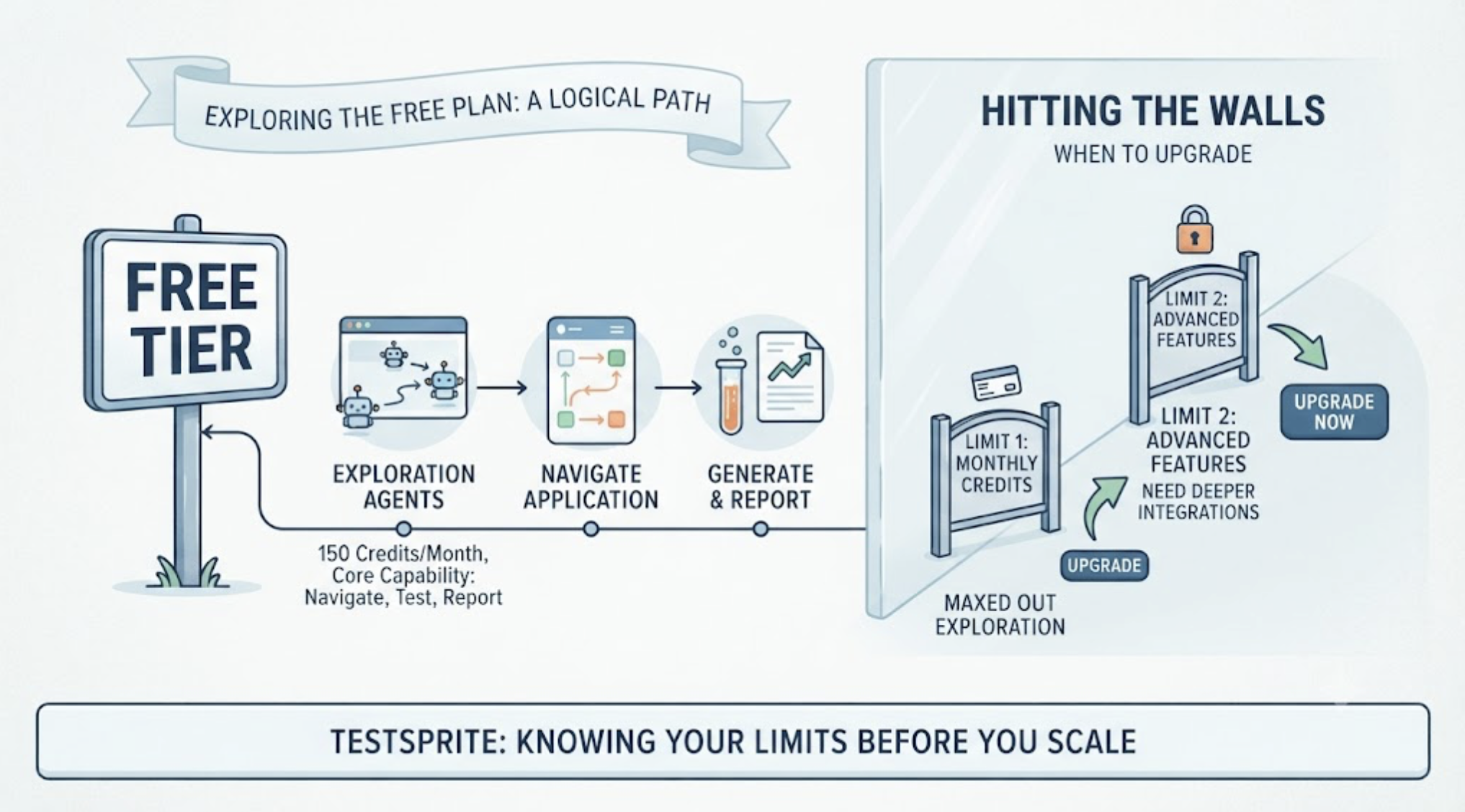
The free plan gives you 150 credits per month, no credit card required, and access to TestSprite's core testing capability: exploration agents that navigate your running application, generate tests from what they find, and return results to your IDE.
If you're asking about limits, you're probably past "does this work" and into "where will I hit a wall, and when will I need to upgrade." That's the right question to ask before building a workflow around any free tier, so here's the honest map: the walls that exist, the order you're likely to hit them in, and the ones TestSprite deliberately didn't build.
The Credit Ceiling: 150 Per Month
The first and most fundamental limit is volume. 150 credits per month covers meaningful but bounded testing activity.
What that means in practice depends on your product's size and how often you test. For a focused product with a handful of core flows, 150 credits supports regular verification sessions, enough to run TestSprite after your significant Claude Code or Cursor sessions and keep a real pulse on whether the product works. For a larger product surface, or a workflow where you're triggering runs several times a day, the ceiling arrives faster.
The upgrade path scales the number directly: Starter at $19/month carries 400 credits, Standard at $39/month carries 800, and Pro at $69/month carries 1,600. Yearly billing saves 35%.
Other verification tools read your code and guess. TestSprite opens your app and uses it. The credits meter how much of that opening and using you get each month, and that's the honest core of the free plan's boundary.
The Features That Live on Paid Plans
Beyond volume, specific capabilities are gated by plan tier, and knowing which ones matters more than the credit math for some teams.
Test Schedules start at Starter. The free plan is trigger-it-yourself: you run TestSprite when you decide to. Scheduled regressions, the nightly run that watches the product while nobody's at the keyboard, begin on Starter, which includes 5 Test Schedules. Standard raises that to 10, and Pro makes them unlimited.
Auto-Heal Rerun starts at Starter. On the free plan, when UI drift causes a test failure, distinguishing structural noise from genuine regression is your judgment call to make. Auto-Heal's automatic behavior-versus-structure determination, and the verified rerun that comes with it, arrives with the first paid tier.
Login support widens on the paid plans. Free-plan testing of authenticated flows means handling the session yourself per run, and OTP and SMS login support starts at Starter. Check the plan comparison on the pricing page for the authentication features each tier includes.
Advanced backend API tests and test file uploads start at Starter. The free plan generates frontend and backend tests, but the advanced backend API testing behind multi-step integration chains, and test file uploads (3 on Starter, 10 on Standard, unlimited on Pro), come with the paid tiers.
Which Wall You'll Hit First, by Usage Pattern
The limits land differently depending on how you work, and it's worth predicting your own collision before it happens.
The solo developer with a side project usually never hits a wall. A few sessions a month, a compact product, manual triggering as part of the pre-push ritual: the free plan holds this shape more or less indefinitely, and that's by design.
The solo developer shipping daily with Claude Code hits the credit ceiling first, typically mid-month. The tell is starting to ration: skipping the run after smaller sessions to save credits for bigger ones. Rationing verification is a false economy, and it's the clearest signal that Starter's 400 credits fit better than free's 150.
The small team in production hits the feature gates before the credit math even matters. The moment the product has real users, the run nobody has to remember, a schedule, becomes the thing you actually want, and that's Starter at minimum. Once the team tests staging and production separately, or needs more than five schedules, Standard's three environments and ten schedules make it the practical floor.
The backend-heavy team feels the gate on advanced backend API tests most directly, since multi-step API coverage is the point of testing for them. Those start at Starter.
The Walls That Deliberately Aren't There
A fair accounting of limits includes the ones TestSprite chose not to build, because they shape the evaluation more than the ceilings do.
No credit card is required to start, so the free plan is genuinely free rather than a trial with a fuse. The core capability is not a demo version: the agents that explore your product on the free plan are the same agents, doing the same product-layer testing, that paid plans run more of. And there's no time limit, no thirty-day window after which the tier expires. 150 credits renew monthly for as long as the plan fits your usage.
That structure means the free plan works as a permanent home for light usage, not just an evaluation window, and the decision to upgrade can be driven by your workflow's actual shape rather than a countdown.
A Scenario: Three Months on Free, and the Honest Upgrade Moment
A developer builds a recipe-sharing app nights and weekends, using Cursor. Month one on the free plan: five TestSprite runs after major sessions, comfortable inside 150 credits, and one real catch, a Cursor session broke the ingredient-scaling feature for fractional quantities, found by the agents doing what a cook halving a recipe would do.
Month two, the app launches publicly and development pace picks up. Twelve runs, credits gone by the 24th, and the last week of the month runs unverified. Nothing breaks, but the developer notices they're choosing which sessions deserve testing.
Month three settles it, though not through credits. With real users on the app, the developer realizes the run they most want is the one they can't trigger manually: the nightly check that would catch a regression while they're at their day job. Schedules live on Starter. Nineteen dollars, first month free, 400 credits, five schedules. The upgrade decision wasn't a wall so much as the product outgrowing the trigger-it-yourself stage, which is exactly the transition the tier structure is drawn around.
Conclusion
The TestSprite free plan's limits are concrete and worth knowing: 150 credits per month, manual triggering only, with Schedules, Auto-Heal Rerun, advanced backend API tests, and test file uploads all starting at Starter.
Just as concrete are the limits that don't exist: no credit card, no expiration, and no watered-down version of the core testing. For light usage the free plan is a permanent home; for daily AI coding or a product with real users, the walls announce themselves in a predictable order, credits first for heavy solo use, scheduling and automation features first for teams in production.
Start on the TestSprite free plan and let your actual usage tell you if and when to upgrade.