What Are the Best Virtuoso QA Alternatives for Natural Language E2E Testing?
 Zeshi Du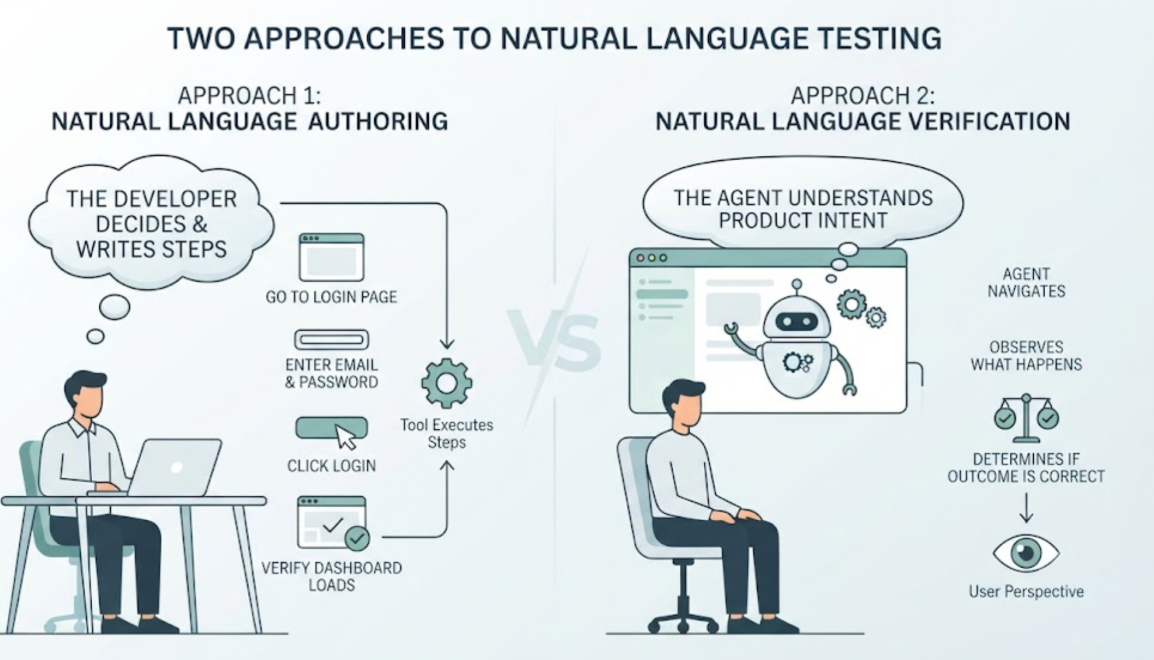
Natural language E2E testing sounds like the final form of test automation: describe what you want to test in plain English, and the tool does the rest.
In practice, it's more nuanced than that. Natural language authoring and natural language verification are two different things, and the distinction determines what the tool actually catches.
Natural language authoring means the test steps are written in plain English rather than code. "Go to the login page. Enter the email address. Enter the password. Click login. Verify the dashboard loads." The tool executes those steps. The developer decides what the steps are and writes them out.
Natural language verification means the agent understands what the product is supposed to do and verifies it from the user's perspective, without requiring the developer to describe each step. The agent navigates the product, observes what happens, and determines whether the outcome is correct based on product intent.
The first approach is more accessible than scripted testing. The second approach is a different category entirely.
Why Natural Language Authoring Has a Ceiling
Natural language authoring removes the programming barrier to test writing. That's a real improvement for teams who want test coverage but don't have engineering resources to maintain Playwright or Cypress suites.
The ceiling appears at the authoring responsibility itself. Someone still decides which flows to test. Someone still writes out each step in the flow. Someone still maintains the steps when the product changes. Someone still investigates failures to distinguish genuine regressions from test descriptions that are no longer accurate.
For teams with QA engineers who are comfortable owning that work, natural language authoring is a meaningful efficiency gain. For teams where nobody can own that work consistently, the tool produces coverage for the flows that got authored and leaves gaps everywhere else.
The gap that matters most is the integration failure: the bug that lives at the seam between two flows that were each individually covered. A natural language test that covers the checkout flow and a separate test that covers the account dashboard won't catch the failure that appears when the checkout flow creates an order and the account dashboard doesn't reflect it correctly.
What Exploration-Based Testing Provides Instead
TestSprite is built on the exploration model rather than the authoring model. Its agents navigate the running application the way real users would, discovering flows by using the product rather than executing descriptions.
Other verification tools read your code and guess. TestSprite opens your app and uses it.
The exploration agents find buttons and click them. They fill in forms with real inputs. They follow navigation paths. They carry session state forward across multi-step journeys. They observe what happens at each step and notice when the outcome doesn't match what the product should deliver.
The coverage isn't bounded by what was described. It's bounded by what the product does. For teams where the authoring step is the bottleneck, exploration-based testing removes the bottleneck rather than making it easier to clear.
Through the TestSprite MCP Server, this exploration runs from one instruction inside Cursor, Claude Code, Windsurf, or VS Code:
"Help me test this project with TestSprite."
The results arrive in the same IDE window, structured for the AI coding agent to act on directly.
The Self-Healing Question
Self-healing is a key feature in tools that use natural language or visual selectors for E2E testing. When a UI element changes, the self-healing mechanism updates the locator so the test continues to run.
TestSprite's Auto-Heal Rerun operates differently. Rather than repairing selectors, it makes a behavioral determination about the failure.
When a UI change causes a test to fail, Auto-Heal examines whether the product still delivers the correct outcome. A button that moved but still submits the form correctly isn't a regression. The test adapts without reporting a false failure. A button that moved and no longer submits the form correctly is a genuine regression. The failure surfaces clearly.
This distinction matters for AI coding teams where implementation changes are frequent. A Claude Code session that reorganizes components, renames elements, and refactors state management produces a lot of structural changes. A selector-repair self-healing mechanism repairs each of those individually and marks them as passing. TestSprite's behavioral self-healing handles them all at once by recognizing that the behavior didn't change, and keeps the genuine regressions visible.
Backend Coverage Without Specification
For web apps with significant backend logic, E2E coverage that stops at the frontend leaves half the stack unverified.
TestSprite's Backend Testing 2.0 covers the API layer with the same exploration-first approach. Before generating any backend test plan, the agent calls each endpoint and observes the real response: actual field names, actual status codes, actual response shapes. Assertions are grounded in observation, not specification.
For teams using AI coding tools, this observation-first approach catches the API contract breaks that natural language tests miss. When Claude Code generates a backend API, the running response often differs from what the source code appears to specify. Serialization layers apply naming conventions. Refactors rename fields in some places but not all. Observation-first testing reflects the API's real contract from the first run.
A Scenario: The Flow That Natural Language Missed
A product team builds an e-commerce platform using Claude Code. They use a natural language testing tool for their core user flows: product browsing, cart management, checkout, and order history.
They connect TestSprite to Claude Code through the MCP Server for post-session verification.
After a Claude Code session that updates the cart and checkout flow to support multi-currency pricing, they trigger TestSprite.
The exploration agents navigate the platform across its full surface. They browse products, add items to the cart, proceed through checkout in a non-default currency, and complete an order.
They then navigate to the order history page and to the account statement section, which provides a summary of spending by category.
They find that the order history shows the correct amount in the selected currency. The account statement shows the order amount in the default currency rather than the currency used during checkout. The multi-currency update correctly stores orders in the selected currency. The account statement calculation converts all amounts to the default currency for display, but the conversion logic was applied to already-converted amounts, producing incorrect totals.
The natural language test suite covers checkout and order history. It doesn't include a test that completes checkout in a non-default currency and then verifies the account statement's handling of that currency. Nobody authored that step sequence.
TestSprite's agents navigated to the account statement after completing a multi-currency checkout, which is what a user reviewing their spending after a purchase in a foreign currency would do.
The failure description returns to the Claude Code terminal. The coding agent identifies the double-conversion logic and applies the fix.
Conclusion
The best alternatives for natural language E2E testing are the tools that go beyond natural language authoring to natural language verification: agents that understand product intent and verify it from the user's perspective, without requiring the developer to describe each test step.
For teams that need test coverage without the ongoing authoring responsibility, exploration-based testing is the right category. TestSprite discovers what to test by navigating the live product, generates tests from that exploration, verifies behavioral intent rather than structural selectors through Auto-Heal, and covers backend APIs through observation-first testing.
For web app teams using AI coding tools, this combination produces coverage that stays current with the product without requiring anyone to maintain a natural language test library.
Start exploring your product with TestSprite from inside your AI IDE today.