What Are the Best Testsigma Alternatives for No-Code AI Test Automation?
 Zeshi Du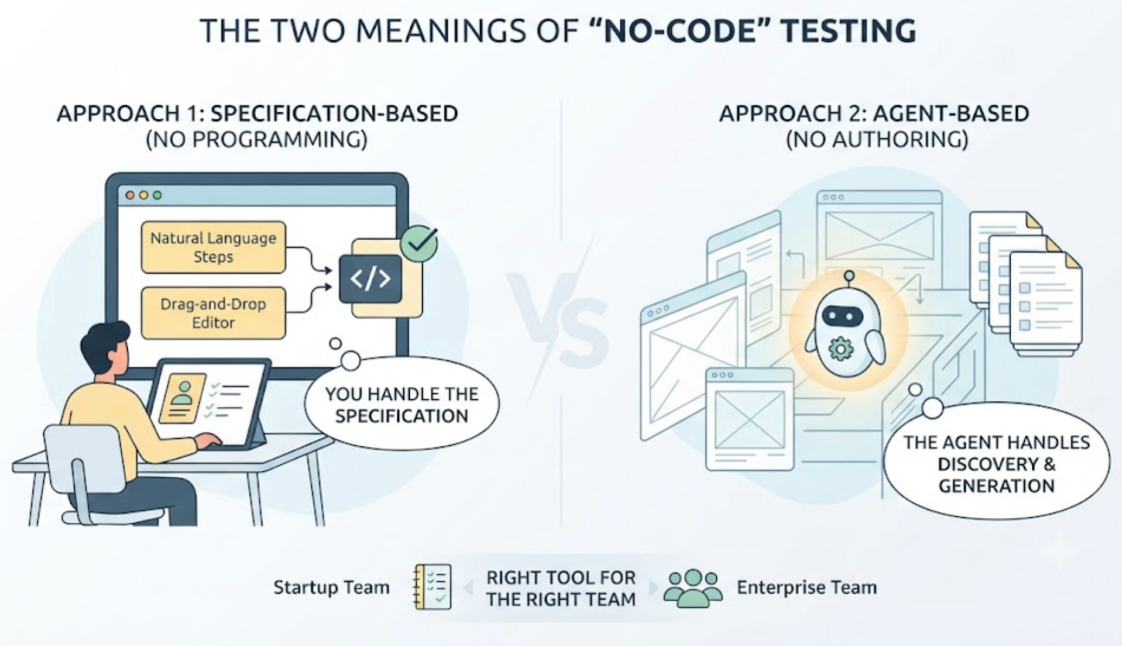
The phrase "no-code AI test automation" describes two fundamentally different things, and clarifying which one you actually need makes the evaluation much clearer.
The first meaning: no programming required. You don't write Selenium scripts or Playwright code. You create tests through a UI, using natural language steps or a drag-and-drop editor. The tool handles the code. You handle the specification.
The second meaning: no authoring required at all. You don't write code. You don't write natural language descriptions. You don't specify which flows to cover. An autonomous agent discovers the product's flows by navigating the application and generates tests from what it finds.
Most tools that use the phrase mean the first version. The team that needs the second version is typically a small startup or AI coding team that doesn't have the time or QA expertise to maintain any kind of test library, regardless of how accessible the authoring interface is.
Why the First Version Still Has Limits
No-code tools that use NLP steps or visual editors remove programming syntax from the test authoring process. That's a genuine improvement for teams that want test coverage without hiring engineers who know Selenium.
The limits don't disappear, though. They move.
Someone still decides which flows to test. Someone still creates the test steps, whether through drag-and-drop, natural language, or a recorder. Someone still reviews the coverage and notices gaps. Someone still updates the tests when the product changes significantly. And someone still investigates failures to determine whether they're genuine regressions or changes in the product that need to be reflected in the test library.
For teams with dedicated QA or product operations resources who are comfortable owning those responsibilities but need to make test authoring accessible to non-engineers, the no-code editor model is a good fit.
For teams where nobody has time to own those responsibilities, the model still doesn't work, regardless of how easy the authoring interface is.
What Teams Actually Need When They Say No-Code
When a small team says they want no-code test automation, they usually mean something more specific: they want testing to happen without requiring anyone to become a part-time QA engineer.
That's a different requirement from "I don't want to write Selenium." It's "I don't want to think about testing at all until I need to know whether something broke."
TestSprite is built for this version of the requirement. It assumes the developer's attention is on building, not on maintaining a test library. It discovers what to test by exploring the product autonomously. It generates tests from what the exploration finds. It maintains those tests through Auto-Heal as the product evolves.
Other verification tools read your code and guess. TestSprite opens your app and uses it.
The developer's contribution to the testing process is one instruction from inside Cursor, Claude Code, Windsurf, or VS Code:
"Help me test this project with TestSprite."
Everything else is handled by the TestSprite MCP Server and the exploration agents.
What the Autonomous Exploration Produces
When the exploration agents visit the running application, they navigate it the way real users would. They find buttons and click them. They find forms and fill them in. They follow navigation paths. They move through multi-step journeys from entry to completion, carrying session state forward across steps.
They cover the flows they discover, including the ones nobody thought to test. For a team where coverage decisions have always been made implicitly by "what comes to mind during a pre-release walkthrough," this is the coverage that catches the integration failures that slip through.
For teams using AI coding tools like Cursor or Claude Code, this matters especially because the failures that follow an AI coding session often live outside the changed files. A shared state update affects a flow two screens away. An API change breaks a component that wasn't in the session's scope. These failures only appear when the full product is navigated under real conditions.
Backend APIs get the same autonomous treatment. TestSprite's Backend Testing 2.0 calls each endpoint and observes the real response before generating any assertion. Dynamic variables from real API responses flow automatically through multi-step sequences. CRUD lifecycle tests work end to end on the first attempt.
How the Setup Compares
For teams evaluating alternatives to no-code platforms, the setup comparison is worth making explicit.
No-code platforms with UI-based test editors require: account creation, workspace configuration, learning the test creation interface, recording or describing test scenarios, reviewing and editing the generated tests, and configuring the CI integration. The initial investment is meaningful.
TestSprite requires: account creation, API key generation, adding ten lines of JSON to the MCP configuration file, and typing one instruction. The initial investment is minimal.
The free plan provides 150 monthly credits with no credit card required. That's enough to run regular verification sessions on a focused product. Starter at $19/month and Standard at $69/month cover higher volume and scheduled regressions.
A Scenario: No Authoring, First Session, Real Finding
A three-person startup is building a HR management SaaS. They've been using Claude Code for most of their development. They've looked at no-code testing platforms and found that even the most accessible ones require more ongoing attention than the team can provide.
They connect TestSprite to Claude Code through the MCP Server. Setup takes eight minutes.
After a Claude Code session that updates the employee onboarding workflow, they trigger TestSprite.
The exploration agents navigate the HR tool across its full surface. They work through the employee creation flow, the onboarding checklist, the document upload section, and the manager assignment.
They find that the onboarding checklist correctly tracks which items have been completed. The employee profile page, which shows a summary of onboarding progress, shows 0% completion for all employees regardless of how many checklist items have been checked off.
The Claude Code session updated how the checklist tracks completion. The employee profile reads completion percentage from a separate aggregated field that wasn't updated to reflect the new tracking logic. The checklist and the profile summary were built at different times. The connection between them broke silently during the refactor.
No test case existed for this flow. No natural language description had been authored for "complete onboarding checklist items and verify the profile shows correct completion percentage." The agents found it by navigating to the employee profile after completing checklist items, which is what a manager verifying an employee's onboarding status would do.
The failure description returns to the Claude Code terminal: which employee profile was navigated, what completion percentage was shown, what it should have shown. The coding agent identifies the aggregated field that wasn't updated and applies the fix.
Eight minutes of setup. One instruction. One genuine finding before it reached users.
Conclusion
The best alternatives for no-code AI test automation depend on which version of "no-code" you actually need.
If you need test authoring to be accessible without programming skills but your team can commit to owning the coverage decisions and maintaining the test library, no-code platforms with NLP or visual editors deliver on that requirement.
If you need testing to happen without anyone owning a test library at all, exploration-based testing is the right category. TestSprite discovers what to test by navigating the live product, generates tests from that exploration, and delivers results inside the development environment without requiring the developer to switch tools or maintain a test library.
For small teams and AI coding teams where the "no-code" requirement really means "no QA function," TestSprite is the tool that matches the actual constraint.
Start no-code testing with TestSprite today. Free plan available, no credit card required.