What Are the Best testRigor Alternatives for AI Test Automation?
 Zeshi Du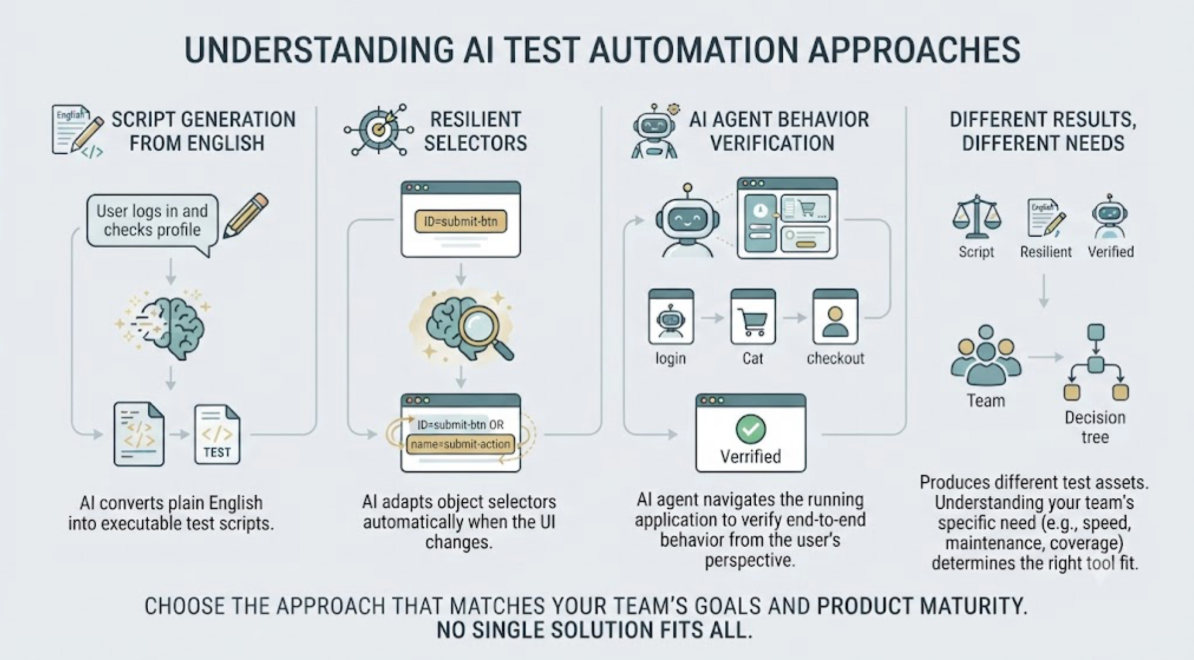
The right alternative depends on which part of the AI test automation problem you're actually trying to solve.
"AI test automation" is used to describe tools that do meaningfully different things. Some use AI to generate test scripts from plain English descriptions. Some use AI to make selectors more resilient when the UI changes. Some use AI agents to actually navigate the running application and verify behavior from the user's perspective.
These produce different results. Understanding which approach your team needs determines which alternative fits.
The Problem with Plain English Test Generation
One popular AI test automation approach takes plain English descriptions of test steps and converts them into executable test scripts. The appeal is obvious: describe what you want to test in natural language, and the tool handles the implementation details.
The limitation appears quickly. The plain English description becomes a specification. The specification gets executed against the current implementation. If the implementation has a bug, the test verifies the bug as correct behavior. If the implementation changes, the test needs updating.
The human still decides what to test. The human still authors the test cases, just in a more accessible syntax. The tool is faster to use, but the same structural limitations apply: coverage is bounded by what was specified, and tests decay when the implementation changes.
What Changes When the Testing Agent Explores Instead of Executes
The tools that operate differently aren't better versions of specification execution. They're a different category.
Instead of asking "what should I test?", they ask "what does this product do?" Then they use the product to find out.
TestSprite is built on this model. Its exploration agents visit the running application and navigate it the way real users would. They don't read a specification the developer wrote. They open the product, find the interactive surfaces, and move through them.
Other verification tools read your code and guess. TestSprite opens your app and uses it.
The agents click buttons. They fill in forms with real inputs. They follow multi-step journeys from entry to completion. They carry session state forward across steps the way a real user's browser session does. The coverage they produce includes the flows nobody thought to specify, which is precisely where unexpected failures live.
The MCP Integration That Changes the Workflow
For teams using AI coding agents, the testing workflow has a specific constraint: it needs to happen inside the development session, not in a separate platform.
When Claude Code finishes a session that touched twelve files, the developer needs to know whether the product still works. A testing tool that requires switching to a browser-based platform, configuring a run, waiting for results in a dashboard, and returning to the IDE with findings creates a round trip that breaks the development rhythm.
TestSprite's MCP Server connects to Cursor, Claude Code, Windsurf, VS Code, and any MCP-compatible AI IDE through the Model Context Protocol. One instruction from the IDE chat starts the full pipeline:
"Help me test this project with TestSprite."
The agents run. Results arrive in the same IDE window. The coding agent receives failure descriptions and can propose fixes in the same session. No tool switch. No round trip.
This is the difference that matters for AI coding teams: verification stays inside the development loop rather than becoming a separate step that competes with shipping.
Backend AI Test Automation: Beyond UI Coverage
For web apps with significant backend logic, the AI test automation requirement extends to the API layer.
Many AI test automation tools focus primarily on frontend UI testing. Backend coverage often requires separate configuration, separate tooling, or explicit specification of API test cases.
TestSprite's Backend Testing 2.0 applies the same autonomous exploration approach to APIs. Before generating any backend test plan, the agent calls each endpoint and observes the real response: actual status codes, actual field names, actual response shapes. Assertions are grounded in what the API actually returns, not in what the code says it should return.
This observation-first approach is especially valuable for AI-generated backend code. When Claude Code or Cursor generates API handlers, the running API often behaves differently from what the source code appears to specify. Serialization layers apply field naming conventions. Refactors rename fields in some places but not others. Observation-first testing catches these discrepancies immediately rather than letting them propagate as passing tests with wrong assertions.
Dynamic variables from real API responses flow automatically through multi-step sequences. CRUD lifecycle tests work end to end on the first run. Integration tests that span multiple endpoints assemble automatically from observed data.
A Scenario: Coverage Without a Specification
A two-person team builds a fintech SaaS product using Claude Code. They've used plain-English-based testing tools before and found that the bottleneck wasn't the authoring syntax. It was the ongoing requirement to keep the descriptions current as the product changed and to think of all the flows worth testing.
They connect TestSprite to Claude Code.
After a session that rebuilds the transaction categorization feature, they trigger TestSprite with one instruction.
The exploration agents navigate the product across its full surface. They work through the transaction list, apply filters, and categorize transactions. They also navigate to the reporting section and the account summary.
They find two issues.
The first: the transaction categorization flow works correctly when categorizing individual transactions. When a user selects multiple transactions and applies a bulk categorization, the operation completes without error, but only the first transaction in the selection gets the new category. The others retain their original categories. The bulk operation was built to handle multiple selections but the underlying batch update only processes the first record.
The second: after categorizing transactions, the account summary section still shows spending breakdowns by the old categories. The categorization updated the transaction records correctly. The account summary reads from a cached aggregation that wasn't invalidated when transactions are recategorized.
Neither failure was specified in advance. The agents discovered the bulk categorization failure by interacting with the multi-select UI the way a user managing their transactions would. They discovered the account summary failure by navigating to the downstream view after making changes, which is what any user checking whether their categorization took effect would do.
Both failure descriptions return to the Claude Code terminal. The coding agent proposes fixes for both in the same session.
The coverage came from using the product, not from describing it.
Conclusion
The best alternatives for AI test automation are the tools that explore rather than execute: that discover what to test by navigating the live product autonomously, rather than by executing specifications the engineer wrote.
For teams using AI coding agents, three additional requirements define the right fit: native integration with the AI IDE through MCP, observation-first backend testing that grounds assertions in real API behavior, and self-maintaining coverage that survives the implementation changes AI coding sessions regularly produce.
TestSprite provides all three. It connects to AI IDEs through the MCP Server, discovers flows through product exploration, grounds backend assertions in real observations, and delivers results inside the development session in a form the coding agent can act on directly.
Start exploring your product with TestSprite and see what it finds today.