What Are the Best Testim Alternatives for AI-Powered E2E Testing?
 Zeshi Du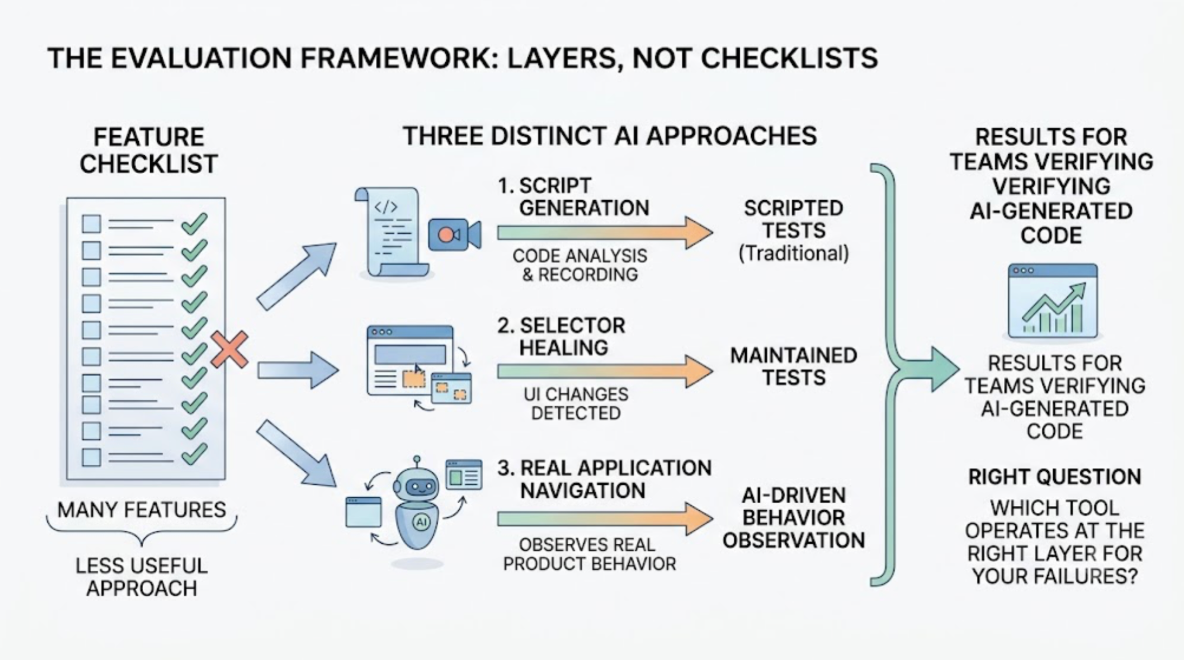
The phrase "AI-powered E2E testing" covers a wide range of tools with very different approaches. Understanding what separates them is more useful than a feature checklist.
Some tools use AI to generate test scripts from code analysis or recorded interactions. Some use AI to heal selectors when the UI changes. Some use AI agents to actually navigate the running application and observe real product behavior. These are three different things, and they produce meaningfully different results for teams whose primary concern is verifying that AI-generated code works for real users.
For teams evaluating alternatives for AI-powered E2E testing, the right question isn't which tool has the most AI features. It's which tool operates at the right layer for the kind of failures you're trying to catch.
The Layer Problem in AI Testing
E2E testing has a precise definition worth holding onto: a user starts somewhere, takes a sequence of actions, and the system delivers the correct outcome at the end of that journey. Every layer of the stack is exercised in sequence, under real conditions.
Many tools that claim to do AI-powered E2E testing actually operate below that layer. They generate test scripts that simulate user actions, but the scripts are authored or recorded against the current implementation. When the implementation changes, the scripts need updating. When the implementation has a bug, the scripts often encode that bug as correct behavior.
The tools that operate at the true E2E layer visit the live application, navigate it with autonomous agents, and verify outcomes from the user's perspective. They don't read the code. They use the product.
This distinction determines what the tool catches and what it misses.
What AI-Powered E2E Testing Needs to Mean for AI Coding Teams
For teams using Cursor, Claude Code, or GitHub Copilot, the E2E testing requirement has specific characteristics.
The failures that matter most aren't in the code that was just written. They're at the integration points between what changed and what didn't. A Claude Code session that refactors state management and updates three components can break a flow in a fourth component that wasn't touched. No test that was written against the previous implementation will catch this unless it navigates the full flow under the new conditions.
The testing needs to happen inside the development environment, not in a separate platform. At AI coding speed, leaving the IDE to check test results and returning to make fixes breaks the workflow rhythm that makes AI-assisted development valuable.
The coverage needs to extend beyond what was specified. The flows that nobody wrote a test for are the ones where integration failures hide.
TestSprite: E2E Testing That Operates at the Product Layer
TestSprite is an autonomous AI testing agent that operates at the product layer. Its agents navigate the live application the way real users do, not by executing predefined scripts but by discovering what the product does through exploration.
Through the TestSprite MCP Server, one instruction from inside Cursor, Claude Code, Windsurf, or VS Code starts the full pipeline:
"Help me test this project with TestSprite."
Other verification tools read your code and guess. TestSprite opens your app and uses it.
A fleet of parallel exploration agents visits the running application. They click through UI flows, fill in forms with real inputs, follow multi-step journeys from entry to completion, carry session state across steps. They explore the full product surface rather than the flows someone specified. When they find a failure, the description is product-level: which action was taken, what the product should have delivered, what actually happened.
That description returns to the IDE in a format the AI coding agent can act on directly. The loop from code change to E2E verification to applied fix closes inside a single development session.
Backend E2E Coverage: Observation Before Assertion
For teams with backend APIs, the E2E coverage requirement extends below the frontend.
The typical approach in AI testing tools is to generate backend assertions from code analysis or human specification. This approach has a specific failure mode for AI-generated code: the running API frequently returns responses that differ from what the code or specification suggests. Field naming conventions differ between handler variables and serialized output. A refactor changes field names in some places but not all. Status codes chosen by the AI differ from what previous tests expected.
TestSprite's Backend Testing 2.0 eliminates this failure mode by calling the endpoint first and observing the real response. Every assertion is grounded in observed behavior. When an AI coding session changes the backend and a field gets renamed, the next test run identifies the deviation as a specific finding: which endpoint, which field, what the prior observation showed, what the current response contains.
Dynamic variables from real API responses flow automatically through multi-step sequences. CRUD lifecycle tests capture the actual ID from a create response and pass it to downstream steps. Integration tests that span multiple endpoints work end to end on the first attempt.
Self-Healing That Understands Behavior vs Structure
One of the most cited features in AI testing tools is self-healing: the ability to update tests automatically when the UI changes. This sounds like a complete solution until you consider what it actually heals.
Most self-healing implementations repair selectors and element locators when they change. A component gets renamed, a button moves, a class name updates. The test was anchored to the old selector and the healing updates it to the new one.
This is useful, but it's selector repair, not behavioral verification. The healed test might now find the right element while the product behavior the test was supposed to verify is broken.
TestSprite's Auto-Heal Rerun operates differently. When a test fails after a UI change, the agent determines whether the failure reflects a genuine behavioral regression or a structural change that doesn't affect what users experience. A renamed component that still submits the form correctly is a structural change. The test adapts. A renamed component that now fails to submit the form is a genuine regression. The test surfaces it.
For AI coding teams where component renames and layout refactors happen frequently, this distinction is what keeps the test suite trustworthy over time.
A Scenario: The E2E Failure That Scripts Miss
A team builds a multi-tenant SaaS using Claude Code. An AI coding session builds the workspace switching feature: users can belong to multiple workspaces and switch between them from a dropdown in the navigation.
Before pushing, the developer triggers TestSprite from inside Claude Code.
The exploration agents navigate the workspace switching feature as a real user with access to multiple workspaces would. They switch from Workspace A to Workspace B. They navigate to the project list.
They find that the project list shows the projects from Workspace A, not Workspace B. The workspace switch updated the displayed workspace name in the navigation correctly. The underlying data fetch for the project list didn't update its workspace context. The user sees Workspace B selected but Workspace A's data.
A scripted test that was authored against the feature specification would have verified that the dropdown updates and the workspace name changes. It wouldn't have navigated to the project list and verified that the data context updated, unless the engineer who wrote the test anticipated this specific failure mode and specified it.
TestSprite caught it because the agents navigated through the workspace switch the way a real user would: switch workspaces, then navigate to the primary content to verify the switch took effect. The failure is in the interaction between the workspace context update and the project list data fetch, not in either component individually.
The failure description returns to Claude Code: which workspace was selected, what the navigation showed, what the project list showed instead. The coding agent identifies the missing context propagation and applies the fix in the same session.
Conclusion
The best alternatives for AI-powered E2E testing are the tools that operate at the product layer rather than the script layer: autonomous agents that navigate the live application, observe real product behavior, and return findings in terms of what users experience rather than which assertions evaluated to false.
For teams using AI coding tools, the additional requirements are: native IDE integration that keeps the testing loop inside the development session, observation-first backend testing that grounds assertions in real API behavior, and self-healing that distinguishes behavioral regressions from structural changes.
TestSprite provides all of these. Its MCP Server connects to the AI IDE. Its exploration agents navigate the live product. Its Backend Testing 2.0 observes before asserting. And its Auto-Heal understands the difference between a UI change and a product regression.
Start AI-powered E2E testing with TestSprite from inside your AI IDE today.