What Are the Best Self-Healing Test Automation Tools for Fast-Changing Web Apps?
 Zeshi Du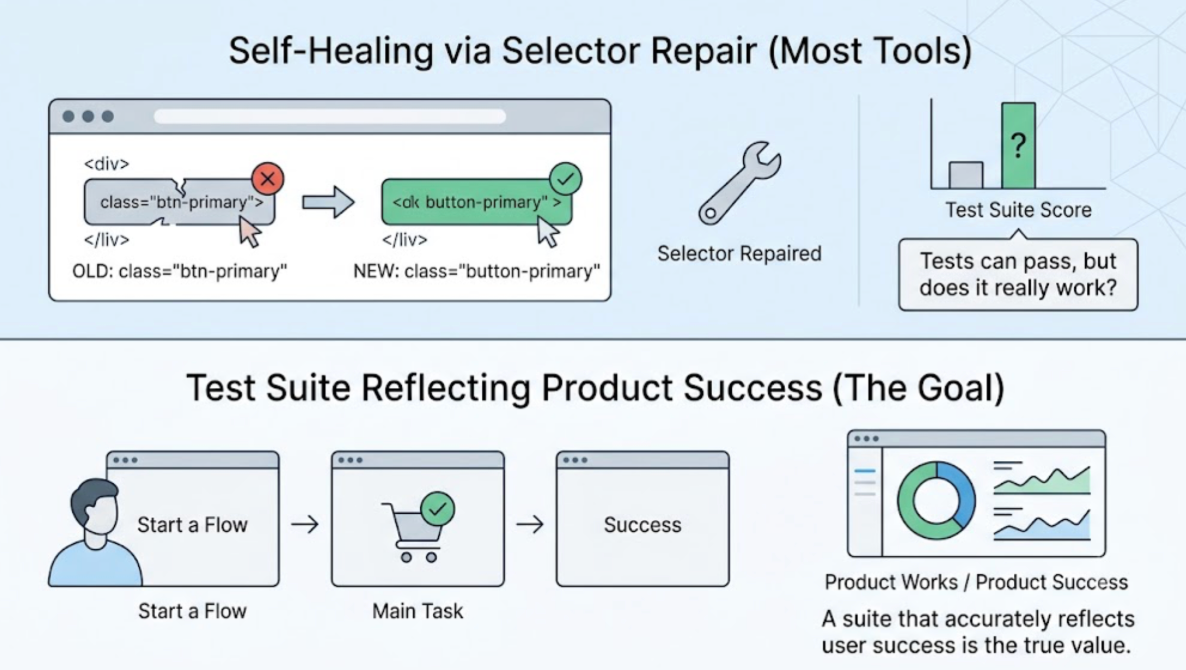
Self-healing test automation is one of those terms that sounds like a complete solution until you ask what it actually heals.
Most tools that advertise self-healing capabilities are doing selector repair. They detect that a CSS class name changed, that an element ID was updated, or that an element's position in the DOM shifted, and they update the selector the test was using to find the element. The test that was failing because class="btn-primary" became class="button-primary" now passes again.
This is useful. It's not the same as a test suite that accurately reflects whether your product works.
Selector repair handles the symptom of one specific cause of test decay: tests anchored to implementation details that change when developers refactor or AI coding agents reorganize component logic. It doesn't handle tests that are passing when the product is actually broken, which is a different and more dangerous failure mode.
The self-healing capability worth having is the one that distinguishes between a test that needs to adapt and a test that needs to surface a genuine regression.
What "Self-Healing" Needs to Mean for Fast-Changing Apps
Fast-changing web apps, especially those built with AI coding tools like Cursor or Claude Code, produce a specific kind of test decay pattern.
A session modifies state management and renames several components. Some tests fail because the component names changed. Those failures should heal: the behavior is correct, the implementation changed.
The same session accidentally changes how context propagates between two components. A test that was passing continues to pass because it was testing the individual components in isolation. A user flow that depends on both components working together is now broken. That shouldn't heal: the failure is real and needs to surface.
A good self-healing tool handles the first case automatically and surfaces the second clearly. A tool that only does selector repair helps with the first case and leaves the second invisible.
The distinction requires something the selector-repair tools don't have: a testing approach grounded in product behavior rather than implementation structure.
Why Product-Layer Testing Heals More Accurately
Selector-based tests fail when selectors change. Product-behavior tests fail when product behavior changes.
When a component gets renamed, a selector-based test's selector becomes invalid. The test breaks. Selector repair updates the selector. Healing complete.
When a component gets renamed, a product-behavior test looks for the element that submits the form, the element that displays the error message, the element that shows the confirmation. If those functional elements still exist and still work, the test passes. The rename didn't change the behavior. The test didn't need to heal because it never broke.
This is a fundamentally cleaner foundation for self-healing. Tests that are anchored to behavior don't decay when implementation changes. They decay when product behavior changes, which is exactly when they should surface a failure.
TestSprite builds its tests at the product layer. Its exploration agents navigate the live application the way real users would, generating test cases that describe user interactions and expected outcomes rather than selectors and assertions against DOM structure.
Other verification tools read your code and guess. TestSprite opens your app and uses it.
Auto-Heal Rerun: How TestSprite Handles Structural Drift
When a test does fail after a product change, TestSprite's Auto-Heal Rerun makes the determination of whether the failure is structural or behavioral.
On rerun, the agent replays the test. If the test fails because a UI element that was in one position is now in another, the agent recognizes that it's looking at a structural change and adapts the test to match the current UI. The product still works. The test updates.
If the test fails because the product no longer delivers the correct outcome, the failure surfaces. The product behavior changed. The agent reports a genuine regression.
This is not Auto-Heal rewriting application code. It's the agent applying the same judgment a QA engineer uses when they triage a failed test before raising a bug: is this a test maintenance issue or an actual product problem?
For teams using AI coding agents that frequently reorganize components, rename elements, and refactor layouts, the distinction matters every day. Without it, the test suite either accumulates false positives that erode trust or misses real regressions because the healing was too aggressive.
Self-Healing for Backend API Tests
Self-healing test automation for fast-changing web apps can't stop at the frontend. The APIs those apps depend on change too, and the test suite needs to adapt correctly when they do.
TestSprite's Backend Testing 2.0 establishes observed baselines for each API endpoint: real status codes, real field names, real response shapes captured from actual calls. When an AI coding session changes the backend and the API now returns a different response shape, the next test run compares the new response against the established baseline.
If the change is intentional and the API contract updated correctly, the baseline updates to reflect the new contract. If the change was unintentional and broke a contract that callers depend on, the deviation surfaces as a concrete finding.
After every backend test run, resources created during testing are swept automatically. The test environment stays clean. The next run starts from a known state.
A Scenario: Healing the Right Failures
A team builds a SaaS dashboard using Cursor. An AI coding session redesigns the navigation structure, renames several components, and reorganizes the sidebar layout. It also, as a side effect, changes how the selected project is passed to the main content area.
The next CI run produces five test failures.
Four are structural drift from the navigation redesign. The component names changed. The layout positions shifted. Auto-Heal recognizes that the navigation still works, the links still go to the right places, and the content still loads correctly. Four tests adapt. No investigation required.
One failure is genuine. The main content area stopped receiving the selected project context correctly because of the side effect in the state management change. The dashboard loads, but it loads without knowing which project was selected, defaulting to the first project regardless of what the user chose.
This is a real regression. It surfaces clearly. The failure description goes to the Cursor coding agent: which flow was navigated, what project selection was made, what the dashboard displayed instead. The agent locates the missing context propagation and proposes the fix.
Four healed. One surfaced. Both outcomes correct.
Conclusion
The best self-healing test automation tools for fast-changing web apps are the ones that heal the right failures and surface the right regressions. That requires tests anchored to product behavior rather than implementation structure, and a healing mechanism that makes the distinction between structural drift and genuine regression rather than repairing everything indiscriminately.
TestSprite's exploration agents generate tests from observed product behavior. Its Auto-Heal Rerun adapts tests when UI structure changes without affecting behavior. Its Backend Testing 2.0 establishes observed API baselines that catch contract breaks. And its structured failure descriptions return genuine regressions to the IDE in a form the coding agent can act on directly.
For teams using AI coding tools to build and iterate fast, that's the self-healing capability that keeps the test suite accurate rather than just keeping it green.
Start using TestSprite's self-healing test automation for your fast-changing web app today.