What Are the Best QA Wolf Alternatives for Automated E2E Testing?
 Zeshi Du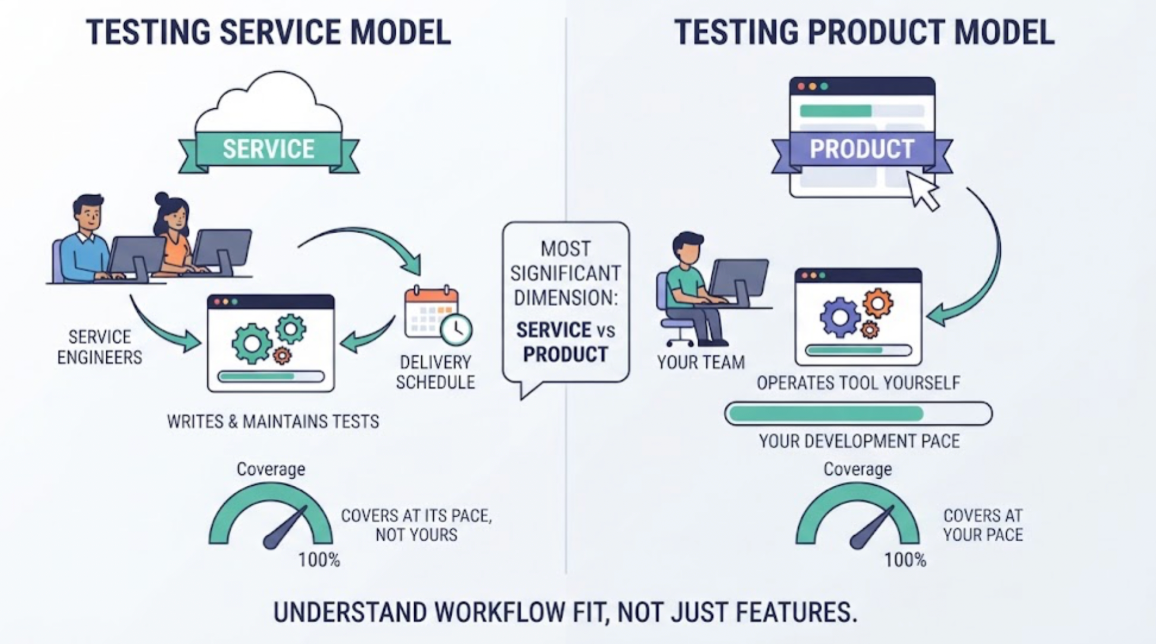
Automated E2E testing is a broad category that includes tools with very different operational models. Understanding which model fits your team's workflow is more useful than comparing feature lists.
The most significant dimension is whether you want a testing service or a testing product.
A testing service delivers test coverage on your behalf. Engineers at the service write and maintain your tests. You get coverage without having to operate the tool yourself. The tradeoff is that the coverage reflects the service's delivery schedule, not your development pace. A Claude Code session that ships changes today gets coverage when the service's next delivery cycle runs.
A testing product gives you a tool that your team operates directly. Coverage runs immediately when you trigger it. The tradeoff is that someone on your team is operating the tool.
For teams using AI coding agents, the delivery schedule tradeoff is often the deciding factor. When code changes at the speed of Cursor or Claude Code, waiting for a service delivery cycle to verify what was built creates a gap that's felt with every session.
What Fast-Moving Development Teams Actually Need
The verification requirement for AI coding teams has two characteristics that a service delivery model struggles to meet.
The first is immediacy. When Claude Code finishes a session, the developer needs to know whether the product still works before pushing. Not in the next service cycle. Now. The product-layer failures that AI coding sessions introduce live in the interaction between what changed and what didn't, and catching them before they merge requires running verification in the window between "AI finished writing" and "push to main."
The second is integration with the development environment. Claude Code runs in the terminal. Cursor runs in an IDE chat interface. A testing service that delivers results in a dashboard somewhere outside the development environment requires a context switch that breaks the development rhythm. For a team that might run three or four Claude Code sessions in a day, that context switch compounds.
What fast-moving teams need is product-layer testing that runs when they trigger it, returns results where they're working, and doesn't require waiting for a delivery schedule.
TestSprite: Product-Layer E2E Testing on Demand
TestSprite is a testing product, not a testing service. When you trigger it, it runs immediately. The results arrive in your IDE. The coverage isn't bounded by a delivery schedule.
Through the TestSprite MCP Server, one instruction from inside Cursor, Claude Code, Windsurf, or VS Code starts the full E2E pipeline:
"Help me test this project with TestSprite."
Other verification tools read your code and guess. TestSprite opens your app and uses it.
A fleet of parallel exploration agents visits the running application and navigates it the way real users would. They click through UI flows, fill in forms with real inputs, follow multi-step journeys, carry session state across steps. They cover the full product surface, not just the recently changed flows. The integration failures that live outside the diff are exactly what they find.
The results arrive in the same IDE window, structured for the AI coding agent to act on directly. The loop from code change to E2E verification to applied fix closes inside the development session.
What "Automated" Means When It's Truly Autonomous
Testing services automate test execution. The test cases are written by humans (or AI-assisted humans), and the execution is automated.
TestSprite automates both execution and discovery. The agents find what to test by navigating the product. They don't need a human to specify which flows to cover. This is the difference between automating a task and delegating a task.
For an E2E testing alternative to a service model, this autonomy is what makes the operational comparison fair. A testing service provides human expertise at the specification and maintenance layer. TestSprite's autonomous agents provide coverage at the same layer without requiring a service relationship or a delivery schedule.
The Coverage That Autonomous Exploration Provides
Because TestSprite's agents discover scenarios by exploring rather than executing specifications, the coverage includes flows that weren't in anyone's test plan.
A shared state update that affects a flow three screens away from the changed component. An API field rename that breaks a frontend component that reads the old field name. An edge case in the checkout flow that only appears when a discount code is applied after the shipping method is selected.
These failures don't require a human expert to identify and specify them in advance. The agents find them by navigating the product the way users do.
Auto-Heal Rerun handles the structural test failures that accumulate as the product evolves. When a UI component moves or gets renamed, the test adapts rather than reporting a false failure. Genuine behavioral regressions surface clearly.
Auto-Auth handles authentication automatically. Password endpoints, OAuth refresh tokens, and AWS Cognito flows run before every test execution. Scheduled regression runs don't fail because a session token expired.
A Scenario: On-Demand E2E After a Major Claude Code Session
A four-person startup uses Claude Code for most of their development. They've evaluated testing services and found that the delivery schedule doesn't match the pace at which they ship. They need E2E verification that responds to their development cadence, not a third-party delivery schedule.
They connect TestSprite to Claude Code through the MCP Server.
After a Claude Code session that rebuilds the team management section of their SaaS product, adding roles, permissions, and bulk operations, they trigger TestSprite immediately.
The exploration agents navigate the team management section as multiple user types would. They log in as an Admin and verify that admin operations are available. They log in as a Member and verify that member-restricted operations are correctly limited.
They find a failure in the bulk operation flow. The bulk user deactivation correctly marks users as inactive and removes them from active project access. The billing calculation for the account still counts deactivated users in the seat total. The team management session updated the user status and access. The billing calculation reads from a separate aggregated count that wasn't updated.
No human QA engineer specified this scenario in a test plan. The agents found it by navigating to the billing section after deactivating users, which is what an admin reviewing the team's costs after reducing headcount would do.
The failure description returns to the Claude Code terminal: which section was navigated, how many users were deactivated, what the billing seat count showed, what it should have shown. The coding agent identifies the aggregated count that wasn't updated and applies the fix in the same session.
E2E coverage ran immediately after the session. The failure was found and fixed before the code was pushed.
Conclusion
The best alternatives to testing services for automated E2E testing are tools that provide on-demand, autonomous coverage that matches the development pace, rather than requiring a delivery schedule and a service relationship.
For teams using AI coding agents, on-demand means immediate. Autonomous means the coverage comes from product exploration rather than human specification. And product-layer means the failures that get caught are the ones users would experience, not just the ones that show up in code-layer assertions.
TestSprite provides all three. It connects to Cursor and Claude Code through MCP, explores the live application like real users, and returns E2E results in the IDE where the fixes happen.
Start on-demand E2E testing with TestSprite today. Free plan available, no credit card required.