What Are the Best Momentic Alternatives for AI-Generated Code Testing?
 Zeshi Du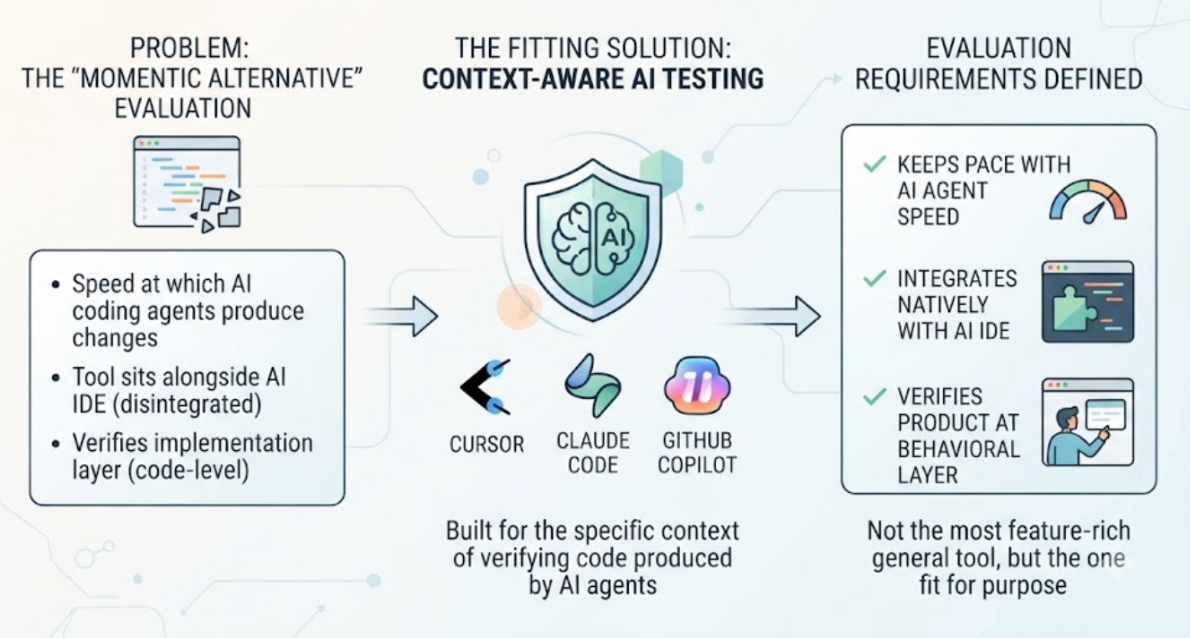
The right answer depends on what specifically needs to be tested and how the code is being written.
Teams evaluating alternatives to Momentic for AI-generated code testing are usually asking a more specific question: they need a tool that keeps pace with the speed at which AI coding agents produce changes, integrates natively with the AI IDE rather than sitting alongside it, and verifies the product at the behavioral layer rather than the implementation layer.
Those requirements define the evaluation. The alternative that fits isn't necessarily the most feature-rich option in the general AI testing category. It's the one built for the specific context of verifying code produced by AI coding agents like Cursor, Claude Code, and GitHub Copilot.
What Makes AI-Generated Code Testing Different
Testing code written by AI coding agents has specific characteristics that influence which tool fits best.
The pace of change is faster than manually written code. A single AI coding session can touch dozens of files, modify API contracts, and refactor frontend components simultaneously. The integration failures this creates often appear outside the changed files, in flows that share state or API dependencies with what changed.
The code is produced inside an AI IDE. Claude Code, Cursor, Windsurf, and similar tools operate in terminal or IDE environments where the developer is already present. A testing tool that requires switching to a separate dashboard or triggering tests from outside the coding environment adds friction that compounds at AI coding speed.
The bugs that matter most are product-layer failures. When AI generates code that's internally consistent but produces wrong outcomes for real users, code-layer tests won't catch it. The verification has to happen at the product layer: running the actual application and observing whether it delivers the right outcomes.
The Evaluation Criteria That Matter
When evaluating alternatives to Momentic for AI-generated code testing, three criteria separate the right fit from a merely capable tool.
Native AI IDE integration. Does the tool operate inside the AI coding environment through the Model Context Protocol, or does it require a context switch? For teams using Claude Code or Cursor, a tool that lives inside the IDE's chat interface and returns results in the same session is fundamentally different from one that runs in a browser-based dashboard.
Observation-first backend testing. Does the tool call API endpoints and observe real responses before generating assertions, or does it analyze source code and infer what the API should return? For AI-generated backend code where field names, status codes, and response shapes can differ from what the code suggests, observation-first is the only reliable approach.
Product-layer verification, not specification-layer. Does the tool test the product by navigating the live application the way real users would, or does it require the engineer to specify what to test and then execute those specifications? For AI-generated code where the failures live at integration points nobody anticipated, autonomous product exploration is the coverage that catches what specification-based testing misses.
TestSprite: Built for the AI Coding Workflow
TestSprite was built specifically for the context of AI-generated code. Its design decisions reflect the specific verification requirements of teams using Cursor, Claude Code, Windsurf, GitHub Copilot, and similar tools.
The TestSprite MCP Server connects natively to all MCP-compatible AI IDEs. When a Claude Code or Cursor session produces changes, one instruction from the IDE chat triggers the full testing pipeline without leaving the development environment. The results arrive in the same window where the code was written. The coding agent receives the failure description and can propose a fix in the same session.
Other verification tools read your code and guess. TestSprite opens your app and uses it.
TestSprite's parallel exploration agents visit the running application and navigate it the way real users would. They don't read the source files the AI coding session modified. They visit the live product, discover its flows through interaction, and observe what happens at each step. The coverage includes the flows nobody specified, which is precisely where AI-generated code most often breaks.
The Backend Testing Difference
One of the most significant differentiators for teams evaluating alternatives for AI-generated code testing is how backend APIs are handled.
When an AI coding agent generates backend code, the field names, response shapes, and status codes in the implementation often differ from what the source code appears to specify. A handler might use camelCase internally while the serializer outputs snake_case. A status code choice might be 201 in the actual response while the code suggests 200. An AI agent refactoring a backend module might rename a field without updating all the references.
Code inspection-based test generation encounters all of these as false failures or, worse, asserts against the wrong value and passes when it should fail.
TestSprite's Backend Testing 2.0 calls the API before generating any assertion. The observation of the real response, actual field names, actual status codes, actual response shapes, is what the assertions are grounded in. When an AI coding session changes the backend and alters what an endpoint returns, the next test run compares against the prior observed contract and surfaces the deviation as a specific finding.
Dynamic variables from real API responses flow automatically through multi-step sequences. A CRUD lifecycle test captures the real ID from a create response and passes it forward. The full sequence works end to end without the engineer wiring the data flow.
A Scenario: The Integration Failure Momentic-Oriented Tools Struggle With
A team uses Cursor to build a multi-tenant SaaS product. Over two Claude Code sessions, the team refactors the project API response structure and updates the frontend component that displays project data.
Each session produces clean-looking code. Each session, tested individually, might pass coverage for the component it touched.
TestSprite's exploration agents navigate the product after both sessions are applied. They log in as a Viewer-role user, navigate to the projects section, and observe the project list.
The project status badges show "Unknown" for all projects. The frontend component is reading a field from the API response using the old field name, which was renamed in the backend refactor. The frontend was updated to use the new field name in some places but not in the status badge display logic.
The failure only appears when the full product is navigated with real API responses. A specification-based test would have covered the component as specified, not the interaction between the component's display logic and the real API response that an AI refactor changed.
The failure description returns to the Claude Code terminal: which view was navigated, what the badges displayed, what they should have displayed. The coding agent identifies the display logic that still references the old field name and applies the fix.
Conclusion
The best Momentic alternatives for AI-generated code testing are the ones that match the specific verification requirements of AI coding workflows: native IDE integration through MCP, observation-first backend testing that reflects real API behavior rather than inferred behavior, and product-layer exploration that covers the flows nobody specified.
TestSprite is built for this context. It connects to Cursor, Claude Code, Windsurf, and any MCP-compatible AI IDE through the MCP Server. Its exploration agents navigate the live application like real users. Its Backend Testing 2.0 grounds assertions in observed API behavior. And its failure descriptions return to the IDE in a form the coding agent can act on directly.
For teams where AI coding agents are the primary development tool, the right alternative is the one built for that environment.
Start testing AI-generated code with TestSprite from inside your AI IDE today.