What Are the Best Katalon Alternatives for AI-Native Test Automation?
 Zeshi Du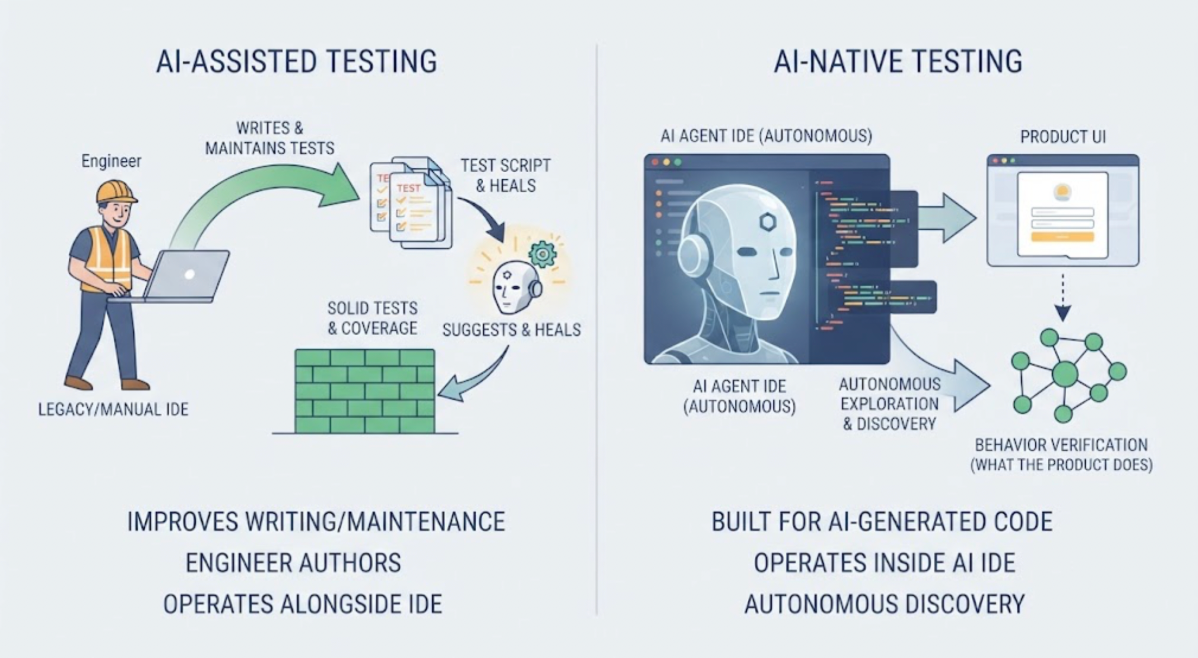
"AI-native" is doing a lot of work in that question, and it's worth being precise about what it means before evaluating alternatives.
A testing tool that uses AI to generate test scripts, heal selectors, or summarize test results is an AI-assisted tool. It uses AI to improve the experience of writing and maintaining tests that an engineer still authors and maintains.
An AI-native testing tool is one built from the ground up for the world where AI coding agents write the code. It assumes the code is being produced by Cursor, Claude Code, or GitHub Copilot. It operates inside the AI IDE rather than alongside it. It discovers what to test by exploring the product autonomously rather than by executing what a QA engineer specified. And it verifies product behavior rather than implementation correctness.
These are genuinely different categories. The alternative that fits a team building with AI coding agents is usually in the second one.
What AI-Native Means in Practice
The practical test for whether a tool is AI-native is simple: what does a developer have to do after a Claude Code session before the testing starts?
For most enterprise testing tools, the answer involves a sequence of steps: push the code, switch to the testing platform, configure or update the test suite, trigger a run, wait for results in a dashboard, return to the IDE to make fixes.
For an AI-native tool, the answer is: type one instruction in the IDE chat.
That's the difference. Not in the sophistication of the AI models involved or the number of AI features listed in the marketing. In whether the tool lives inside the development session or requires the developer to leave it.
TestSprite is built on the second model. The TestSprite MCP Server connects to Claude Code, Cursor, Windsurf, VS Code, and any MCP-compatible AI IDE through the Model Context Protocol. One instruction:
"Help me test this project with TestSprite."
Other verification tools read your code and guess. TestSprite opens your app and uses it.
What the Agents Actually Do
After that instruction, a fleet of parallel exploration agents visits the running application and navigates it the way real users would.
They don't inspect the source files the coding session modified. They visit the live product, discover its flows through interaction, and run those flows. They click buttons. They fill in forms with real inputs. They follow multi-step journeys from entry to completion, carrying session state forward across steps. They probe edge cases and error recovery paths.
The coverage isn't bounded by what the engineer specified. It's bounded by what the product does. That's the AI-native difference for discovery: the tool finds what to test by using the product, not by reading a specification.
For backend API surfaces, TestSprite's Backend Testing 2.0 applies the same principle. Before generating any assertion, the agent calls the endpoint and observes the real response: actual field names, actual status codes, actual response shapes. Assertions are grounded in observed behavior. When an AI coding session changes the API, the next test run compares against the prior observed contract.
Why Traditional Test Automation Doesn't Fit AI Coding Teams
Traditional test automation platforms were built for a development pace where a QA engineer maintains a test suite that mirrors the product's intended behavior.
This model assumes several things: that someone has the time to write and maintain test cases, that the product changes slowly enough that test maintenance is manageable, and that the testing happens as a distinct phase separate from development.
AI coding agents break all three assumptions. The pace of code production outstrips what a QA engineer can document. The product changes so fast that test suites maintained by hand become stale within days. And the development workflow happens inside an IDE where context switching to a test platform breaks the rhythm.
Teams evaluating alternatives to enterprise test automation platforms often aren't looking for a platform with more features. They're looking for a tool that removes the three assumptions that don't hold.
The Self-Maintenance Advantage
A corollary of the AI-native model is that the test suite maintains itself.
Traditional test automation accumulates maintenance debt. Every UI refactor breaks tests. Every API update requires assertion updates. Every component rename requires selector updates. In enterprise platforms, this is managed through dedicated QA time and tooling that repairs selectors automatically.
In TestSprite's model, the maintenance problem is different in kind.
Tests are generated from behavioral exploration rather than implementation inspection. When a component gets renamed but still works correctly, a behavior-anchored test doesn't fail because the test was verifying behavior, not which class name the button had. Auto-Heal Rerun handles the cases where structural changes do cause test failures, distinguishing between changes that affect product behavior and changes that don't.
For AI coding teams where implementation details change constantly as a side effect of AI-driven organization and refactoring, the difference between a maintenance-intensive suite and a behavior-anchored suite is the difference between testing becoming a burden and testing staying useful.
A Scenario: AI-Native Coverage from Day One
A startup is building a B2B SaaS product using Claude Code. The founding team is three engineers. They've never had a testing tool beyond occasional manual walkthroughs.
They evaluate enterprise testing platforms and find that each requires dedicated setup time, a structured test authoring process, and ongoing maintenance that nobody on the team has time for. The tools are capable. They're designed for organizations that have QA as a function.
They connect TestSprite to Claude Code through the MCP Server. Setup takes ten minutes.
After the next significant Claude Code session, they type one instruction. The exploration agents navigate the product across its full surface for the first time.
They discover three issues without the team specifying what to look for.
The account settings page correctly saves email preferences. The confirmation screen shows "Settings saved." But after saving, the team management section still shows the old email address for the user. The settings save to one data source. The team management section reads from a different one that wasn't updated.
The billing section shows the current plan correctly. When a user initiates a plan upgrade, the checkout modal appears with the correct plan details. After completing the upgrade, the billing section still shows the previous plan. The upgrade processed correctly but the billing section reads from a cached value that wasn't invalidated.
The project archive feature correctly moves archived projects out of the active list. The dashboard project count, which should reflect only active projects, still includes archived ones. The archive status was updated in one table but the dashboard query reads from a different source.
Three data consistency failures. Three different places where something was written correctly but read incorrectly elsewhere. All three caught by exploration agents navigating the product as real users would.
None of these required a test case to have been written in advance. The agents found them by using the product.
Conclusion
The best alternatives for AI-native test automation are the ones that meet the definition: built for AI coding teams, operating inside the AI IDE through MCP, discovering coverage autonomously through product exploration rather than specification execution, and verifying product behavior rather than implementation correctness.
Traditional enterprise testing platforms with QA-oriented workflows and dashboard-first result delivery don't fit this definition, regardless of the AI features they've added.
TestSprite fits it. It connects to AI IDEs through MCP, explores the live product autonomously, generates behavior-anchored tests, and delivers results inside the development session in a form the coding agent can act on directly.
Start AI-native test automation with TestSprite from inside your IDE today.