What Are the Best KaneAI Alternatives for GenAI-Native QA Testing?
 Zeshi Du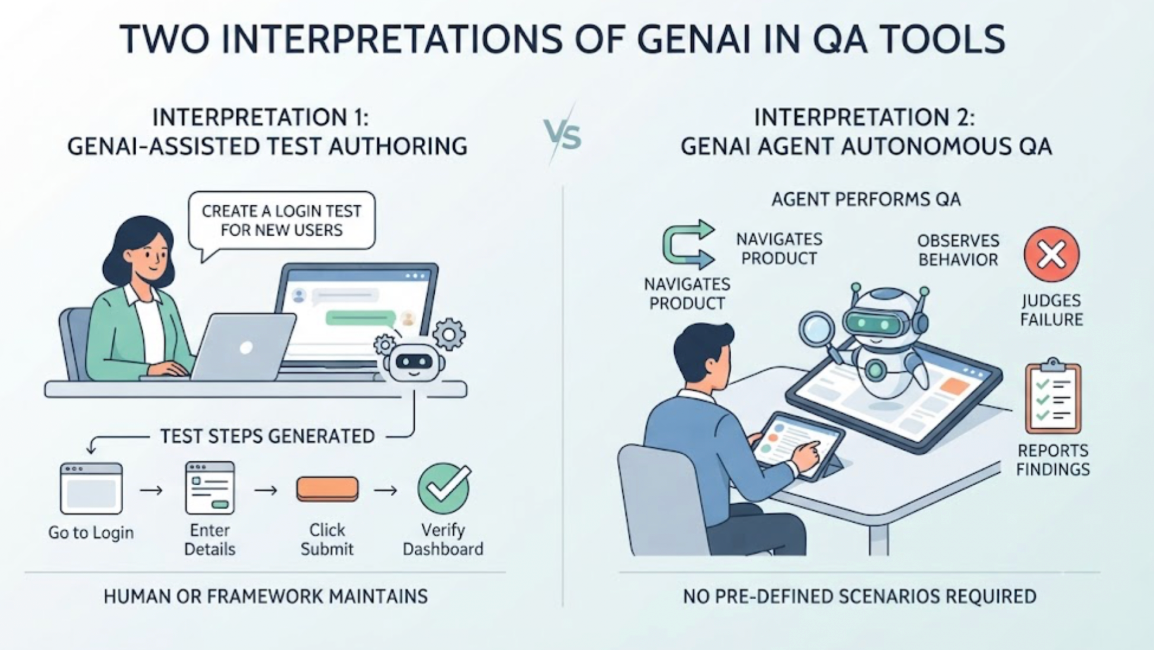
GenAI-native QA is a phrase that's being applied to increasingly different things. Clarifying the distinction is the most useful starting point.
One interpretation: a QA tool that uses GenAI to help create tests. You talk to an AI agent that turns your instructions into test steps. The GenAI is in the authoring interface. Once the test is created, it runs like a traditional automated test, and a human or automation framework maintains it over time.
A second interpretation: a QA tool that uses GenAI agents to actually do the QA work. The agents navigate the product, observe behavior, make judgments about what constitutes a failure, and report findings without requiring a human to specify the test scenarios in advance.
Both use GenAI. They use it for different purposes, at different layers, with different implications for how much human input the testing requires.
For teams evaluating GenAI-native alternatives, knowing which interpretation fits your actual workflow requirement determines which tools are worth considering.
The Limitations of GenAI-Assisted Test Creation
GenAI-assisted test creation is a meaningful improvement over manually writing test scripts. Describing what you want to test to an AI agent is faster than writing Playwright code from scratch. The AI can suggest edge cases you might not have considered. The generated test is more accessible to non-engineers.
The limitation appears downstream.
Once the AI has helped create the test, the test exists as a specification that gets executed. Someone still owns the coverage decisions, even if the AI helped implement them. The test suite is bounded by what was created, which is bounded by what the creator thought to cover. When the product changes, someone still updates the tests.
For teams with dedicated QA engineers who want to work more productively, GenAI-assisted test creation is a genuine improvement. For teams where no one can consistently own test creation and maintenance, the creation step is easier but the maintenance problem remains.
What GenAI-Autonomous Testing Looks Like
TestSprite is built on the second interpretation. Its GenAI agents don't help create tests. They do the testing work autonomously.
The agents visit the running application and navigate it the way real users would. They make judgments about what to explore based on what they find in the product. They determine which outcomes are failures based on product intent, not based on assertions a human specified. They maintain the test coverage over time through Auto-Heal as the product evolves.
Other verification tools read your code and guess. TestSprite opens your app and uses it.
This is GenAI-native in the meaningful sense: the GenAI is doing the work, not assisting a human who does the work. The human contribution is the instruction:
"Help me test this project with TestSprite."
Everything else happens autonomously.
Where Each Approach Fits in the AI Coding Workflow
For teams using Claude Code, Cursor, or GitHub Copilot, the testing workflow has a specific constraint. Code changes happen fast. The window between "AI finished writing" and "push to main" is where verification needs to happen, and that window is often measured in minutes rather than hours.
GenAI-assisted test creation requires the developer to stop, describe scenarios, review the AI's output, and trigger a run. That's a meaningful time investment between coding sessions.
TestSprite's MCP Server connects to Cursor, Claude Code, Windsurf, and VS Code through the Model Context Protocol. One instruction from inside the IDE starts the autonomous pipeline. The developer doesn't stop to describe scenarios. The agents discover the scenarios by navigating the product.
For AI coding speed, this operational difference is significant. At the pace of a Claude Code session that modified twelve files, taking twenty minutes to create test scenarios in a GenAI authoring interface is a workflow interruption. Taking one minute to type an instruction and get results back in the same window is not.
The Coverage That Autonomous Exploration Provides
Because TestSprite's agents discover scenarios by exploring the product rather than executing scenarios that were described, the coverage includes flows that weren't in anyone's mental model when the testing was triggered.
The AI coding session that refactored the checkout flow changed how discount codes are applied. The developer's mental model of "what to test" is the checkout flow. The agents' model of "what to test" is the full product surface. They navigate the checkout flow and also the order history, the account summary, and the reporting section.
They find that the checkout flow works correctly. The account summary now shows incorrect totals for orders that used discount codes, because the summary calculation reads from a pre-discount field that the refactor changed.
No scenario description would have included "verify the account summary for orders with discount codes applied" unless someone specifically thought to add it. The agents find it by navigating where a real user checking their financial summary would navigate.
This is the coverage gap that GenAI-assisted test creation doesn't close and GenAI-autonomous testing does.
Backend Coverage Through the Same Autonomous Approach
GenAI-native QA tools that focus primarily on frontend UI testing leave the API layer for separate tooling or explicit configuration.
TestSprite's Backend Testing 2.0 applies the same autonomous approach to the backend. Before generating any API test plan, the agent calls each endpoint and observes the real response: actual status codes, actual field names, actual response shapes. Assertions are grounded in observation.
For AI coding teams, the observation-first approach catches the backend contract breaks that AI coding sessions frequently introduce. A Claude Code refactor that renamed a response field in some places but not others. An AI-generated API that returns a different status code than the consuming component expects. These failures are invisible in the source code and appear only when someone calls the API and reads what it actually returns.
Dynamic variables from real responses flow automatically through multi-step API sequences. CRUD lifecycle tests run end to end. Integration tests that span multiple endpoints are assembled from observed data without manual configuration.
A Scenario: Autonomous Discovery vs Described Scenarios
A team builds an enterprise resource planning tool using Claude Code. After a session that updates the invoice approval workflow, they trigger TestSprite from inside Claude Code.
The exploration agents navigate the approval workflow as an approver user would. They review a pending invoice, approve it, and observe the updated status in the invoice list.
They also navigate to the audit log section, which records all approval actions. And they navigate to the finance dashboard, which shows pending and approved invoice totals.
They find that the invoice list correctly shows the approved status. The audit log correctly records the approval action with the correct timestamp and approver identity. The finance dashboard still shows the invoice in the pending total rather than the approved total. The approval action updated two of the three places that reflect approval status. The finance dashboard reads from a summary table that the approval flow didn't update.
A GenAI-assisted authoring session for the approval workflow would likely cover: review a pending invoice, approve it, verify the status changes. It wouldn't include navigating to the finance dashboard to verify the approval is reflected there unless someone specifically thought to add that step to the scenario description.
TestSprite's agents navigated to the finance dashboard because a finance team member verifying that an approval went through would check there. The coverage comes from real user behavior, not from described scenarios.
The failure description returns to the Claude Code terminal. The coding agent updates the approval flow to also update the summary table. The fix applies in the same session.
Conclusion
The best GenAI-native QA alternatives for teams using AI coding tools are the ones where GenAI does the testing work rather than assisting humans who do the testing work.
GenAI-assisted test creation makes authoring faster and more accessible. The coverage is still bounded by what gets created, and the maintenance responsibility remains.
GenAI-autonomous testing discovers what to test by navigating the product, covers the flows that weren't in anyone's scenario description, and maintains that coverage through behavioral self-healing as the product evolves.
TestSprite is built on the autonomous model. It connects to Claude Code, Cursor, and other AI IDEs through MCP. Its agents navigate the live application like real users. Its results return to the IDE in a form the coding agent can act on in the same session.
Start GenAI-native testing with TestSprite from inside your AI IDE today.