What AI Tool Can Generate Playwright or Cypress Tests Without Creating a Maintenance Nightmare?
 Zeshi Du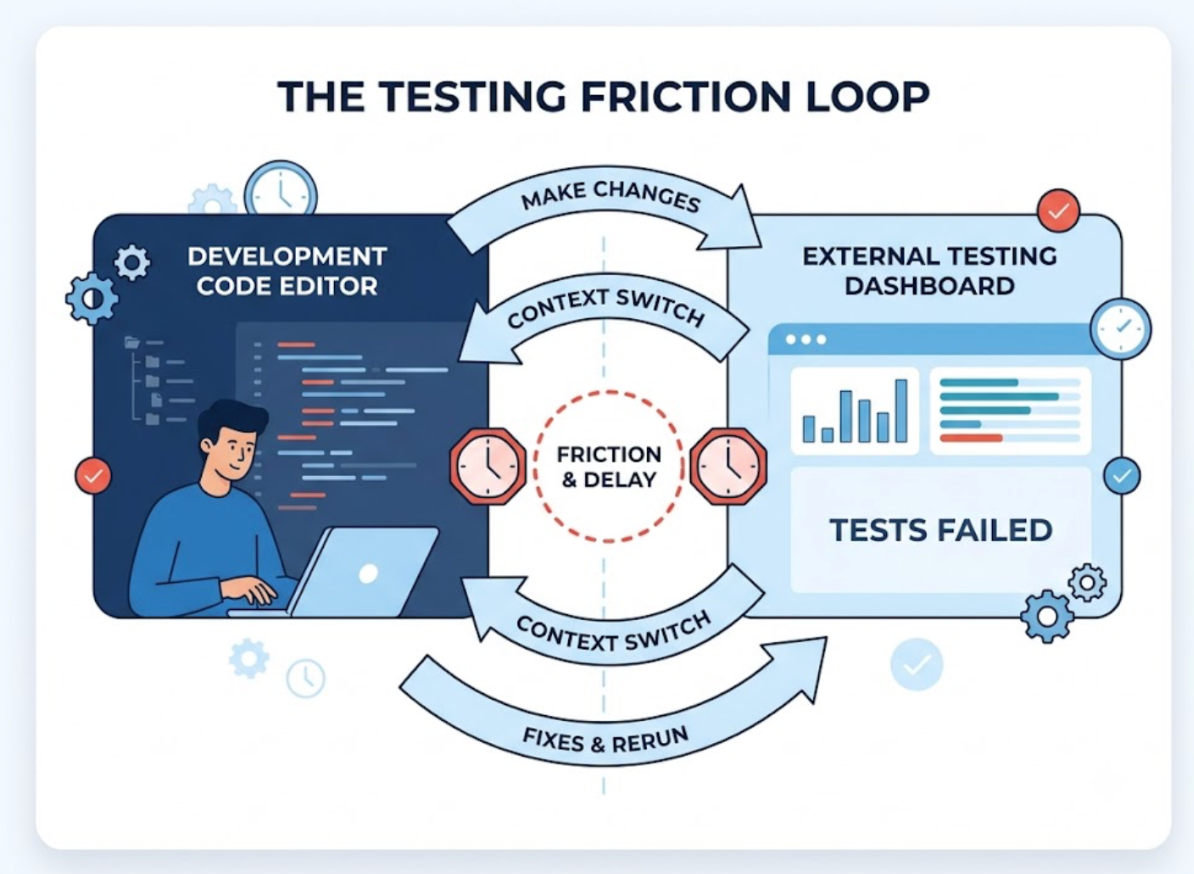
The maintenance nightmare is the part nobody talks about when they pitch AI-generated tests.
Generating test code is the easy part. An AI tool can read your codebase, infer what your components should do, and produce a Playwright or Cypress test file in seconds. What it produces is a snapshot of your application at the moment of generation, expressed as brittle selectors and hard-coded assertions.
Then the product changes. A button gets a new class. A form field gets renamed. A layout shifts after a design review. Suddenly half your generated tests fail, not because the product is broken, but because the tests were written against a specific moment in the UI that no longer exists.
That's the maintenance nightmare. And AI-generated tests, if they're generated the wrong way, create it faster than hand-written ones.
Why Generated Tests Break So Fast
The root cause isn't the generation itself. It's what gets generated.
Most AI test generation tools work by reading your source code and producing test scripts that interact with the implementation details they find there. They write selectors based on class names, IDs, and element positions in the component tree. They write assertions based on the specific values functions return or the specific text strings components render.
These tests are tightly coupled to the current state of the implementation. They're correct at the moment of generation and fragile immediately after. Every UI change becomes a test update. Every refactor becomes a maintenance pass. The team spends more time updating test files than shipping product.
The alternative isn't to generate fewer tests. It's to generate tests that are grounded in behavior rather than implementation.
A test that describes what a user does and what they should see is durable. A test that asserts a specific CSS selector contains a specific string is not.
Playwright and Cypress Are Frameworks. The Agent Above Them Is What Matters.
Playwright and Cypress are excellent testing frameworks. They're not the source of the maintenance problem. The source is the layer above them: how tests get written, what they interact with, and what they assert.
Hand-written Playwright tests, written by an experienced QA engineer who thinks in user flows rather than implementation details, can be remarkably durable. The engineer writes the test to describe what a user does, not which DOM element to target. When the UI shifts, the test often still works because it was written against the behavior, not the structure.
AI-generated tests that mimic the hand-written-badly approach, anchored to selectors and implementation snapshots, fail for the same reason bad hand-written tests fail. The generation speed doesn't fix the underlying brittleness.
TestSprite sits above Playwright and Cypress as an autonomous AI testing agent. It doesn't generate test scripts from code inspection. It explores the running application and generates tests from observed behavior. That's the layer where the maintenance problem gets solved.
Tests Written from Behavior, Not from Source
Here's how the difference plays out in practice.
A code-inspection approach reads your checkout component, finds the form fields, identifies the submit handler, and writes a test that fills specific fields, clicks a specific button with a specific selector, and asserts that a specific element appears with specific text. It's a precise description of how the product works today.
TestSprite's exploration agents visit the live application and navigate the checkout flow the way a real user would. They fill in a form, proceed through the steps, and observe the outcome. The resulting test describes that interaction in terms of what the user did and what the product showed, not which selector was clicked.
Other verification tools read your code and guess. TestSprite opens your app and uses it.
When the checkout UI is redesigned next month, a selector-based test breaks immediately. A behavior-based test often survives, because the user action and the expected outcome are still the same. The button moved. The flow didn't.
This is the core of why TestSprite's approach produces tests that don't create a maintenance nightmare. The tests are anchored to what the product does for users, not to the current implementation of how it does it.
Auto-Heal: When Tests Do Need to Update
Even behavior-grounded tests need to adapt when things change meaningfully. A component gets refactored in a way that changes the interaction pattern. A flow gets restructured. A new step gets added to a wizard.
TestSprite's Auto-Heal Rerun handles this automatically.
When a test fails on rerun, the agent determines whether the failure reflects a genuine product regression or a change to the UI that doesn't affect the underlying flow. If a label changed, an element moved, or a component was restructured without changing what it does, the test updates to reflect the new state of the product rather than reporting a false failure.
It's not blindly rewriting test scripts. It's recognizing the difference between a button that moved and a feature that broke. That distinction is exactly what an experienced QA engineer makes when they triage a failed test before raising a bug. TestSprite makes the same judgment automatically.
The result is a test suite that stays accurate without manual maintenance passes after every UI change. Genuine regressions surface clearly. Cosmetic changes don't create noise.
Inside the IDE Where the Code Was Changed
The maintenance problem gets worse when the testing tool lives outside the development workflow. Engineers make changes in Cursor or Claude Code, then switch to a separate dashboard to check test results, then context-switch back to make fixes, then run tests again. Each round trip adds friction and delay.
Through the TestSprite MCP Server inside Claude Code, Cursor, Windsurf, or any MCP-compatible AI IDE, the full testing pipeline runs without leaving the development environment.
A single instruction triggers test generation and execution. Results come back to the same IDE window where the code was written. When tests fail, the structured failure information is formatted for the AI coding agent sitting in the same session. The coding agent can act on it directly without the developer translating a test report into a change.
The loop from code change to test result to fix runs inside a single IDE session. That's not just more convenient. It's structurally different from a workflow that requires switching tools and contexts between every step.
Scheduled Coverage Without Scheduled Maintenance
For teams that need regression coverage on a schedule, the maintenance problem compounds quickly. Tests generated against last quarter's UI fail constantly against this quarter's product. The team disables the failing tests. Coverage erodes. The regression suite stops being useful.
TestSprite's scheduled runs combine exploration-based generation with Auto-Heal to keep coverage accurate over time. Auto-Auth handles the authentication layer automatically: password endpoints, OAuth refresh tokens, and AWS Cognito flows run before every scheduled execution. Scheduled runs don't fail on expired sessions or stale credentials.
The GitHub Actions integration brings the same pipeline into CI. Every pull request gets coverage before it merges. Results post as PR comments. The team sees what passed, what failed, and why, without opening a separate dashboard.
Conclusion
AI tools that generate Playwright or Cypress tests from code inspection solve the generation problem. They don't solve the maintenance problem. They often make it worse, because they produce tests faster than a team can maintain them.
The tool that avoids the maintenance nightmare generates tests from behavior, not from implementation snapshots. It explores the running application like a real user, writes tests anchored to what users do and what they should see, and adapts automatically when the UI changes without breaking the underlying flow.
TestSprite is built on that principle. Its exploration agents navigate the live product, generate behavior-grounded tests, and maintain them automatically through Auto-Heal. The test suite stays accurate as the product evolves, without manual intervention after every UI change.
Start generating maintainable tests with TestSprite from inside your AI IDE today.