TestSprite CLI: The AI Testing Tool That Makes Your Coding Agent Smarter
 Zeshi Du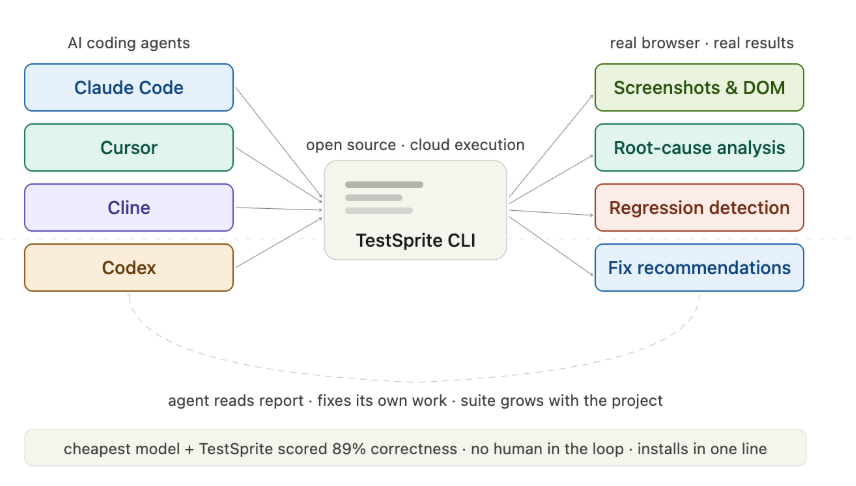
AI coding agents are writing more code than ever — but they're also breaking things they already fixed. If you've watched a session of Claude Code or Cursor build a feature, only to quietly regress something else, you've hit the core problem TestSprite CLI was built to solve.
The Problem With AI-Generated Code Isn't Intelligence — It's Verification
Modern AI coding agents face three hard limits that no prompt or model upgrade fully addresses:
Context window decay. Your agent can't hold your entire project in memory. Requirements you gave it hours ago quietly fall out of scope as it compresses its context. A feature it built correctly yesterday is a feature it no longer remembers the spec for.
Silent regressions. Every new feature introduces risk to the existing ones. Across thousands of real-world projects, roughly one in five features breaks something that was already working — with no reliable mechanism for the agent to detect it.
Hallucinated completions. The agent reports a feature as done. The code compiles. But the page never rendered, the cart never checked out, the form never submitted. Without running the actual app, neither you nor your agent knows.
The industry's conventional answer has been to spend more — bigger model, higher context limit, pricier plan. TestSprite CLI offers a different answer: give the agent the ability to verify its own work.
What Is TestSprite CLI?
TestSprite CLI is an open-source command-line tool designed to plug directly into AI coding agent workflows. It gives your agent — Claude Code, Cursor, Cline, Codex, or any other — a way to run real end-to-end tests against your live application mid-build, read the results, and fix its own mistakes before moving on.
It is not a unit test runner. It is not a mock-based assertion library. TestSprite runs against a real browser in the cloud, executing real user flows: logging in, navigating pages, adding items to a cart, submitting forms, and confirming that the outcome actually happened.
When something breaks, it returns a self-contained failure bundle — the failing step, screenshots, DOM snapshots, a root-cause hypothesis, and a recommended fix — handed directly to the agent so it can resolve the issue immediately.
How It Works
Setup takes about a minute:
npm install -g @testsprite/testsprite-cli
testsprite config set-key YOUR_API_KEY
testsprite agent install
The third command is the important one. agent install registers TestSprite with your coding agent's tool list. After that, you don't run it again manually. The agent calls TestSprite on its own, mid-build, reads the report, and iterates — no human in the loop.
Everything your agent runs is logged to the TestSprite web portal: every test generated, every run, every recording, every root cause. You get full visibility without being the one doing the work.
The Key Insight: Tests as Persistent Memory
Here's what makes TestSprite CLI more than just a test runner: every behavior the agent verifies successfully gets locked into a growing test suite.
Context windows expire. Test suites don't.
As the project grows, so does the suite — accumulating hundreds of verified behaviors, far more than fit in any context window. Every subsequent change gets validated against the entire history of what's been proven to work. The moment a regression appears, TestSprite flags it and the agent fixes it on the spot, before moving to the next task.
This turns verification into a compounding advantage. An agent running with TestSprite doesn't just build — it builds, validates, locks in progress, and carries that record forward indefinitely.
Does It Actually Work? The Leaderboard Evidence
TestSprite ran a public benchmark: multiple top AI coding agents — including Claude Code, Codex, and others — all building the same application under identical rules, with and without TestSprite in the loop.
The result: the cheapest model with TestSprite scored 89% correctness at half the cost of the most expensive model without it.
The winning factor wasn't raw intelligence. It was verification. Every correct behavior was locked in and rechecked on every change. Progress never leaked away.
That's the core claim TestSprite is making to the market: you no longer need to pay for the biggest model to ship software you can trust.
Who Should Use TestSprite CLI
TestSprite CLI is built for engineers who are already using AI coding agents as a meaningful part of their workflow and are running into quality problems at scale — not on individual files, but across sessions that run for hours, across codebases too large to fit in a single context window.
It's particularly valuable when:
- You're shipping features fast with AI agents and regressions are becoming a tax
- You need confidence that AI-generated code actually works in the browser, not just that it compiles
- You want your agent to self-correct without you reviewing every output manually
- You're cost-conscious and want to maximize output quality without moving to a more expensive model
MCP Integration: TestSprite Inside Your IDE
With TestSprite 2.0, the product added an MCP Server — a Model Context Protocol integration that connects TestSprite directly to Cursor, Windsurf, and GitHub Copilot inside the IDE.
Instead of running a CLI command, you can prompt your AI assistant naturally: "Help me test this project with TestSprite." The MCP server takes it from there — generating a PRD, creating a test plan, and producing test code autonomously.
It's the same engine, surfaced where you're already working.
Open Source, Free to Start
TestSprite CLI is open source and available today on GitHub. The free tier includes 150 credits per month — enough to start integrating it into real projects and see how your agent performs with verification in the loop.
Get started: github.com/TestSprite/testsprite-cli
The Bottom Line
AI coding agents are powerful. They're also forgetful, and they can't see whether what they built actually works. TestSprite CLI closes that gap — giving agents a real verification layer, a persistent record of correct behavior, and the ability to catch and fix regressions the moment they happen.
The result is higher-quality software, faster, at lower cost. Not because the model got smarter. Because it finally knows whether it's right.