Testim vs TestSprite: Which Is Better for Reducing E2E Test Maintenance?
 Zeshi Du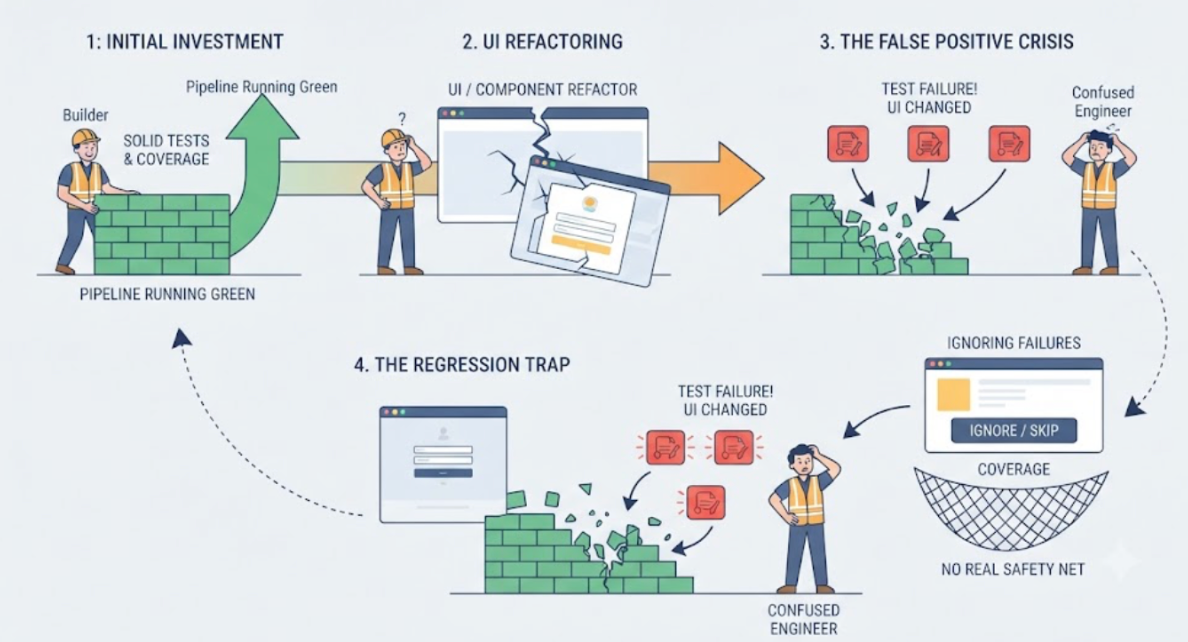
E2E test maintenance is where most test suites quietly die.
The initial investment seems worth it. Tests get written, coverage looks solid, the CI pipeline runs green. Then the UI gets refactored. A component gets renamed. A layout shifts after a design review. Three tests fail, not because the product broke, but because the tests were anchored to implementation details that changed. Someone investigates, finds false positives, updates the selectors, and the suite runs again.
This cycle repeats. Engineers start ignoring the failures. The suite that was supposed to catch regressions becomes noise that people click past. At that point, the coverage exists on paper but provides no real safety net.
The teams that succeed with E2E testing are the ones who solve the maintenance problem, not just the initial authoring problem.
Why E2E Tests Break So Often
The root cause of E2E test maintenance overhead is test anchoring. Tests are written against the current state of the implementation: specific selectors, specific element positions, specific text strings, specific API response shapes. The moment any of those implementation details change, the test breaks.
In traditional development where an engineer writes every line of code, this is manageable. The engineer who made the change knows which tests to update. The surface of change is bounded by what one person can hold in their head.
AI coding agents change this. A Claude Code or Cursor session can touch dozens of files simultaneously. Components get reorganized. State management patterns change. API response structures shift as a side effect of a performance refactor that wasn't about the response at all. The surface of potential test breakage grows with every AI coding session.
The maintenance problem isn't just frequent. It's unpredictable. The test that breaks might be covering a flow that's two screens away from anything the AI session touched.
Two Different Approaches to the Maintenance Problem
Testing tools address the maintenance problem in two fundamentally different ways.
The first approach is selector repair. When a test fails because a CSS class name changed or an element ID was updated, an AI-powered mechanism detects the change and updates the selector automatically. The test that was pointing to class="btn-submit" now points to class="button-submit" and passes again.
This is useful. It handles one specific cause of test decay. It doesn't handle the more fundamental problem: tests that pass when the product is broken, or tests that fail when the product is fine but the implementation changed in ways that aren't selector-level.
The second approach is behavioral anchoring. Tests are generated from observed product behavior rather than from implementation details. When the implementation changes, the test only fails if the behavior changed. A renamed button that still submits the form correctly doesn't break a behavior-anchored test. A renamed button that now fails to submit the form does.
The first approach reduces maintenance overhead by automating selector updates. The second approach reduces maintenance overhead by not anchoring to selectors in the first place.
How TestSprite Reduces Maintenance at the Source
TestSprite generates tests from observed product behavior rather than from implementation inspection. Its exploration agents navigate the running application the way real users would and build test cases from what they observe, not from what the code says should happen.
Other verification tools read your code and guess. TestSprite opens your app and uses it.
Because the tests are anchored to behavior rather than implementation, a significant category of maintenance failures disappears. A component that gets renamed, a layout that shifts, a class name that changes: these are structural changes. If the behavior is the same, the test passes. No selector to update. No investigation to determine whether the failure is real.
Auto-Heal Rerun handles the cases where structural changes do cause test failures. When a test fails after a UI update, the agent makes the determination that an experienced QA engineer would make: is the product working correctly and the test is stale, or is the product actually broken?
If the product is working and the test was anchored to an element that moved, the test adapts. The suite continues to run correctly without manual intervention.
If the product behavior actually changed in a way users would notice, the failure surfaces clearly. The developer receives a description of what user action was taken, what the product was supposed to deliver, and what it actually delivered.
This is the distinction that keeps the test suite trustworthy. The engineers stop seeing failures that aren't real. When a failure appears, it's worth investigating.
What This Means for AI Coding Teams Specifically
For teams using Claude Code, Cursor, or GitHub Copilot, the maintenance problem is most acute because the AI changes implementation details frequently as part of its natural operation.
A Cursor session that improves component organization will rename things. A Claude Code session that improves performance might change how state is managed, which changes how components are composed. A GitHub Copilot refactor might consolidate several selectors into a shared component.
All of these produce correct-looking code that passes code review. All of them can break implementation-anchored tests. None of them change the product behavior.
For teams using AI coding agents, a testing approach that anchors to selectors will produce constant maintenance overhead. Every organizational refactor becomes a test maintenance event.
A testing approach that anchors to behavior survives these refactors. The tests verify that the product still does what it's supposed to do. The implementation can change as the AI coding agent sees fit.
A Scenario: Two Refactors, Two Different Outcomes
A team uses Cursor to maintain a project management SaaS. Over two weeks, Cursor runs two refactoring sessions.
The first session reorganizes the component structure of the main navigation. It renames several components, consolidates some props, and moves some styling. The navigation still works identically for users.
The second session updates the project status calculation logic. It changes how project completion percentages are computed. Due to a subtle bug in the new calculation, projects with no tasks show as 100% complete instead of 0%.
With implementation-anchored tests: The first refactor breaks three tests because the component names in the selectors changed. Engineers investigate, find false positives, update the selectors. Time spent: around two hours.
The second refactor passes all tests because the calculation logic looks correct in isolation and no test verified what a project with no tasks displays.
With behavior-anchored tests (TestSprite): The first refactor produces no test failures. The navigation still works. The tests that cover navigation flows still pass.
The second refactor produces one failure. An agent navigated to a project with no tasks and observed that it displayed 100% complete. The agent expected 0% or no percentage displayed. The failure is specific: which project, what was displayed, what should have been displayed.
The outcome: zero false positives from the structural refactor. One real finding from the behavioral bug. The maintenance overhead is near zero. The bugs that matter surface cleanly.
Conclusion
Reducing E2E test maintenance comes down to what the tests are anchored to.
Implementation-anchored tests produce maintenance overhead every time the implementation changes, which is frequently for teams using AI coding agents. Selector repair reduces some of this overhead by automating the selector update step, but it doesn't address the deeper problem.
Behavior-anchored tests survive implementation changes because they verify outcomes rather than implementation details. When the implementation changes but the behavior doesn't, the tests pass. When the behavior changes, the tests surface it.
TestSprite generates behavior-anchored tests through product exploration. Its Auto-Heal distinguishes structural changes from behavioral regressions. For teams using AI coding agents where implementation details change constantly, this is the approach that keeps the test suite useful rather than becoming a maintenance burden.
Start reducing E2E test maintenance with TestSprite from inside your AI IDE today.