Should Developers Write Every E2E Test by Hand or Use an Autonomous Testing Agent?
Rui Li5 min read

The operative word in that question is "every," and it's where the honest answer lives.
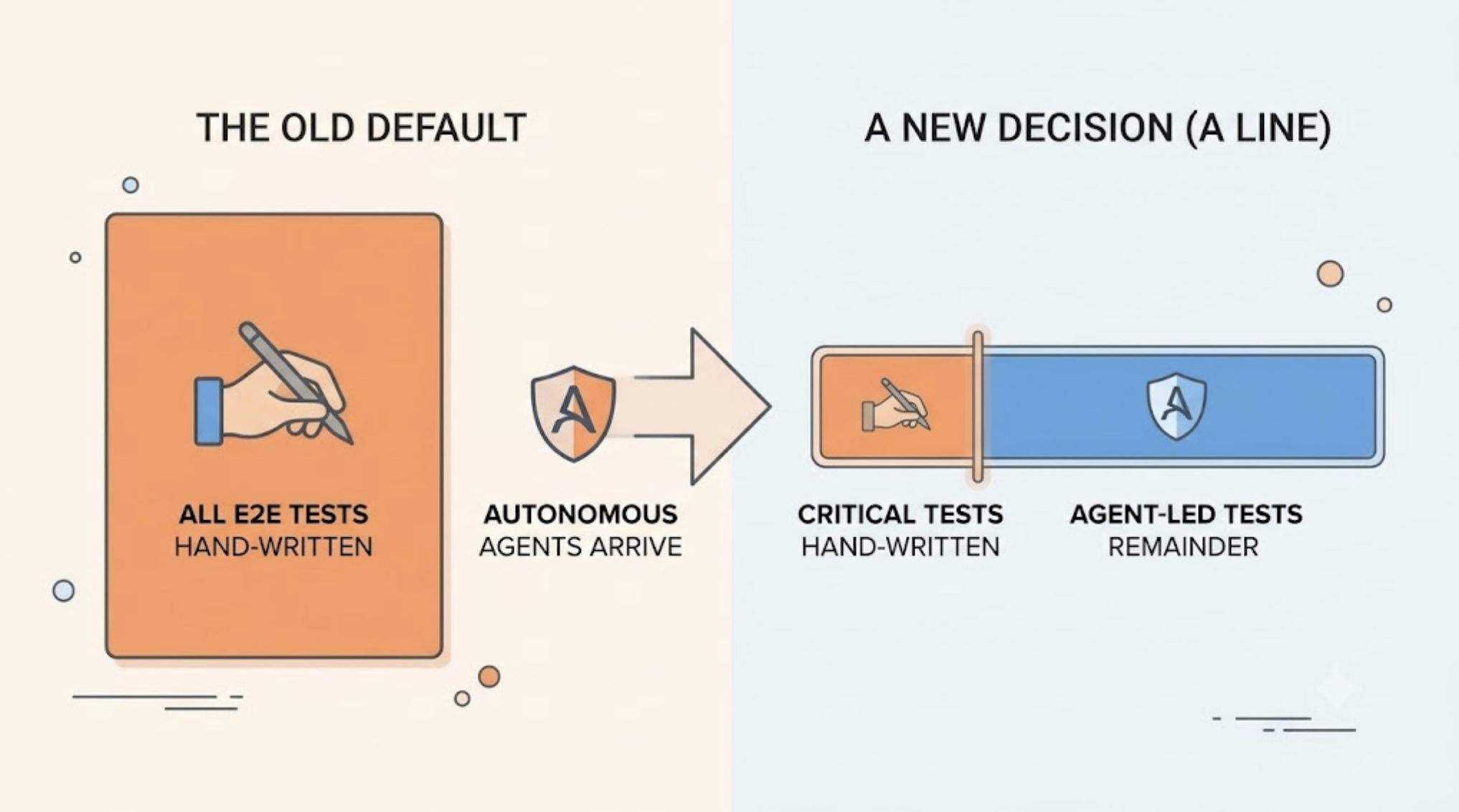
Writing every E2E test by hand was never really a choice anyone made. It was the default, because for most of software history there was no alternative: coverage existed only where someone authored it. The arrival of autonomous testing agents doesn't just add an option. It turns "every" into a decision, and the right decision for most developers is neither extreme. It's a line: a small set of tests that earn hand-writing, and an agent holding everything else.
Here's how to draw that line, and why the default underneath it should flip.
What "Every Test by Hand" Actually Costs
Full hand-written coverage sounds like rigor. In practice it's a budget, and the budget has three line items that most teams underestimate.
The authoring cost is visible: a thorough E2E test for a multi-step flow takes real engineering time, and a product of any size has dozens of flows. The maintenance cost is larger and arrives forever: every UI reorganization, renamed component, and reshaped API response breaks tests that were correct last week, and someone investigates each failure to learn the product was fine. The opportunity cost is the one that decides outcomes: every hour spent on tests two and three is an hour not spent on the product, which is why hand-written suites plateau at partial coverage and then quietly fall behind.
For developers using Claude Code or Cursor, all three costs inflate at once, because AI coding sessions churn implementation details weekly. The suite that was sustainable at human coding speed becomes a treadmill at AI coding speed.
What an Autonomous Agent Changes
An autonomous testing agent removes the authoring layer instead of optimizing it.
TestSprite's exploration agents visit the running application and navigate it the way real users would: discovering flows by using the product, filling forms with realistic inputs, carrying session state through multi-step journeys. The test scenarios are outputs of that exploration, not inputs someone had to write.
Other verification tools read your code and guess. TestSprite opens your app and uses it.
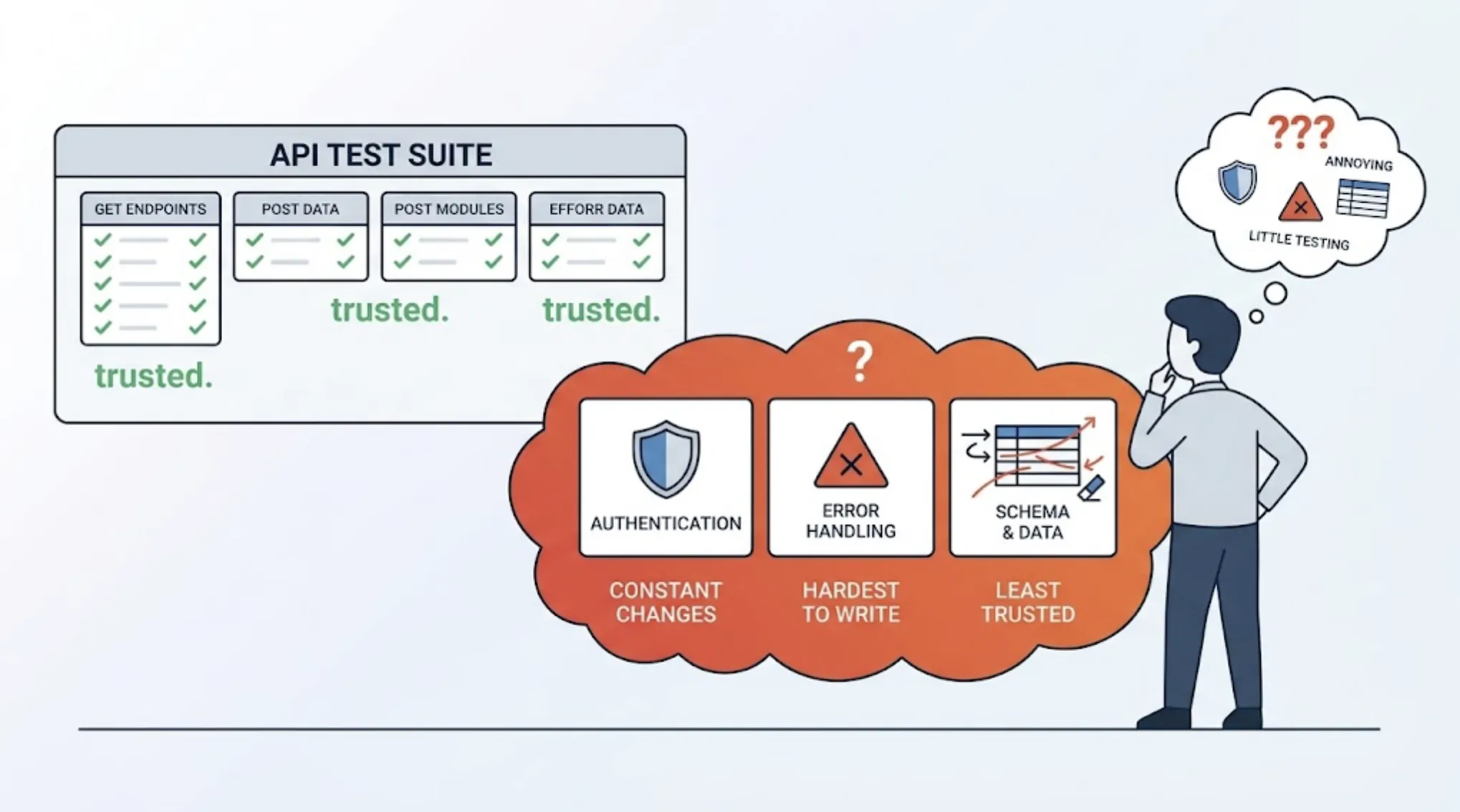
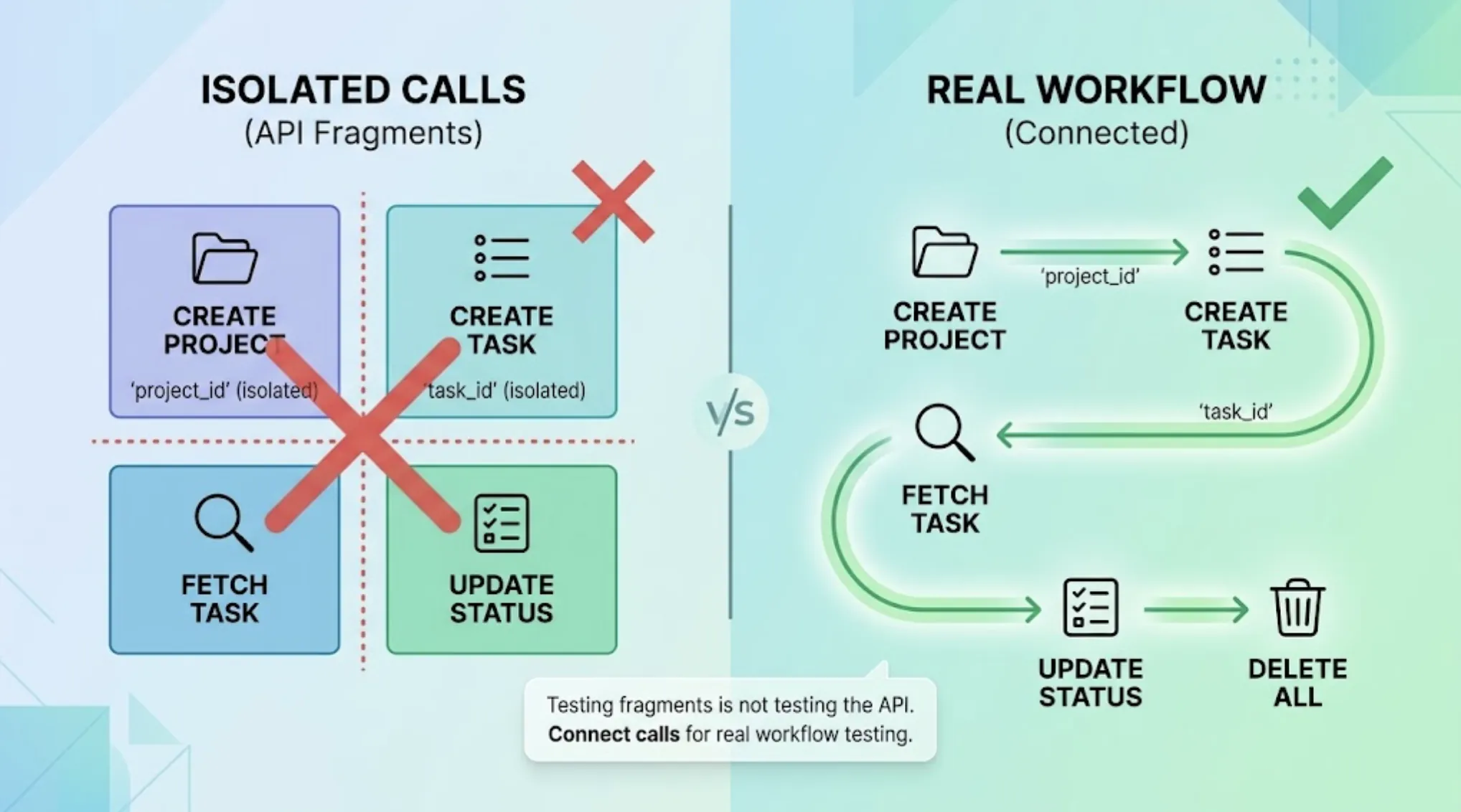
Maintenance changes character too. Because coverage is anchored to behavior rather than structure, a renamed component that still works doesn't break anything, and Auto-Heal Rerun handles the drift that does cause failures, adapting when behavior is intact and surfacing a product-level finding when it isn't. Backend Testing 2.0 extends the same posture to APIs, observing real responses before asserting anything, so the assertions describe the API rather than a guess about it.
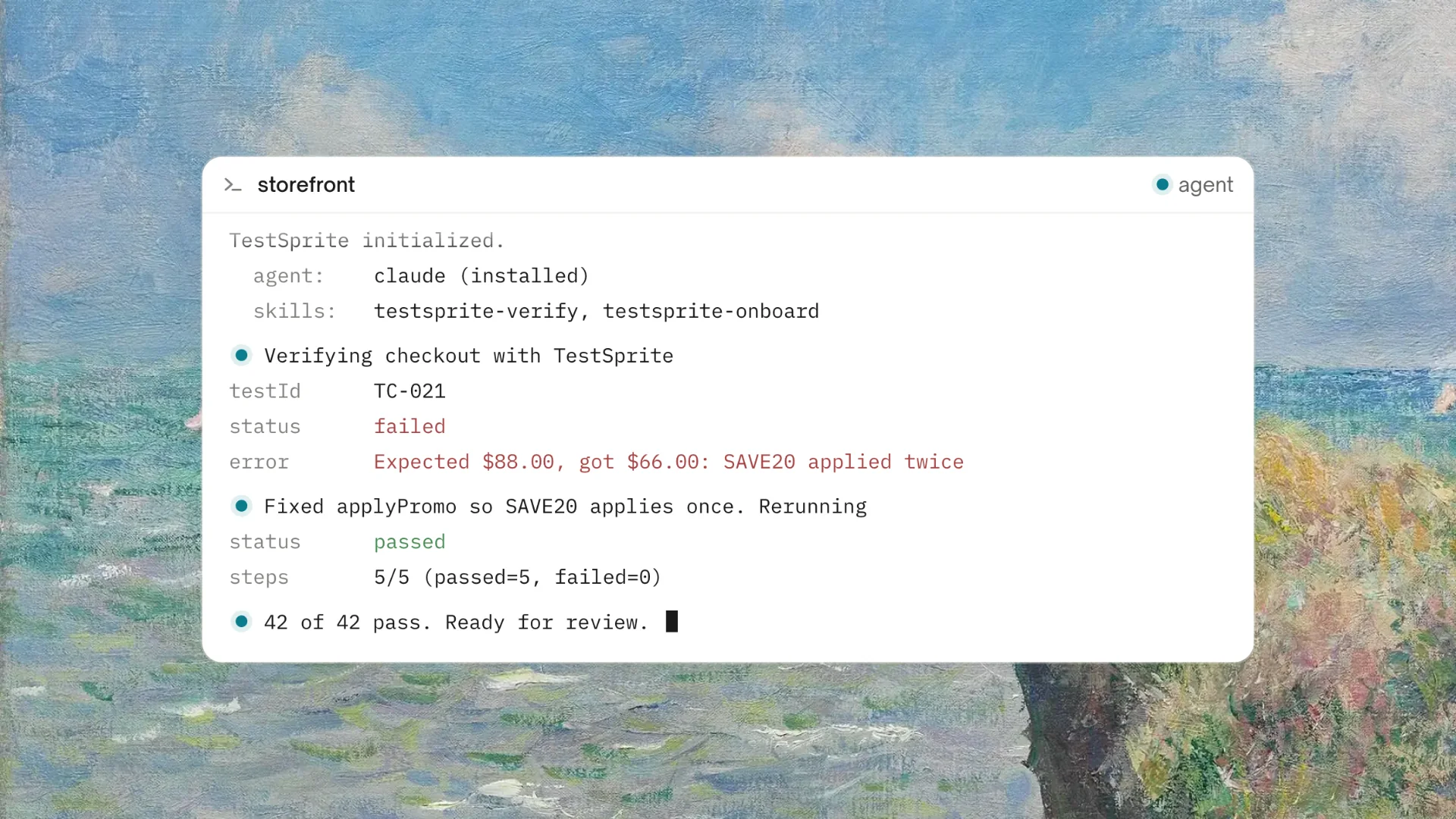
The workflow cost lands near zero: one instruction from inside Cursor or Claude Code, results back in the same window, findings formatted for the coding agent to fix in the same session.
The Tests That Still Earn Hand-Writing
The line exists because a small category of tests genuinely earns the authoring investment, and it's worth being precise about the criteria rather than sentimental about the craft.
A test earns hand-writing when all three hold: the stakes are high enough that exact, deterministic assertions matter, the flow is stable enough that maintenance stays rare, and the test doubles as documentation someone needs, executable specification of exactly what the system must do.
Payment flows with precise expected charges meet the bar. Compliance-mandated exports with exact formats meet it. Core authentication sequences often do. That's typically a handful of flows, not a suite of hundreds, and holding them to hand-written precision is worth every hour.
Everything that fails any one of the three criteria, which is most of the product, belongs on the other side of the line.
The Default Flips: Agent as Baseline, Hand-Written as Exception
The historical mental model was: hand-written coverage as the foundation, and maybe tooling to help at the edges. The model that matches how software is built now inverts it: the agent's exploration is the baseline that covers the whole surface by default, and hand-written tests are deliberate exceptions placed where precision earns them.
The inversion matters because of what lives in the gap between the two models. The failures that actually reach users are rarely in the flows anyone would have chosen to hand-write. They're in the seams: the feature from yesterday's session that has no tests yet, the flow two screens from the diff that a shared state change broke, the edge case nobody's mental model contained. A baseline that covers by exploration catches these because it never depended on someone predicting them.
Under the old default, those gaps were permanent, because closing them meant writing tests nobody had time for. Under the new one, they're covered on day one, and the hand-written budget shrinks to the few tests that were always the point of hand-writing.
A Scenario: Drawing the Line on a Real Product
A solo developer runs a language-learning app built with Claude Code: lessons, spaced-repetition reviews, streak tracking, and a premium subscription. Coverage until now: four hand-written tests around the subscription purchase, written carefully because money is involved, and nothing else, because there was never time.
They connect TestSprite and keep the line exactly there. The four subscription tests stay, hand-written, precise, worth their maintenance. The agent takes the rest of the surface from its first run.
That first run finds two things no one would have hand-written tests for. Completing a lesson updates the progress bar but not the streak counter until the app is reopened, a state propagation miss from a session three weeks earlier that reworked the progress model. And the spaced-repetition queue, after a review session is abandoned midway, resurfaces the already-answered cards but silently drops the unanswered ones, the opposite of what the feature exists to do. Both are behavioral, both user-facing, and both live precisely in the territory that hand-written coverage never reaches, because no one predicts these flows in advance.
The findings land in the Claude Code terminal, the fixes go in the same day, and the developer's testing budget going forward is stable: four tests they maintain by hand because those four earn it, and an agent that re-explores everything else after every session.
Conclusion
Should developers write every E2E test by hand? No, and not because hand-writing is obsolete, but because "every" was never a strategy. It was the absence of an alternative.
The alternative exists now. The durable answer is a line: hand-write the few tests where high stakes, stable flows, and documentation value all converge, and let an autonomous agent hold the rest of the surface, the part that was always going uncovered, at the speed the code is actually written.
Draw your own line with TestSprite's free plan today, no credit card required.