QA Wolf vs TestSprite: Should I Use a Managed QA Service or an AI Testing Agent?
 Zeshi Du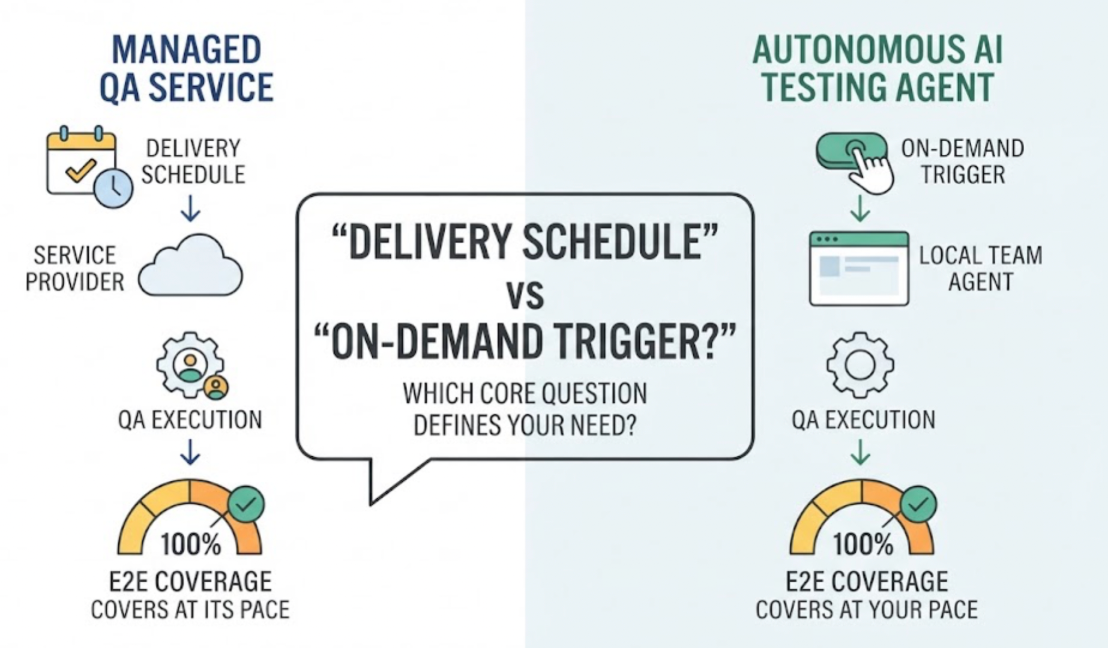
The question is real and the answer isn't obvious. Both managed QA services and autonomous AI testing agents provide E2E coverage. They serve different teams in meaningfully different ways, and choosing the wrong one creates friction that compounds over time.
The decision comes down to one core question: does your team need QA coverage that runs on a delivery schedule, or coverage that runs when you trigger it?
What a Managed QA Service Provides
A managed QA service handles E2E test creation and maintenance on your behalf. A team of QA engineers, often AI-assisted, authors your test cases, runs them on a schedule, maintains them as the product evolves, and delivers coverage reports. You get E2E coverage without operating a testing tool yourself.
The value proposition is clear for the right team: you outsource the QA function to specialists who own it. The service handles test authoring, maintenance, and execution. Your team focuses on building.
The tradeoffs are equally clear. The service delivers on its schedule, not yours. For teams shipping multiple times per day with AI coding tools, the coverage that matters most is the coverage that runs immediately after a coding session, before the changes merge. A managed service that delivers coverage on a weekly or bi-weekly cycle can't close that gap.
There's also a cost structure consideration. Managed QA services are typically priced as a service with delivery guarantees and ongoing human involvement. For early-stage teams and startups where budget is a constraint, the economics don't always work out.
What an Autonomous AI Testing Agent Provides
TestSprite is a self-serve autonomous AI testing agent. When you trigger it, it runs. When a test fails, the finding goes to your IDE immediately. The coverage operates at your pace, not a delivery schedule.
Through the TestSprite MCP Server, one instruction from inside Cursor, Claude Code, Windsurf, or VS Code starts the full pipeline:
"Help me test this project with TestSprite."
Other verification tools read your code and guess. TestSprite opens your app and uses it.
A fleet of parallel exploration agents visits the running application and navigates it the way real users would. They discover the product's flows by using it, not by executing scenarios that QA engineers authored. The coverage includes flows that were never specified because the agents find them by exploring.
When tests fail, structured failure descriptions arrive in the IDE. The coding agent receives them and can propose fixes in the same session. No waiting for a service cycle. No dashboard to check separately.
The Timing Difference That Matters Most for AI Coding Teams
The most consequential difference between a managed service and an autonomous agent is timing.
Managed QA services are designed around a delivery cycle model. Tests get authored, scheduled, and run on a cadence. For products with stable features and a predictable release schedule, this works well. The QA team can keep pace.
For teams using Claude Code or Cursor, the release cadence is measured in sessions rather than sprints. A developer might run three Claude Code sessions in a day, each producing significant changes. The managed service's delivery cycle doesn't map to this cadence. Coverage arrives after the fact.
The failures that matter most for AI coding teams live in the window between "AI finished writing" and "push to main." A checkout flow that breaks because two AI-generated components interact incorrectly needs to be caught in that window, not in the next service cycle.
TestSprite operates inside that window. One instruction after a Claude Code session. Results before the push.
What Autonomous Exploration Catches That Specification Misses
Managed QA services author test coverage based on the product's known behavior. A QA engineer walks through the product, identifies the flows worth testing, and creates test cases that cover those flows.
This produces excellent coverage for the flows that were identified and specified. The gap is everything else: the integration failures that live at the seam between specified flows, the edge cases that only appear when a user takes a path nobody anticipated, and the failures introduced by AI coding sessions that changed shared dependencies without anyone updating the test specification.
TestSprite's exploration agents cover these gaps by navigating the product rather than executing specifications. When a Claude Code session changes the state management layer, the agents don't check the specified flows for the changed layer. They navigate the entire product to find every place where the change had an effect.
A Scenario: The Failure That Needed Immediate Coverage
A startup is building a B2B SaaS product. They considered using a managed QA service and found that the delivery cycle didn't match their development pace. They need coverage that responds to their Claude Code sessions, not a service cycle.
They connect TestSprite to Claude Code through the MCP Server.
After a Claude Code session that rebuilds the workspace management feature, adding member limits based on subscription tier, they trigger TestSprite.
The exploration agents navigate the workspace management section under multiple subscription contexts. They log in as a Pro tier workspace owner and verify that member invitations work correctly up to the Pro tier limit.
They then navigate to the billing section and the admin dashboard.
They find a failure in the admin dashboard. The dashboard shows the workspace's current member count as a fraction of the available seats. After the Claude Code session added subscription-tier member limits, the admin dashboard reads the member limit from a configuration table that wasn't updated for the new tier structure. The Pro tier seats are displayed using the default tier limit rather than the Pro tier limit.
A managed QA service's test coverage for workspace management would include invitation flows and member limits. The specific failure of the admin dashboard displaying the wrong tier limit requires navigating to the admin dashboard after the subscription tier is set, which requires knowing to include that step in the test specification.
TestSprite's agents navigated to the admin dashboard because an admin verifying that the workspace configuration is correct after setting the subscription tier would check there.
The failure description returns to the Claude Code terminal: which section was navigated, what member limit was displayed, what the Pro tier limit should be. The coding agent identifies the configuration table that wasn't updated for the new tier structure and applies the fix.
Coverage ran immediately after the session. The failure was caught and fixed before the code was pushed.
Which One Is Right for Your Team
The managed service model is the right fit when: the team wants to outsource the QA function entirely, the delivery schedule matches the development cadence, and the budget supports ongoing service pricing.
The autonomous agent model is the right fit when: the team ships at AI coding speed and needs coverage that responds immediately, the team is small enough that a managed service's economics don't work, and the development workflow runs through an AI IDE where the coverage needs to arrive.
For most teams using Claude Code, Cursor, or GitHub Copilot as their primary development tools, the timing and workflow fit of an autonomous agent is more practical than a managed service's delivery model.
Conclusion
Managed QA services and autonomous AI testing agents both provide E2E coverage. The operational model is different in a way that matters for AI coding teams.
A managed service delivers coverage on a schedule. An autonomous agent delivers coverage when you trigger it. For teams shipping at AI coding speed, that difference determines whether the coverage is in place before the bugs merge or after.
TestSprite is the autonomous option. It connects to Cursor and Claude Code through MCP, explores the live application like real users, and returns results inside the development session in a form the coding agent can act on immediately.
Start with TestSprite's free plan and see what it finds in your next Claude Code session.