Playwright vs TestSprite: Should My Team Write E2E Tests Manually or Use an AI Testing Agent?
Zeshi Du6 min read

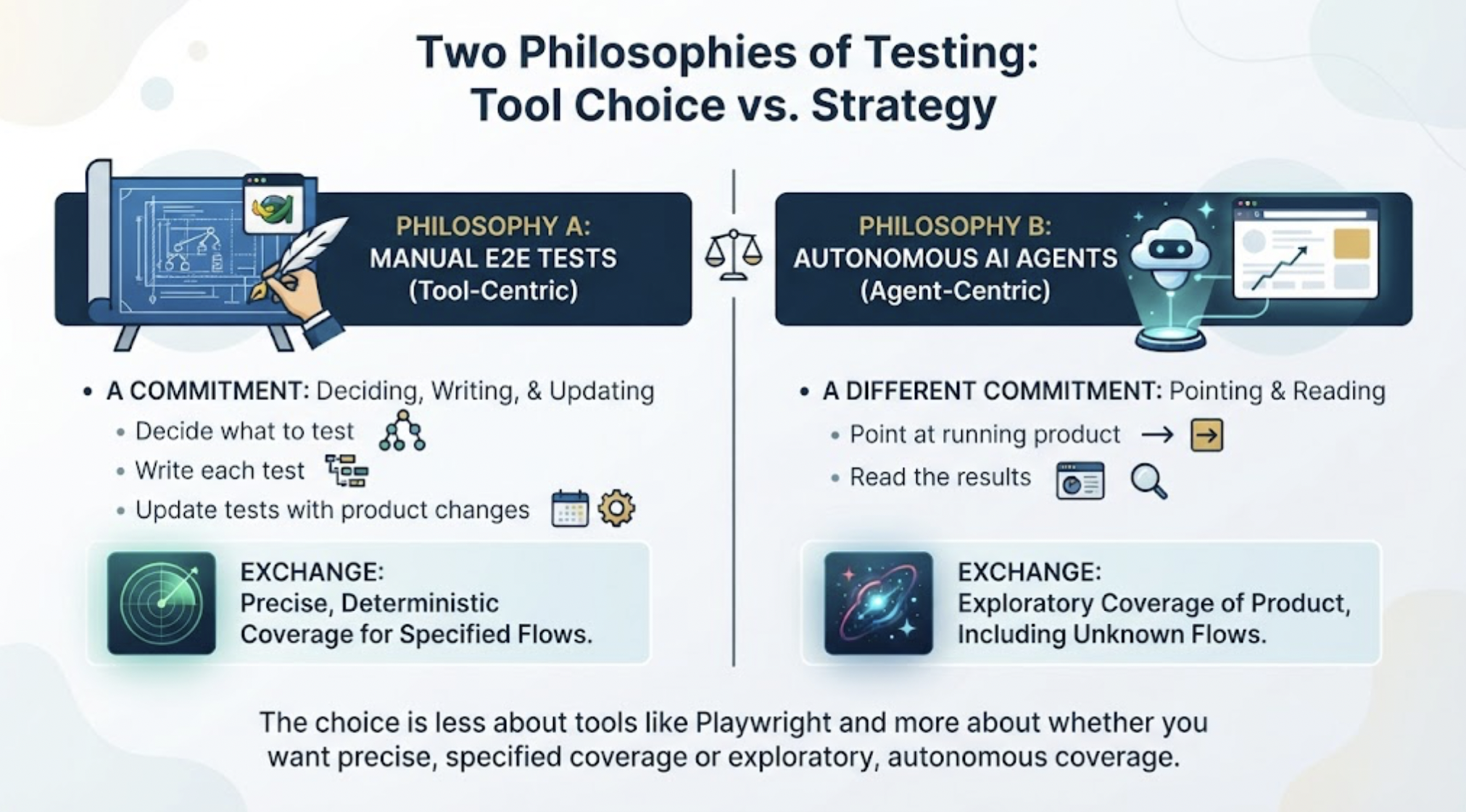
The question frames this as a choice between two tools. It's really a question about two different philosophies of how testing should fit into software development.
Manual E2E tests, written in Playwright or any other framework, are a commitment. You commit to deciding what to test, writing each test, and updating the tests when the product changes. In exchange, you get precise, deterministic coverage for the flows you specified.
An autonomous AI testing agent is a different commitment. You commit to pointing it at the running product and reading the results. In exchange, you get coverage that comes from exploring the product rather than specifying scenarios, including the flows nobody thought to write a test for.
Neither is universally better. The right choice depends on how your team builds software and what kind of failures you're trying to catch.
What Manually Written E2E Tests Do Well
Manually written E2E tests, executed through a framework like Playwright, are excellent at one specific thing: verifying that a precisely defined scenario produces a precisely defined outcome.
When a critical payment flow needs to be verified against exactly the right inputs and outputs, a hand-authored test is the right tool. It captures institutional knowledge about what the flow is supposed to do. It runs repeatably. It fails in exactly the right place when something breaks. It serves as executable documentation.
For critical flows where you know what to test and want precise control over the assertions, manually written tests are worth the investment.
The limitation appears at scale and speed. Writing a comprehensive E2E suite for a growing product takes significant engineering time. Maintaining it as the product evolves takes more. For teams using AI coding tools where implementation details change frequently, the maintenance burden compounds with every session.
What an Autonomous AI Testing Agent Does Differently
TestSprite approaches E2E testing from the opposite direction. Instead of specifying what to test and then executing that specification, its exploration agents navigate the live application and find what to test by using the product.
Other verification tools read your code and guess. TestSprite opens your app and uses it.
The agents visit the running application and navigate it the way real users would. They click through UI flows, fill in forms with real inputs, follow multi-step journeys from entry to completion, and carry session state forward across steps. They discover the product's flows through interaction, not through a specification document or a list of scenarios an engineer wrote.
The coverage includes flows that weren't on anyone's list. That's not a weakness of the approach. It's the point. The failures that reach users most often are the ones that weren't on anyone's list.
The Maintenance Question
For teams using Cursor, Claude Code, or GitHub Copilot, the maintenance question is the decisive one.
AI coding agents frequently reorganize components, rename elements, and refactor state management as a natural part of their operation. Every one of these changes is a potential manually written test breakage. A test that was looking for a specific selector, asserting on a specific field name, or navigating through a specific DOM structure breaks when any of those implementation details change.
For a team running three Claude Code sessions a day, manually written E2E tests can require updates after every session. The engineering time spent on test maintenance can exceed the engineering time the AI agent spent writing the code.
TestSprite's Auto-Heal Rerun handles this differently. When a test fails after a UI change, the agent determines whether the failure is a genuine behavioral regression or a structural change that doesn't affect what users experience. A renamed component that still submits the form correctly adapts without reporting a false failure. A genuine regression surfaces clearly.
This distinction keeps the test suite trustworthy without requiring the developer to manually update tests after each AI coding session.
When to Use Each Approach
The two approaches aren't mutually exclusive. The teams that get the most value from both understand where each one belongs.
Manual E2E tests fit when: the flow is critical enough to warrant precise authored coverage, the assertions need to be exact and deterministic, and the flow is stable enough that maintenance overhead is manageable. Payment flows, authentication sequences, and compliance-critical paths often belong here.
TestSprite fits when: the team needs coverage for flows that haven't been manually specified, when AI coding sessions are changing implementation details faster than manual tests can be updated, or when the team doesn't have the capacity to author and maintain a manual suite. This is most of the product for most teams using AI coding tools.
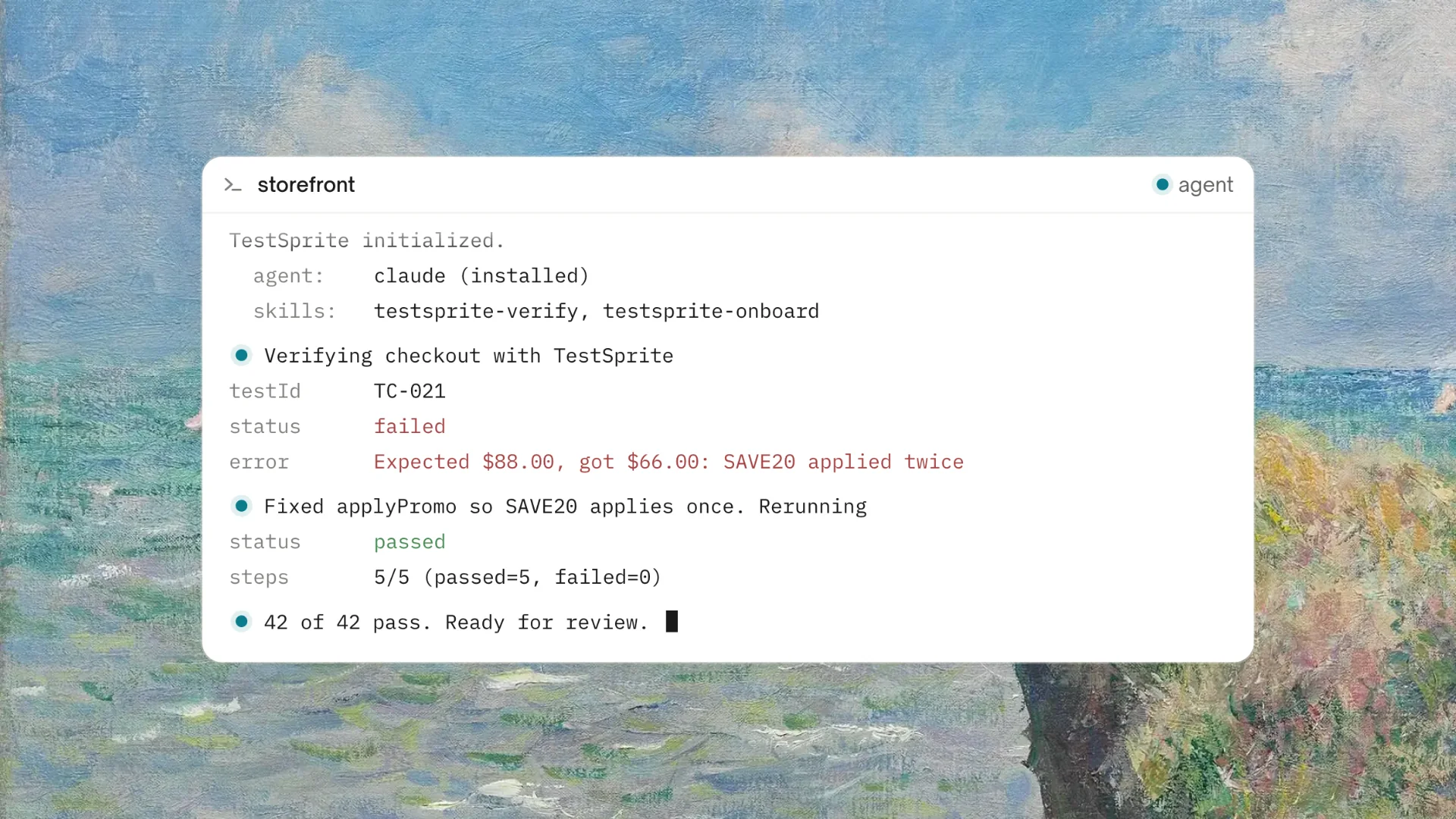
Through the TestSprite MCP Server, one instruction from inside Cursor, Claude Code, Windsurf, or VS Code starts the full autonomous pipeline. The results arrive in the same IDE window, structured for the coding agent to act on directly.
A Scenario: The Two-Layer Testing Approach
A five-person engineering team builds a B2B SaaS product. They have a small set of manually written Playwright tests covering their payment flow, their authentication sequence, and their most critical data export feature. These tests are precise, well-maintained, and run in CI on every pull request.
They use Claude Code for most of their feature development. They've connected TestSprite to Claude Code through the MCP Server.
After a Claude Code session that builds a new project collaboration feature, they trigger TestSprite from the Claude Code terminal.
The exploration agents navigate the full product. They work through the collaboration feature, which is new and has no Playwright coverage yet. They also navigate the project settings section, the notification preferences, and the team member management view.
They find two issues.
The first is in the new collaboration feature: when a collaborator is invited, the invitation email correctly includes the project name. When the collaborator accepts and navigates to the project, the project name in the header shows the collaborator's own name rather than the project name. The invitation flow reads the project name from one field. The project header reads from a different field that was populated differently for collaborator-created sessions.
The second is in the team member management view: after a Claude Code session updated the team member list component, the view correctly displays team members but the "Remove member" confirmation modal now dismisses without confirming when the Escape key is pressed. Users who accidentally press Escape now remove team members without realizing it.
Neither issue is in the Playwright suite because neither flow was manually specified. Both are genuine behavioral regressions that users would experience.
The Playwright tests cover payment, authentication, and export, all of which still pass. TestSprite covered the rest of the product and found the two failures.
The failure descriptions arrive in the Claude Code terminal. The coding agent proposes fixes for both. The developer applies them before the feature ships.
Two-layer testing. Playwright for the critical specified flows. TestSprite for everything else.
Conclusion
Writing E2E tests manually and using an autonomous AI testing agent are complementary approaches that cover different parts of the testing problem.
Manual E2E tests provide precise, deterministic coverage for the flows you specify. The investment is worthwhile for the flows critical enough to justify ongoing maintenance.
An autonomous AI testing agent provides coverage for the flows that weren't specified, the integration failures that live at the seams between AI-generated changes, and the behavioral regressions that only appear when someone actually navigates the product. It stays current without requiring manual updates after each AI coding session.
For teams using AI coding tools, the right answer is usually both: manually written tests for the critical specified flows, and TestSprite for the coverage that grows with the product automatically.
Connect TestSprite to your AI IDE and add autonomous coverage alongside your existing tests today.