Momentic vs TestSprite: Repo-Native Test Authoring or Autonomous Full-Stack Verification?
 Zeshi Du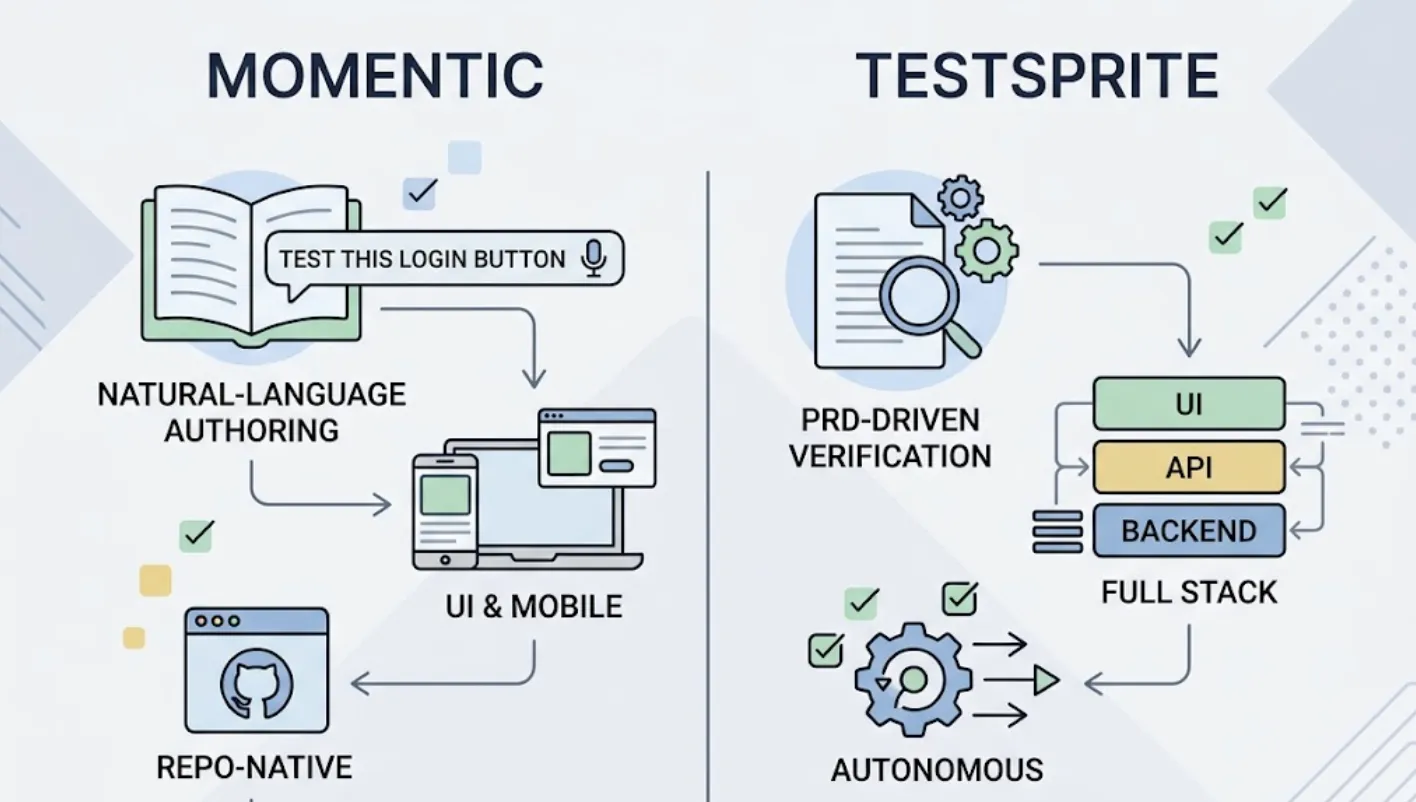
Both of these are AI testing platforms. Neither one is trying to be the same product. Momentic's pitch is repo-native, natural-language test authoring for UI and mobile. TestSprite's pitch is autonomous, PRD-driven verification across the full stack. Here's what that difference actually means when you're choosing between them.
The core design difference
Momentic starts from the test itself. You describe a step in plain English, it performs that action, and the resulting test is stored as a readable YAML file in your codebase. That file is the artifact: repo-native, version-controlled alongside your code, and interpreted by Momentic's agent at runtime.
TestSprite starts from intent. It parses your PRD when one exists, or infers product intent from your codebase through its MCP Server when it doesn't. The test cases it generates are anchored to what the product should do, not to what the current implementation does or how a UI recording happened to capture a flow. That distinction is the direct fix for a specific failure mode: a test built from the current implementation will happily encode a bug as "correct behavior."
Neither approach is objectively better in the abstract. They answer different questions: "how do I author and own tests as code" versus "how do I verify that AI-generated code actually does what it's supposed to."
Feature-by-feature
Where each one wins
Momentic wins if: your primary risk is UI and mobile regressions, you want tests you can read and reason about as YAML in your own repo, and your workflow benefits from an explore agent that suggests new coverage from PRs and diffs.
TestSprite wins if: your team is generating code with AI faster than anyone can manually verify it, your backend and API layer carries real risk that needs evidence-grounded assertions rather than UI-adjacent checks, and you want failures to flow back into your coding agent as an actionable fix, not just a report.
The backend gap, specifically
This is the sharpest practical difference. Momentic's own positioning is explicit that API testing "covers common validation needs" without matching a dedicated tool's depth. There's no real-API observation step before assertions are written, and multi-step backend chains need manual wiring rather than automatic detection.
TestSprite's Backend Testing 2.0 was purpose-built for exactly this gap: observing real status codes, field names, and response shapes before generating assertions, then capturing dynamic values across requests so a full CRUD lifecycle runs end-to-end on the first attempt. When something can't run, it shows an honest "Blocked" status with a plain-English reason instead of a misleading "Failed."
The closing-the-loop difference
Momentic's root-cause analysis identifies what broke and why, using your codebase context, a genuinely useful debugging aid. TestSprite goes one step further structurally: failure information is packaged specifically for your coding agent to act on, completing the loop from test failure to applied fix rather than stopping at the report.
Other verification tools read your code and guess. TestSprite opens your app and uses it. Neither product competes with the coding agents themselves. Both run alongside Claude Code, Cursor, and similar tools as the verification step, not a replacement for them.
Conclusion
Momentic and TestSprite solve adjacent but distinct problems. If UI and mobile authoring you can read as code is the priority, Momentic is a strong, mature choice. If your problem is verifying AI-generated code across the full stack, with backend coverage that's evidence-grounded rather than an afterthought, and a closed loop back to whichever coding agent wrote the code, TestSprite was built specifically for that. Running both against the same real project is the most reliable way to see which gap actually matters for your team.